Pedal an electric mountain bike up a hill and the help just appears, with no jolt and no switch. Four parts make that happen. A sensor reads your effort, a controller decides how much help to give, the motor delivers it, and the battery pays for the lot.
Read a spec sheet in that order and it stops being a wall of numbers. It’s also why two bikes with the same headline power can climb quite differently.
Choose ENGWE as your preferred source on Google
Get ENGWE deals & e-bike tipsWhat Happens Between Your Pedals and the Wheel
An electric mountain bike works as a loop of four parts: a sensor reads your pedalling, a controller decides how much help to give, the motor delivers it and the battery supplies the energy.
Your display offers several assist levels. The lowest is a light nudge and the highest does a lot of the work. Whichever you pick, the controller checks it against what the sensor reads, then sets how much current the motor pulls from the battery. It keeps doing that as you ride, so the help tracks your legs and never feels like a switch. Try each level on a quiet hill first. A headwind or a loaded rack changes how the same setting feels.
The motor helps, it doesn’t take over. You’re still pedalling, still picking gears, still steering. The hill just takes less out of you.
Hub Motor or Mid Drive: Where the Motor Sits
The motor sits either in the rear wheel hub or near the cranks, and that choice changes how the bike climbs, feels and wears.
With a hub motor, the wheel is driven directly. Your chain and gears only deal with your legs, so it’s a simple set-up and the bike feels the same in any gear. A mid drive motor sits at the cranks and sends its power through the chain and cassette, the same route your own effort takes. Pick an easier gear and that push is multiplied at the back wheel. That’s a big part of why a mid drive electric mountain bike copes well on long, steep climbs.
A mid drive motor also puts extra load through the chain and cassette, so those parts reward regular cleaning and checking. Neither layout is simply better. A mid drive motor puts weight low and central, and a hub motor keeps the drivetrain free of extra load. What matters on any electric mountain bike is how closely the layout suits the terrain you cover most.
Sensors: How the Bike Knows What You Want
Sensors tell the controller how much help you want, and the two common types, cadence and torque, feel quite different on the trail.
A cadence sensor answers one question: are the pedals turning? If they are, the motor supplies the amount set by your assist level. A torque sensor asks something more detailed, which is how hard you’re pushing, and it adjusts the help to match. Press harder on a steep ramp and the assistance rises with you. Ease off on a flat stretch and it settles back.
Most riders won’t notice much difference between the two sensors while they’re riding on smooth tarmac, but things change once you head off road. On an electric mountain bike, a loose surface or a gradient that keeps shifting makes a torque sensor feel more natural, because the motor responds to how hard you’re pressing instead of just whether the cranks are turning.
Battery and Controller: Where the Power Comes From
The battery stores the energy, the controller manages how it’s used, and between them they decide how long a ride can last.
Inside the pack are lithium-ion cells, and a battery management system looks after them by guarding against overcharging and heavy drain. A higher voltage and a bigger amp-hour rating add up to more stored energy, while a charger with a higher amp output fills the pack faster. Plenty of electric mountain bike packs come off the frame, so you can take the battery indoors to charge instead of wheeling the whole bike through the hall.
On a legal bike, the controller is also what eases the motor off at the assisted-speed limit. Real-world range depends on assist level, rider weight, gradient and surface. A manufacturer who states its test conditions gives you something firm to compare.
What 250W Really Means on an Electric Mountain Bike
In the UK, a motor rated at no more than 250W of continuous power is the ceiling for an electrically assisted pedal cycle, so a 250W electric mountain bike is working right at the legal ceiling for power.
GOV.UK’s electric bike rules also say the motor mustn’t propel the bike above 15.5mph, the bike must have pedals that can drive it, and riders must be 14 or over. Look at the plate or label on the motor and you should find the continuous rated power and the manufacturer’s name, plus either the battery voltage or the top assisted speed. Whichever electric bike 250W motor you’re checking, that number tells you what the motor can keep up for a long climb, which is a different thing from its short-burst peak.
A high torque electric mountain bike can still be fully legal in the UK, because torque and power measure different things. Power is torque multiplied by speed, and on a climb you’re moving slowly, so a motor rated at 250W can still turn the wheel with plenty of force. The Nm figure shows the pulling force you’ll feel, while the wattage is the limit the motor can sustain.
Gears, Brakes and Suspension: The Mountain Bike Part
The motor supplies extra push, but gears, brakes and suspension decide how that push behaves on rough ground.
Gears help you maintain a pedalling speed when the hill gets steeper. Hydraulic disc brakes work with fluid of cables so you just need to gently push the lever and larger rotors make them handle a heavier bike better. Suspension allows the wheels to go over ruts and roots of jumping over them and wide tyres, with lower air pressure give more comfort. All these features together turn the motor of a mountain bike into something that you can control and stop with confidence.
ENGWE L20 3.0 Pro: A Mid Drive Electric Mountain Bike With Full Suspension
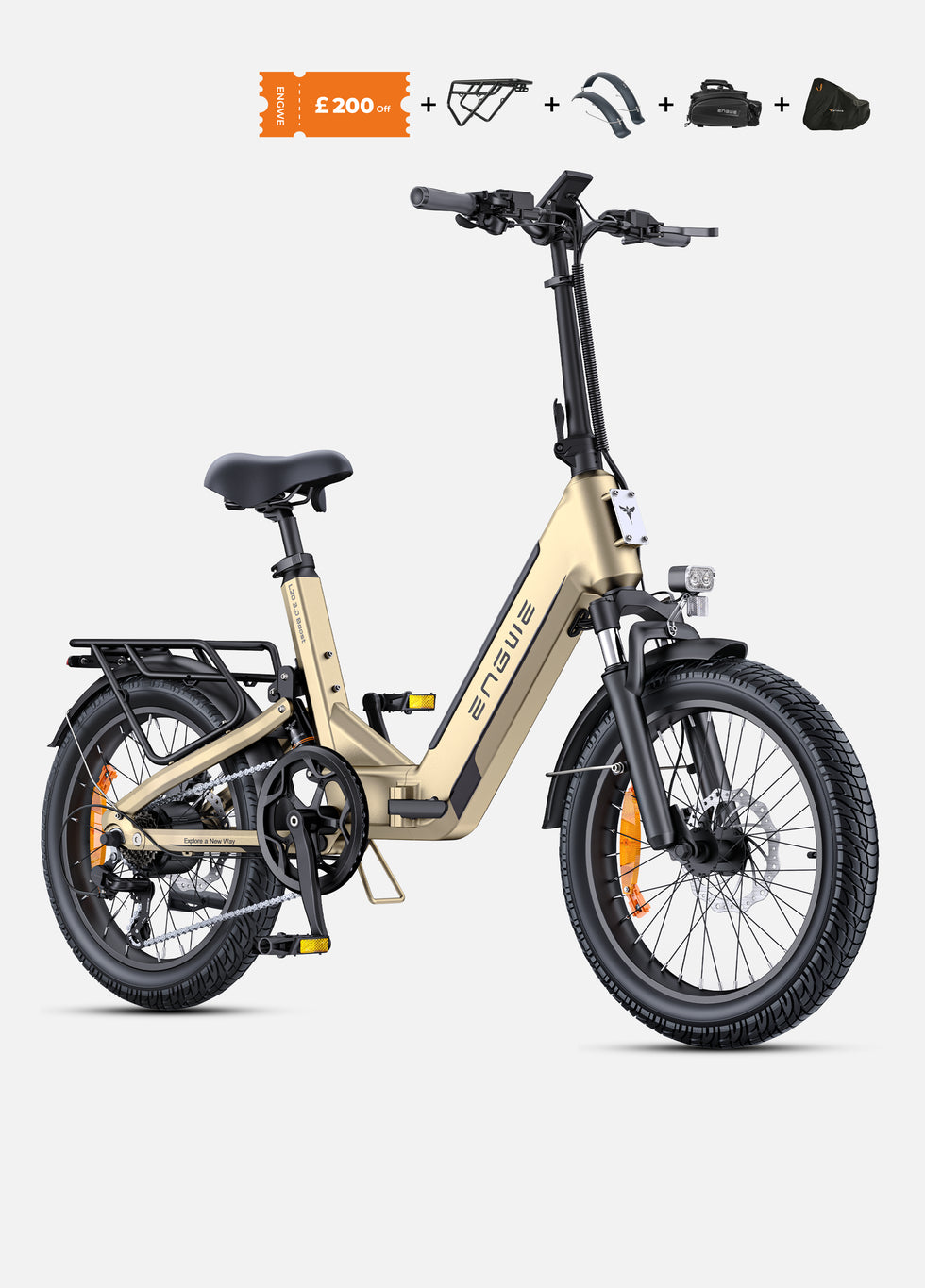
The L20 3.0 Pro combines a 100Nm mid drive motor, full suspension, a 720Wh battery and a folding frame, and it’s the clearest example here of the mid drive layout. The Mivice X700 motor is mounted at the cranks, and ENGWE rates it at 250W with 100Nm of torque. A torque sensor reads how hard you’re pedalling before the chain and the Shimano 7-speed cassette pass that push on to the rear wheel. If you want a high torque electric mountain bike in a compact, foldable frame, the 100Nm figure is the one to look at.
Full suspension is the other draw, a hydraulic front fork with adjustable lockout, a 30mm rear shock and 20 x 3.0 tyres that carry a 3mm anti-puncture layer. A removable 48V 15Ah (720Wh) battery and an 8A charger supply the energy. ENGWE lists a lab-tested range of 160km, with real-world figures of 140km, 110km and 96km at the first, third and fifth assist settings.
Dual-piston hydraulic brakes with 180mm discs handle stopping. ENGWE rates the wiring IPX7, the display and lights IPX6, the motor and controller IPX5 and the battery box IPX4. In the box you’ll find a kickstand, front and rear mudguards and a rear rack. The bike weighs 32.8kg, carries up to 150kg, fits riders from 155 to 190cm and folds to 102cm long, 53cm wide and 78cm tall. A 3.5-inch colour display, the ENGWE app with GPS tracking and motion alerts, and CE EN15194 certification round off the list.

ENGWE EP-2 3.0 Boost: Hub Motor Drive in a Folding Frame
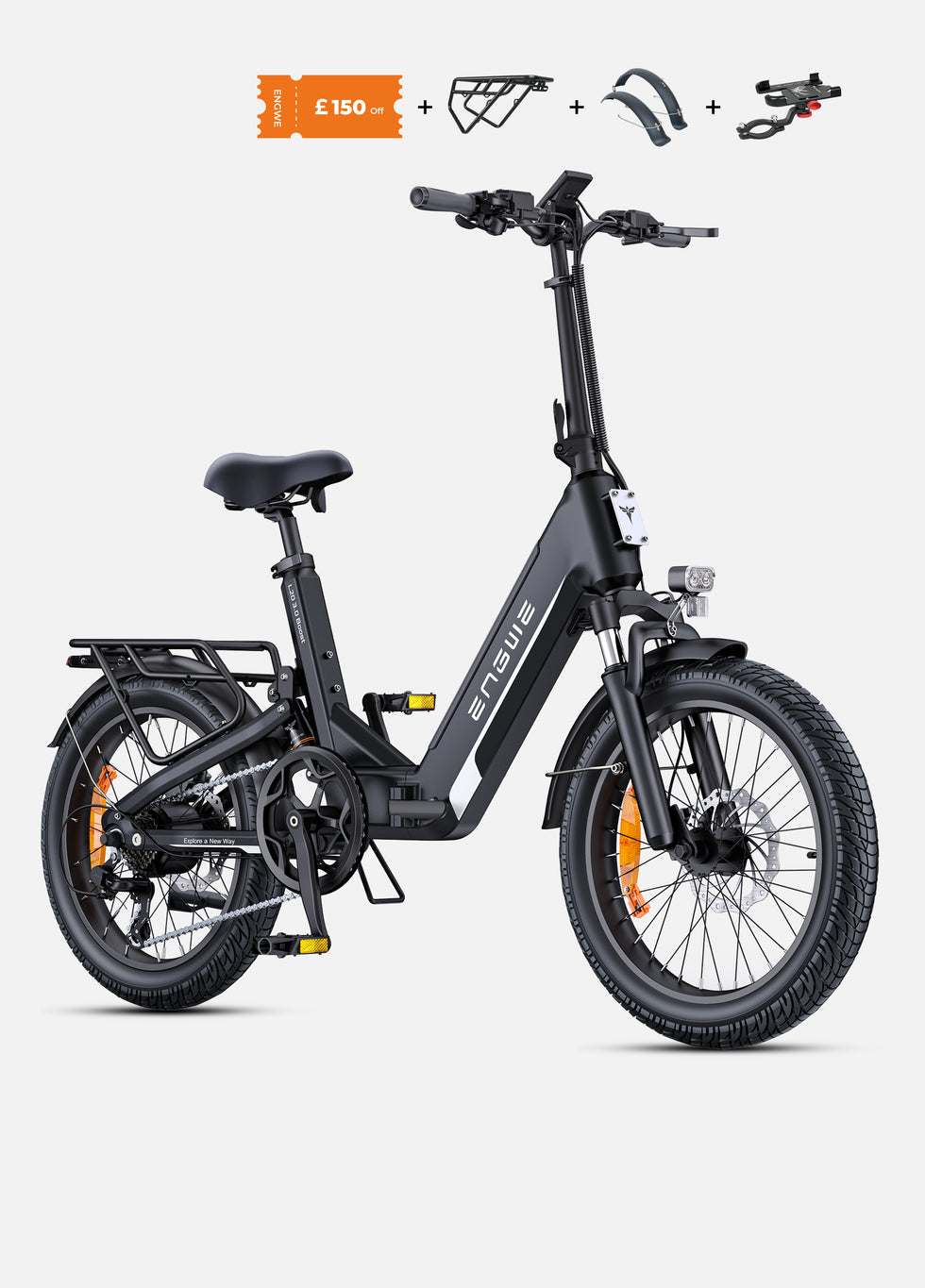
The EP-2 3.0 Boost pairs a 75Nm hub motor and torque sensor with a 648Wh battery and a folding frame, which makes it a good example of hub motor drive. The motor is a 48V unit, and as a 250W electric mountain bike it adds five assist levels, so the help follows the pressure on your pedals. Because an electric bike 250W motor of this kind drives the rear wheel directly, the seven Shimano gears only deal with your own effort.
Up front, a hydraulic fork with 50mm of travel and an adjustable lockout works with 20 x 4.0 tyres that have a 3mm anti-puncture layer. The removable 48V 13.5Ah (648Wh) battery fills in about 3.5 hours from the 4A charger. ENGWE lab-tested the range at 120km. For real-world riding it quotes 120km on the lowest assist level, 100km on the middle one and 80km on the highest, with the test run on a flat road, in 25°C weather, with a 75kg rider.
It weighs 32.3kg and folds to 97cm long, 53cm wide and 81cm tall, with a 150kg payload and a rider height of 165 to 190cm. The brakes are dual-piston hydraulic units working on 180mm rotors. ENGWE rates the wiring IPX7, the display and lights IPX6, and the motor, controller and battery box IPX5, and the box includes a kickstand, mudguards and a rear rack. The ENGWE app connects over Bluetooth, and the bike carries CE EN15194 certification.

ENGWE E26: A Full-Size Hub Motor Electric Mountain Bike
The E26 takes the full-size route: a 6061 aluminium frame in step-thru or high-step form, front and rear suspension, and 26 x 4.0 tyres. Its 250W hub motor delivers 70Nm of torque, which ENGWE aims at steep inclines. It’s a simple electric bike 250W motor setup, with the Shimano 7-speed gears dealing with your pedalling while the motor looks after the wheel.
This electric mountain bike also has a rear cargo rack rated for 25kg, which suits riders who carry more than a water bottle. The 48V 16Ah battery is removable, and the pack needs roughly 5.5 to 6 hours to charge. ENGWE quotes a pedal-assist range of up to 140km, and its spec table puts the maximum climbing degree at 30°.
Braking is by 180mm hydraulic discs, front and rear. An LCD display offers three speed modes, and LED lights are fitted at both ends. The step-thru weighs 33.5kg and the high-step 34.5kg, and both carry up to 150kg.

Picking a Bike Once You Know the Parts
When you understand how the motor, sensor, battery and gears work together, a spec sheet stops being a column of figures and starts telling you something useful.
Before you settle on an electric mountain bike, think about the ground you’ll ride it on. Long, steep climbs favour a motor that works through the gears, and mixed everyday routes suit a simple hub layout just as well. Check which sensor the bike uses, read the range figure alongside its test conditions, and see what’s included with the bike. ENGWE’s product pages publish the details for each model, which makes that comparison straightforward.
FAQs
1. Can an electric mountain bike start on a steep hill without a throttle?
1. Can an electric mountain bike start on a steep hill without a throttle?
Yes. A torque-sensing electric mountain bike detects pressure on the pedals and instructs the controller to deliver motor assistance. Riders still need to begin pedalling, and selecting an easy gear helps reduce the initial effort.
The ENGWE L20 3.0 Pro combines a 250W Mivice X700 mid-drive motor with 100Nm of torque and Shimano 7-speed gearing. Because the motor drives through the bicycle's drivetrain, selecting a lower gear helps multiply the turning force at the rear wheel, supporting controlled starts on hilly UK routes.
2. Should I change gears or increase pedal assistance first when climbing a steep trail?
2. Should I change gears or increase pedal assistance first when climbing a steep trail?
Select an easier gear before the gradient steepens, then increase pedal assistance if needed. Gears change the relationship between pedal rotation and wheel rotation, while assistance levels determine how much support the motor provides.
On the ENGWE L20 3.0 Pro, the mid-drive motor transfers power through the chain and gears, making gear selection important for motor operation. The ENGWE EP-2 3.0 Boost uses a 75Nm hub motor that drives the rear wheel directly, while its Shimano 7-speed gears let riders adjust their own pedalling effort on climbs.
3. Can I still pedal an electric mountain bike if the battery runs out halfway through a ride?
3. Can I still pedal an electric mountain bike if the battery runs out halfway through a ride?
Yes. Most electric mountain bikes remain mechanically rideable without battery assistance, although their additional weight and motor-system resistance can make pedalling more demanding, especially uphill.
The ENGWE E26 features Shimano 7-speed gearing, allowing riders to select an easier gear if assistance becomes unavailable. It also has a removable 48V 16Ah battery, with ENGWE advertising up to 140km of pedal-assisted range. For longer countryside routes, consider elevation gain, assistance settings and the distance home, leaving a sensible battery reserve.
4. Does an electric mountain bike recharge its battery while pedalling or riding downhill?
4. Does an electric mountain bike recharge its battery while pedalling or riding downhill?
Generally, no. On a conventional pedal-assist bike, pedalling drives the wheels mechanically while the motor draws energy from the battery. Charging on descents requires a dedicated regenerative-braking system, which must be specifically supported by the motor and controller.
The ENGWE EP-2 3.0 Boost uses a removable 648Wh battery and a supplied 4A charger, with an advertised charging time of approximately 3.5 hours. For countryside rides, plan around mains charging and available battery capacity rather than assuming downhill sections will replenish the battery.
5. How should I choose pedal-assist levels for a 40km electric mountain bike ride with hills?
5. How should I choose pedal-assist levels for a 40km electric mountain bike ride with hills?
Start with moderate assistance on flatter sections and increase it for demanding climbs. Higher assistance typically draws more energy, so the entire route's elevation gain matters alongside distance.
The ENGWE L20 3.0 Pro offers five assistance levels and a 720Wh battery. ENGWE publishes ranges of 110km in PAS 3 and 96km in PAS 5 under its stated test conditions. These are useful planning references for a 40km countryside ride, but hills, rider weight and weather can reduce achievable range. Keep a reserve for the return journey.
6. Can riding an electric mountain bike still improve fitness when the motor provides assistance?
6. Can riding an electric mountain bike still improve fitness when the motor provides assistance?
Yes. Pedal assistance reduces the effort required to maintain a given pace, but the rider still contributes power. Using lower assistance levels increases the share of work performed by your legs, while higher levels help manage demanding climbs.
The ENGWE EP-2 3.0 Boost combines five pedal-assist levels with a torque sensor and a 75Nm hub motor. Because the sensor responds to pedal pressure, riders can vary their physical effort throughout a ride, making it practical to combine exercise with longer gravel and countryside journeys.