Ask anyone who rides through a British winter and they will tell you the same thing. It is never just cold. Sometimes cold, then wet, and then frozen again. All of this in a single shift. So what do electric bike tyres actually need to do on each surface, and which of the four ENGWE bikes below wears the right rubber for which winter? One thing first: none of these bikes comes on a proper winter tyre, and pretending otherwise helps nobody.
Choose ENGWE as your preferred source on Google
Get ENGWE deals & e-bike tipsWhy Snow and Ice Ask Different Things of Electric Bike Tyres
Snow grips a tread, ice does not, slush moves around under you, and a cold wet road is a fourth thing entirely, which is why one set of electric bike tyres can be brilliant in January snow and useless on a frosty Tuesday.
A knob, any decent knob, can dig into it, and a wide tyre spreads your weight instead of ploughing a furrow and stalling. Slush is nastier. It hides kerbs and pothole edges, and it shoves the front wheel about.
Cold wet tarmac is most of your winter, just a greasy road and rubber gone hard in the cold. And then on ice, normal rubber on sheet ice has next to no grip.
Tyre Width: When a Fat Tyre Electric Bike Helps, and When It Does Not
For riding in snowy conditions you need to go wide and choose a tire that will float over the snow instead of cutting through it. How much of the time will you be riding in the snow depends on the actual amount of time you spend riding in the snow on the streets where you live.
A fat tyre electric bike runs something like a 4.0 inch tyre, soft, big footprint, loads of rubber down at once. The bike stops twitching in towpath ruts.
Here is the catch. Most of Britain does not get proper snow. It gets a centimetre on a gritted road, where a wide tyre can feel worse and is slower the rest of the week. Hills, untreated lanes, snow that stays? Go wide. Town riding on treated roads? Mid width, every time. Choosing an electric bike for snow starts with admitting what your snow really looks like.
Tread, Compound and Studs: Choosing Winter Tyres for Electric Bikes
What makes a tyre a winter tyre, really? A tread that throws snow back out instead of clogging solid, rubber that has not gone stiff in the cold, and studs if ice is your problem, because on ice nothing else honestly works.
Start with the tread itself. Big gaps, knobs spread out, so snow gets thrown out instead of packing in solid. Then the little slits across the blocks, sipes, which flex and open up tiny edges that do real work on cold wet roads. Fill those gaps with slush, as a tight town tread does within half a mile, and you have a slick. In January, it feels like an unwanted burden.
Rubber stiffens up in the cold and stiff rubber lets go earlier, which is why year round electric bike tyres are made to stay a touch softer once it drops below zero. First frosty junction of the year tells you which sort you have got.
Studded Tyres, and the Limits of Stock Tyres
You can buy studded winter tyres for electric bikes, they do work, and they are also a racket to ride on and not cheap, so unless ice is a weekly thing where you live, save your money.
All a stud is, is a little metal pin stuck in the tread. Those pins bite into ice and keep you upright in the dips, over bridge decks and down shaded lanes. On clear tarmac you can hear every one. Click, click, click, all the way to work.
The four ENGWE bikes below run hybrid or town electric bike tyres, none of them studded, and a hybrid tyre on ice is just a hybrid tyre on ice, whatever the product page hints at. Ice every day? Then budget for a studded set in your size when you buy the bike, or make your peace with the bus on the worst mornings.
Tyre Pressure: A Small Job That Decides Electric Bike Safety in Winter
A cheap pressure gauge, honestly, does more for electric bike safety in winter than most upgrades people pay real money for. Five minutes, and the tyre grips, steers and stops like a different tyre. Nearly everybody skips it anyway.
Tyres lose pressure in the cold, so the tyre you pumped up in October is not the one you ride in January. Gauge on, morning of the ride, thirty seconds, done.
On snow, drop towards the bottom of the range printed on the sidewall. More rubber down, more grip. But stay inside the range. Under the minimum you are asking for a pinch flat, and too soft wallows in corners. The fat tyres below are rated to a maximum of 20 PSI. Soft is the design, not a fault, and ordinary electric bike tyres behave far better at the right pressure.
ENGWE Engine Pro 3.0 Boost: The Fat Tyre Electric Bike for Proper Snow
Widest tyres and the 90Nm torque here make the Engine Pro 3.0 Boost the one to pick if your winter genuinely means snow and not a dusting gone by lunch.
It runs 20 x 4.0 inch electric bike tyres, urban hybrid tread, 3mm anti puncture layer underneath. Run them soft and the bike settles, over compacted snow, frozen towpaths and rutted farm tracks.
Power delivery matters on a surface like that, more than the headline number. The 250W hub motor makes up to 90Nm and a torque sensor reads it, so when you press, it presses, gently, in proportion. No lunge, no sudden shove to break the back wheel loose on a snowy climb. Full suspension and hydraulic brakes on 180mm rotors handle the rest, on a 34.7kg bike that needs stopping.
Trade off? On clear, gritted roads it is slower, heavier work than the narrower bikes below. If it is a season, this is the fat tyre electric bike that makes sense of it.

ENGWE L20 3.0 Pro: An Electric Bike for Snow and Slush on 3.0 Inch Tyres
Three inch tyres and a mid drive motor with more torque than anything else here make the L20 3.0 Pro the one most UK riders would use most happily through a normal winter.
3.0 inches is the width people overlook. Not fat, not skinny, and that turns out to be the point. On compacted snow and slush it stays composed, and on a thin covering it can still push down towards the road instead of skating on top, on 20 x 3.0 inch urban hybrids with a 3mm anti puncture layer that earns its keep in winter.
The motor is the headline though. A 250W mid drive unit, a Mivice X700, making 100Nm, torque sensor in charge. Hill starts on snowy side streets are where you feel it. The 720Wh battery is rated up to 160km, charging is around two hours, and you get full suspension and hydraulic brakes on 180mm rotors.
For the slushy weeks and cold rain that make up most people's winter, this is probably the most sensible electric bike for snow in the range.

ENGWE L20 3.0 Boost: Winter Tyres for Electric Bikes, City Edition
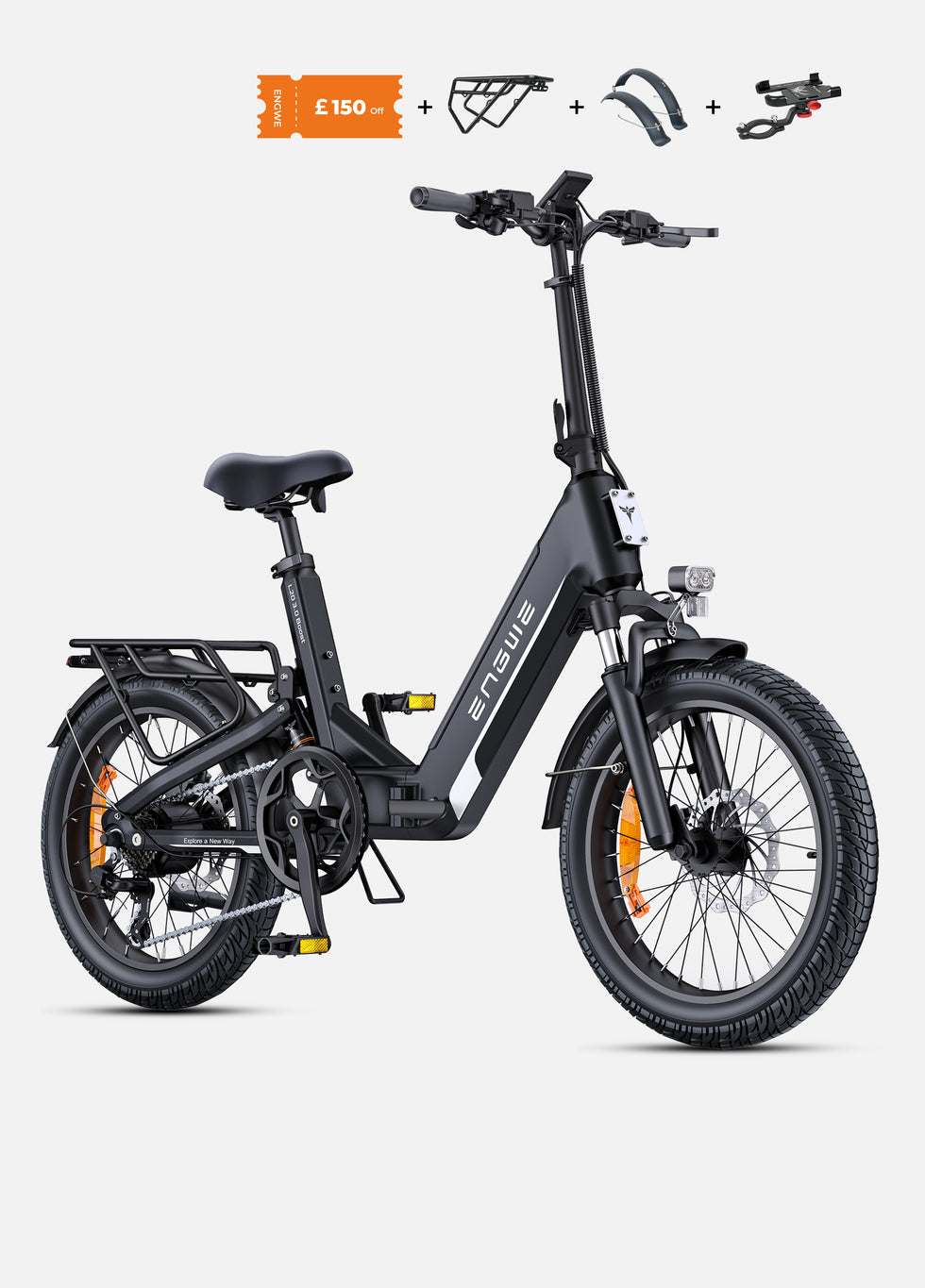
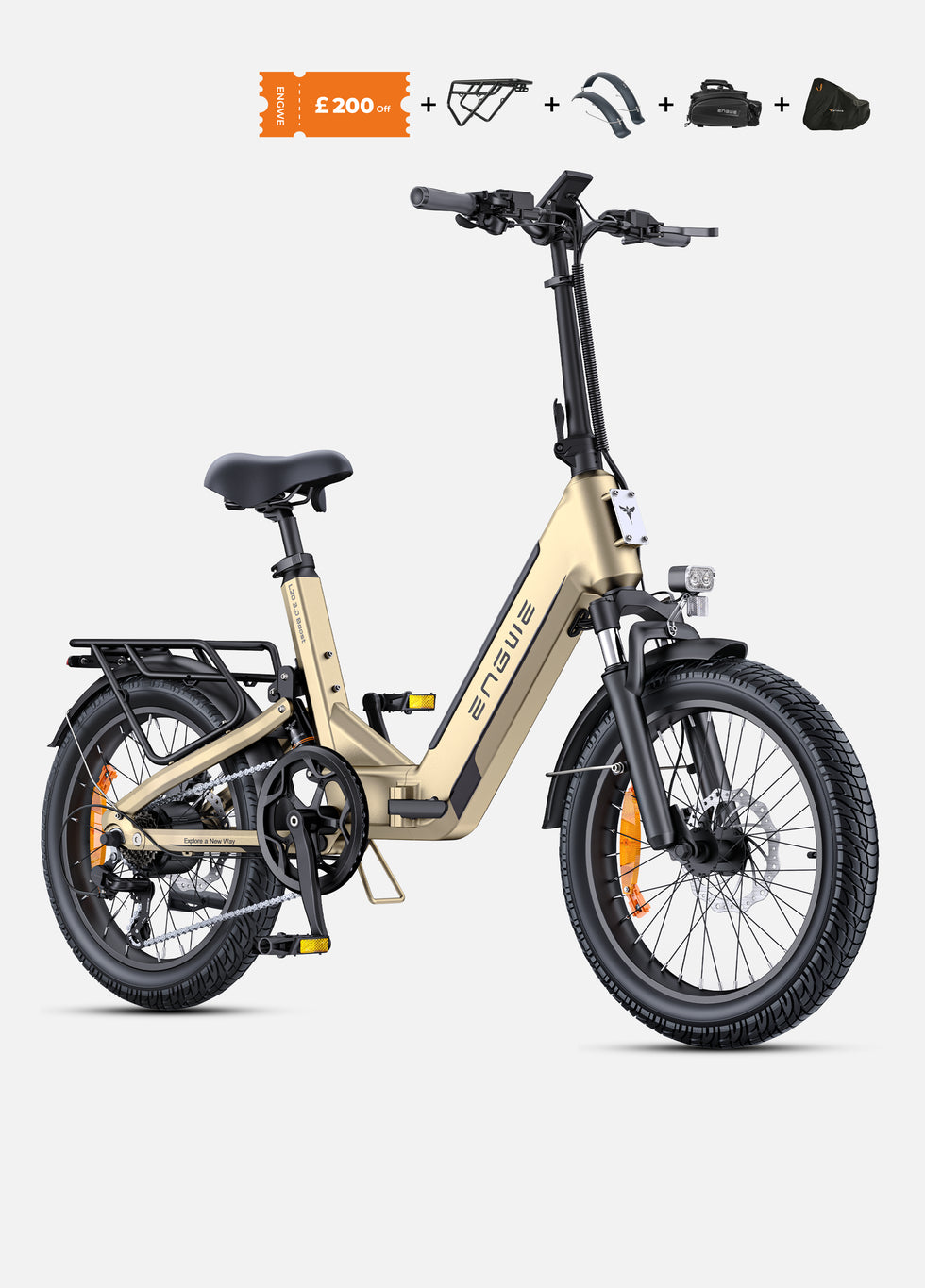
Same 3.0 inch tyres as the Pro on a hub motor bike with a smaller battery makes the L20 3.0 Boost the town version of the same idea, and there is nothing wrong with that.
Tyres first, since that is the subject. 20 x 3.0 inch urban hybrids, 3mm anti puncture layer, same winter manners as the Pro, calm on light snow and fine on slush. Full suspension, hydraulic fork and 30mm rear shock, keeps the tyre in contact with the road.
The motor is a 250W hub unit, up to 75Nm in Boost mode, torque sensor again. The battery is smaller than the Pro's, 648Wh, good for up to 135km on paper, about two hours to charge, and the bike itself is 33.2kg, rated for a 150kg payload, and folds for storage.
It is a good buy as a town bike, because these are town winter tyres for electric bikes, built for gritted routes and light snow. Untreated lanes at 6am, sheet ice, a foot of the white stuff? Wrong tool, and the two bikes above this one exist for exactly that job.

ENGWE P275 SE: Honest Limits of a City Tyre in Winter
A 27.5 x 1.95 inch town tyre on a light, quick commuter is a perfectly good winter bike for treated city streets and a genuinely poor one anywhere else, and the P275 SE deserves that said plainly rather than politely.
The tyres roll fast, and on treated routes that is all you need. The kit on it is sensible commuter stuff, a smart torque sensor so the power comes in gently at greasy junctions, hydraulic discs that keep working in the wet, and a 36V 13Ah battery ENGWE rates at up to 100km, all on a bike of about 24kg.
But a narrow set of electric bike tyres with a light tread cannot float on snow and cannot bite into it either, and on compacted snow or ice it will let go with very little warning, and braking distances stretch.
So use it for what it is. Treated network, town miles, sensible speed. It will never be a fat tyre electric bike and asking it to be one helps nobody.

Electric Bikes for Winter: What the Cold Does to the Rest of the Bike
Tyres get the headlines, but winter also messes with your range and your brakes, and both are worth knowing about before you find out the hard way on electric bikes for winter.
Batteries hate the cold, and that big number on the product page was measured warm and gentle, so a freezing ride into a headwind with the lights on will give you less. Leave yourself a margin, keep the battery indoors overnight if it comes off, and let a cold one warm through before you plug it in.
All four bikes here run hydraulic discs, luckily, since cable brakes go vague in the wet. First squeeze on a frosty morning does little more than wipe water, or a skim of ice, off the rotor. Half a second of nothing much. Brake earlier than feels necessary, and assume the car in front has not cleared its windows properly, because nine times out of ten it has not.
What to Check Before You Choose, and Before You Ride
Six quick checks cover most of what decides electric bike safety once the roads turn cold.
● Name Your Surface First: Snow is not slush and neither is ice. Buy for the surface you ride most.
● Width Follows The Surface: Snow all winter points to 4.0 inches, mixed slush to 3.0, a city tyre only on treated streets.
● Ignore The Brochure, Read The Tread: If the blocks are open and there is siping cut in, electric bike tyres grip in winter. A smooth tread fills with slush and lets go.
● Accept The Ice Rule: Nothing grips sheet ice except studs, so if you fit a studded set, check your size and your mudguard clearance first.
● Set Pressure For The Day: Use a gauge, stay inside the sidewall range, run softer on snow.
● Check The Whole Bike: Charge, brake feel, lights, and a tread clear of flint and glass.
The Bottom Line
There is no one answer here, because there is no one British winter to answer for. Snow wants width and electric bike tyres with a tread that can dig. Ice wants proper winter tyres for electric bikes with studs fitted, or it wants you on the bus.
Inside the ENGWE range it shakes out like this. The Engine Pro 3.0 Boost is the fat tyre electric bike for people whose winter is a season, not a surprise. The two L20 3.0 models are the balanced electric bikes for winter as most of us get it, cold, wet and slushy. Your electric bike tyres will look after you better than any headline figure will.
FAQs
Can you fit studded winter tyres to an ENGWE electric bike?
Can you fit studded winter tyres to an ENGWE electric bike?
Only if the replacement tyres match the wheels and have sufficient clearance. The folding ENGWE L20 3.0 Boost comes with 20 × 3.0-inch urban-hybrid tyres for everyday city journeys, while the ENGWE Engine Pro 3.0 Boost uses 20 × 4.0-inch tyres for cushioning on uneven routes. Before buying studded tyres, check the ISO/ETRTO bead-seat diameter, compatible rim width, tyre load rating and clearance around the frame, fork and mudguards. Confirm the specific fitment with ENGWE or a qualified bicycle mechanic.
Do puncture-resistant electric bike tyres help on gritted winter roads?
Do puncture-resistant electric bike tyres help on gritted winter roads?
Yes. Wet roads can collect glass, flint and other sharp debris, and a protective layer can reduce the chance of punctures. The ENGWE L20 3.0 Pro features 20 × 3.0-inch urban-hybrid tyres with a 3 mm anti-puncture layer, helping riders avoid interruptions during daily winter journeys. Its full suspension also cushions uneven road surfaces. Puncture resistance and winter grip serve different purposes, so the tyre's tread and rubber compound remain important considerations.
How does a mid-drive motor work with electric bike tyres on slippery hills?
How does a mid-drive motor work with electric bike tyres on slippery hills?
A mid-drive motor transfers power through the chain and gears, allowing riders to select a lower gear for controlled uphill starts. However, available traction still depends on the tyres and road surface. The ENGWE L20 3.0 Pro combines a 250 W mid-drive motor delivering up to 100 Nm with a torque sensor and 20 × 3.0-inch urban-hybrid tyres. Motor assistance responds to pedalling pressure, helping riders apply power progressively on damp inclines while benefiting from the bike's gearing.