Plenty of new e-bike buyers get stuck on the same choice once they want something for rougher ground. Do they go for an electric mountain bike, or a bike that copes with a bit of everything? The two are often displayed next to each other in shops, but they’re made for different kinds of riders.
A mountain bike is built for trails. An all terrain electric bike is built for mixed riding, like a bit of road, then a gravel path or towpath, and maybe a muddy field at the end. If you’re new to e-bikes, this choice matters. It changes how confident you feel on your first rides, how much setting up the bike needs, and how often you’ll actually take it out of the shed.
Choose ENGWE as your preferred source on Google
Get ENGWE deals & e-bike tipsWhat Separates an Electric Mountain Bike From an All Terrain Electric Bike
It really comes down to what you want the bike to do. One is made mainly for trail riding, while an all terrain electric bike is made to handle whatever surface you end up on that day.
Electric Mountain Bike: Built Around the Trail
Most trail-focused e-bikes borrow their frame shape, suspension and tyres from a standard mountain bike. Not every brand builds them the same way, though. Some only have a suspension fork at the front, while others have it front and back, and the motor and tyre size can vary as well. You’ll often see knobbly tyres that are thinner than fat tyres. The riding position also puts more of your weight over the front, and that’s a big help on steep downhills and narrow, technical trails.
That works well at a trail centre. On roads and cycle paths, though, those trail tyres and that riding position can feel less comfortable than a bike made for mixed riding, depending on the model.
All-Terrain E-Bike: Built Around Mixed Surfaces
An all-terrain e-bike is built with more in mind. The idea is that it stays comfy and steady whether you’re on tarmac, gravel, grass, sand or mud, sometimes all on the same ride. You’ll see plenty of variety here too, from full-size bikes to folding ones. A lot of them have fat tyres around four inches wide, a hub motor and a more upright seating position. The suspension is there to smooth out the bumps, not to take big drops.
If you love steep, technical downhill runs, a trail-focused e-bike is the better match. Most people’s weekly rides are a mix of surfaces, though, and that’s where an all-terrain design fits in. Because it’s comfortable in more places, an electric bike for all terrain riding tends to get used on weekdays as well as at weekends.
UK Rules Every All Terrain Electric Bike Must Follow
Whichever type you go for, it has to meet the same UK rules to count as a legal e-bike.
It needs pedals that can move the bike, a motor rated at 250 watts or less, and motor help that cuts out once you hit 15.5mph. You also have to be at least 14 to ride one. If it ticks those boxes, you can ride it on roads, cycle paths and anywhere else normal bikes are allowed, though not on the pavement. You won’t need a licence, tax or insurance either. If a bike goes past those limits, the law treats it as a motorbike or moped, so it has to be registered, taxed and insured, and you’ll need a licence to ride it.
Off the road, access depends on the type of path and its own rules, so check before heading onto a bridleway or trail. The government's electric bike rules page has the full details. All three ENGWE bikes below are listed with 250W motors and a 15.5mph assisted top speed.
Which Is Easier for a Beginner to Ride
For lots of first-time riders, an all terrain electric bike is the easier place to start. That’s down to how it handles, how the power comes in and how well it deals with rough ground, though how it actually feels will depend on the bike and on you.
Handling and Confidence at Low Speed
When you’re new, a lot of your riding happens at low speed. You’re setting off, steering round a puddle or stopping to open a gate. Wide tyres and a more upright position can make those moments feel a lot less wobbly. A trail-focused e-bike has quicker steering and leans you further forward, which suits people who’ve ridden a bit already. Some beginners get used to it fast. Others would rather have something more relaxed while they get comfortable on loose ground.
Power Delivery and Torque Sensors
A torque sensor picks up how hard you’re pushing on the pedals and adds the right amount of help, so the bike speeds up gradually. That gentle start makes a real difference on loose gravel or wet grass, where a sudden burst of power can make the back wheel spin. Two of the ENGWE models below have a torque sensor, and if you’re fairly new to riding, it’s a good thing to look for on any electric off-road bike.
Comfort, Grip and Wide Tyres
A four-inch tyre, pumped to the right pressure, spreads your weight across a much bigger patch of ground. You’ll usually get more grip on mud and sand. Small bumps get softened before they reach your hands, and the bike stays steadier when the surface shifts under you. How much you notice this comes down to your tyre pressure, your weight and the ground itself, and it shows most on soft or loose surfaces. If you’re still getting the hang of reading the ground, an electric mountain bike with fat tyres, or a fat-tyre all-rounder, tends to feel far more forgiving than a trail bike on narrow tyres.
Where Each Type Makes More Sense
The right choice depends less on which category sounds more capable and more on where you will actually ride most weeks.
|
Your typical riding |
Better fit |
|
Trail centres, steep descents, technical singletrack |
Trail-focused e-bike |
|
Towpaths, gravel tracks, country lanes and parks |
All terrain electric bike |
|
Beaches, sandy paths or muddy fields |
Fat-tyre all terrain electric bike |
|
Road commute plus weekend off-road rides |
All terrain electric bike |
|
Limited storage space at home |
Folding all-terrain e-bike |
If you already feel at ease on a bike and plan to ride technical trails most weekends, a dedicated trail e-bike makes sense. For everyone else, particularly newer riders whose routes mix road and rough ground, an all terrain electric bike usually gets more use.
ENGWE E26: A Full-Size All Terrain Electric Bike for Longer Rides
The E26 is ENGWE’s full-size all terrain electric bike, and it doesn’t fold. It’s made for longer rides over mixed ground, with suspension at the front and back and big 26-inch tyres.
Its 26 x 4.0-inch tyres are the biggest of the three bikes here. With suspension at both ends, they keep the ride settled over gravel, grass and broken tarmac. A bigger wheel also rolls over ruts and roots more easily, so bumpy ground feels less scary when you’re starting out. It rides a lot like an electric mountain bike with fat tyres, but it’s set up more for relaxed, longer rides.
Its 250W motor gives you 70Nm of torque, which is plenty for most hills you’ll come across. The 48V 16Ah battery can be taken out, and ENGWE quotes up to 140km in pedal-assist mode. Charging from empty takes around 5.5 to 6 hours, so you can plug it in after work and it’ll be ready by evening. It has 180mm hydraulic disc brakes on both wheels and a Shimano 7-speed gear setup.
You can pick from two frame styles, which helps with fit. There’s a High-Step version and a Step-Thru version, and the Step-Thru is easier to get on and off. The High-Step weighs 34.5kg and the Step-Thru 33.5kg. Both have a 150kg payload rating and a rear rack that takes up to 25kg, so there’s room for a day’s worth of kit. The full-size frame gives you plenty of space to sit comfortably, and you can check ENGWE’s UK size chart to make sure it fits you before you order.

ENGWE Engine Pro 3.0 Boost: Full Suspension for Rougher Ground
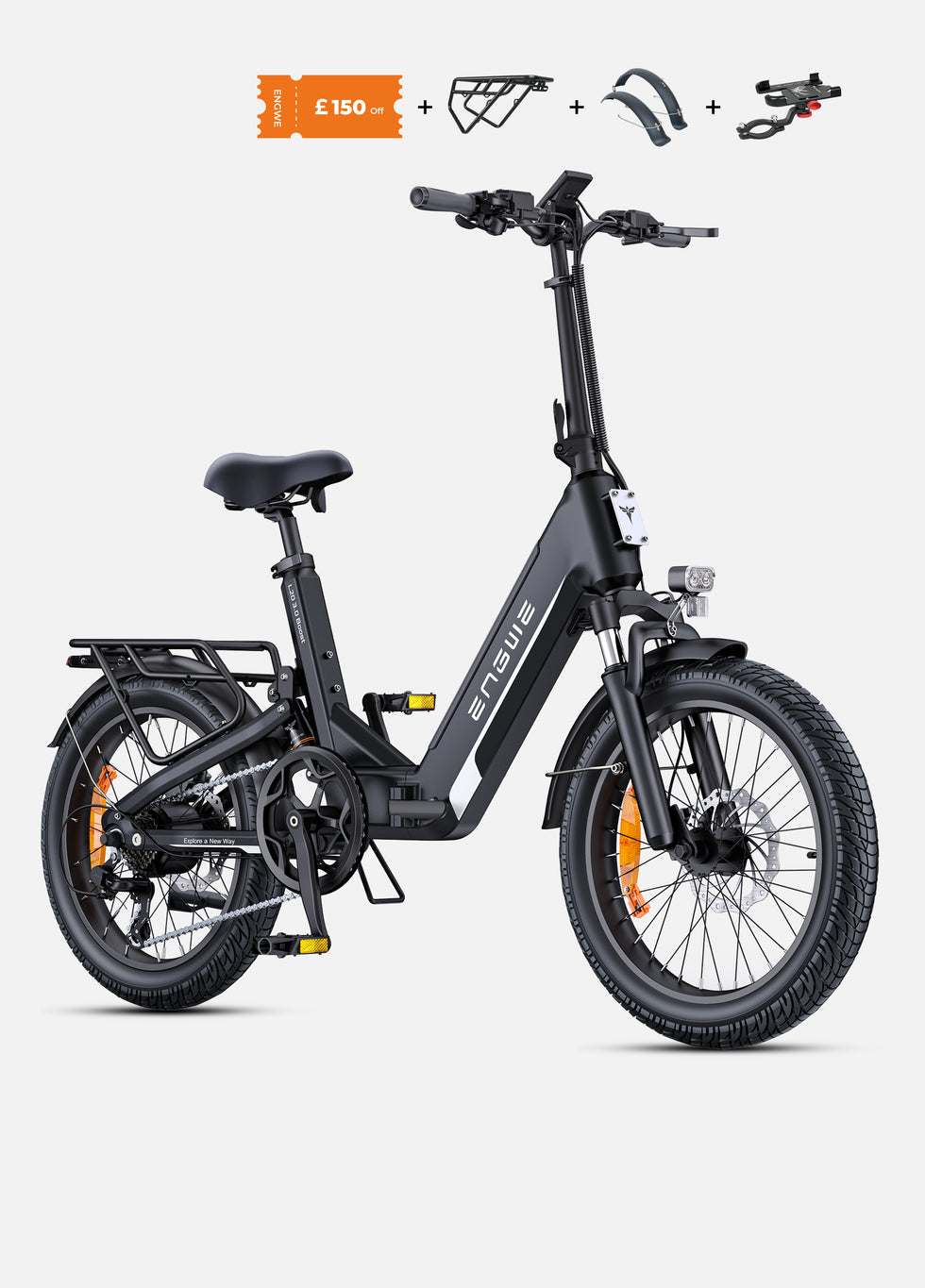
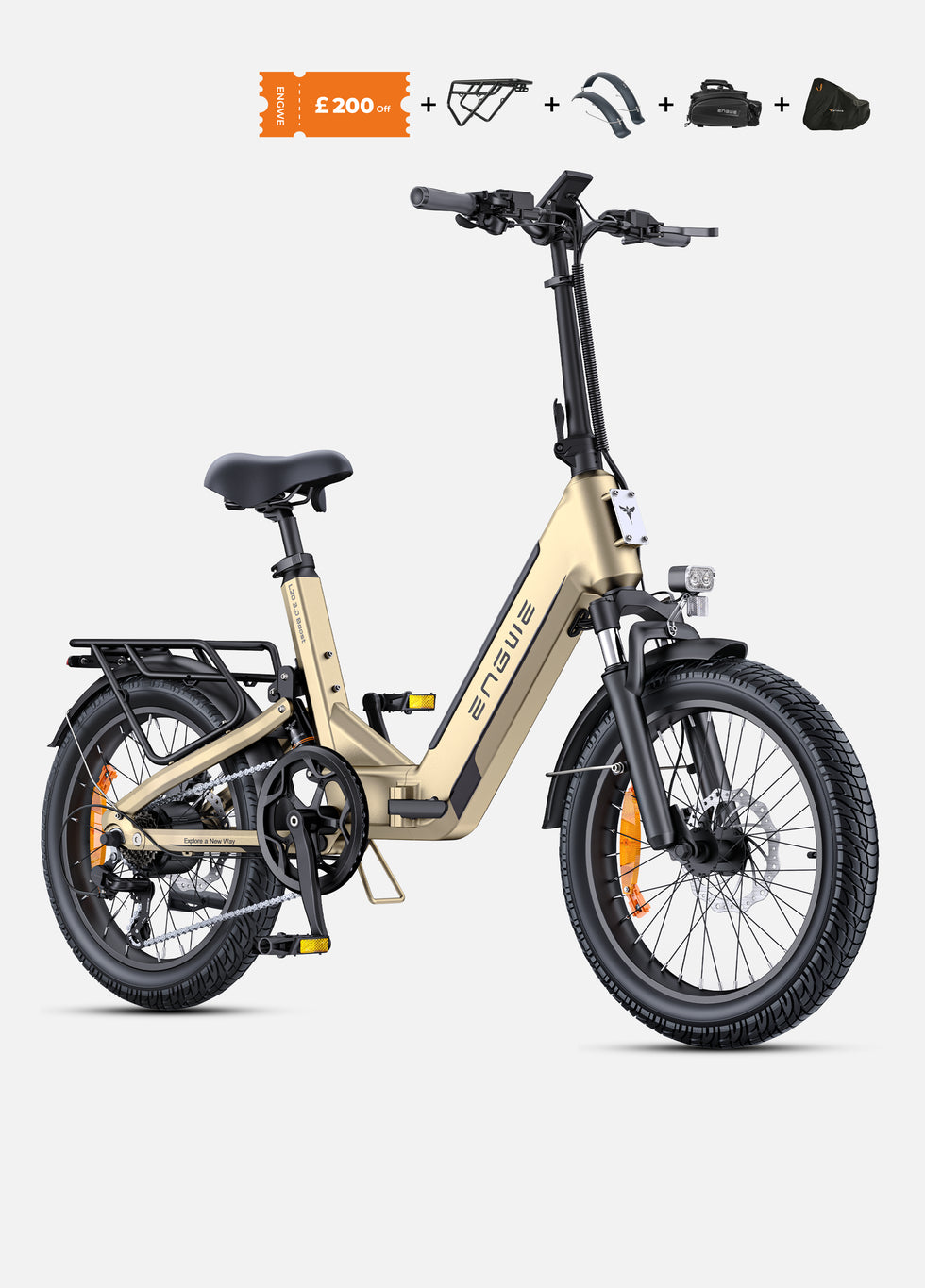
The Engine Pro 3.0 Boost puts full suspension, fat tyres and a torque sensor into a bike that folds. Of the three here, it’s the all terrain electric bike that copes best when the ground gets really rough.
Rough ground is where this bike’s suspension earns its place. The front fork gives you 50mm of travel and the rear adds another 62mm, so the bike moves with the bumps and you don’t feel every one of them. The fork has a lockout too. Flick it on when you’re on the road and it stiffens up, then switch it off when the track gets bumpy again. As for the tyres, they’re 20 x 4.0-inch urban hybrids with a 3mm layer built in to stop punctures. If your rides take you down narrow lanes full of hedge clippings or over stony paths, you’ll be glad of it.
It runs on a 48V hub motor, sold in the UK as a legal 250W motor, and you get up to 90Nm of torque. The torque sensor reads how hard you’re pedalling and gives you just enough help, so setting off on loose ground stays smooth and easy to control. As for range, ENGWE says the 720Wh battery will do 130km in PAS 1, 108km in PAS 3 and 80km in PAS 5. Those numbers are based on a 75kg rider on flat ground at 25°C. Charging is quick too, as the 8A charger gets it full again in roughly two hours.
Stopping is handled by dual-piston hydraulic brakes with 180mm rotors. The frame is magnesium alloy with a step-through shape, and it can take a 150kg payload. At 34.7kg it’s not light, but that weight comes from the full suspension and fat tyres. Fold it and it shrinks to 97 x 53 x 81cm, which helps if you’re short on storage space at home. There’s also a built-in IoT module, so you get GPS tracking and anti-theft features through the ENGWE app. If you’re a beginner after an electric off-road bike you won’t outgrow once you start tackling rougher rides, this one handles the widest mix of ground of the three.

ENGWE EP-2 3.0 Boost: A Folding Electric Bike for All Terrain Riding
The EP-2 3.0 Boost brings fat-tyre grip and a torque sensor to a lighter folding package, giving newer riders a simpler route into mixed-surface riding.
It uses the same 20 x 4.0-inch tyres with a 3mm anti-puncture layer as the Engine Pro 3.0 Boost, along with a 50mm hydraulic front fork with lockout. Its front-suspension design keeps the bike simpler and, at 32.3kg, the lightest of the three. It is well matched to gravel paths, parks, towpaths and country lanes, and riders expecting regular rough, rooty trails can step up to the Engine Pro 3.0 Boost's full suspension.
The 250W hub motor delivers up to 75Nm through a torque sensor, so assistance builds gradually and predictably. Its 648Wh battery is rated at 120km in PAS 1, 100km in PAS 3 and 80km in PAS 5 under ENGWE's test conditions, and the 4A charger takes around 3.5 hours. Dual-piston hydraulic disc brakes on 180mm rotors and a Shimano 7-speed drivetrain complete the setup.
It folds to 97 x 53 x 81cm and connects to the ENGWE app over Bluetooth. As an electric bike for all terrain use at a moderate level, it suits beginners who want a capable all-terrain e-bike that folds away neatly when space at home is limited.

ENGWE Models at a Glance
|
Model |
Frame |
Suspension |
Tyres |
Peak torque |
Battery |
Weight |
|
E26 |
Full-size, High-Step or Step-Thru |
Front and rear |
26" x 4.0" |
70Nm |
48V 16Ah |
33.5-34.5kg |
|
Engine Pro 3.0 Boost |
Folding, step-through |
Front 50mm, rear 62mm |
20" x 4.0" |
90Nm |
720Wh |
34.7kg |
|
EP-2 3.0 Boost |
Folding, step-through |
Front 50mm |
20" x 4.0" |
75Nm |
648Wh |
32.3kg |
What Beginners Should Check Before Buying
A few practical checks will tell you more than any headline figure.
● Where you ride most: Think about the paths and roads you actually use from week to week, and choose a bike that suits those. The big adventure you might take once a year shouldn’t decide it.
● UK compliance: Check the UK product page and make sure the motor is rated at 250W continuous power and the assistance stops at 15.5mph.
● Sensor type: With a torque sensor, the bike pulls away more smoothly, so it’s easier to stay in control when the ground is loose.
● Suspension: For gravel and towpaths, a front fork is usually enough. If your tracks are bumpier, full suspension will make the ride a lot more comfortable.
● Weight and storage: Fat-tyre bikes carry extra weight, so think about where yours will live; a folding frame helps when space is tight.
● Frame height: A step-through frame is easier to mount, especially when stopping on uneven ground.
● Charging time: Check how long a full charge takes and whether the battery comes out for indoor charging.
Final Thoughts
For a lot of beginners, an all terrain electric bike is the more sensible first buy. An electric mountain bike starts to make more sense once technical trail riding is what you mainly want to do.
The all-terrain approach offers wide tyres, a relaxed position and steady handling at the speeds newer riders use most. ENGWE's three models cover the range well: the E26 for full-size comfort and longer rides, the Engine Pro 3.0 Boost for full suspension on rougher ground, and the EP-2 3.0 Boost for a lighter folding option. Choose by where you ride and where the bike will live, and the right all terrain electric bike will be the one you keep reaching for.
FAQs
1. Should beginners choose 20-inch or 26-inch fat tyres for gravel and uneven tracks?
1. Should beginners choose 20-inch or 26-inch fat tyres for gravel and uneven tracks?
Both wheel sizes can suit beginners, but consider the terrain and how you store your bike. Larger-diameter wheels roll over shallow ruts and small obstacles at a gentler angle, while compact wheels work well with folding frames.
The ENGWE E26 features 26 × 4.0-inch tyres and a full-size frame, making it well suited to longer countryside rides over gravel and uneven tracks. The ENGWE EP-2 3.0 Boost combines 20 × 4.0-inch tyres with a folding frame, providing wide-tyre cushioning for mixed-surface rides and convenient storage afterwards.
2. Do beginners need full suspension for forest tracks and rough bridleways?
2. Do beginners need full suspension for forest tracks and rough bridleways?
Full suspension is worth considering if your routes regularly include exposed roots, deep ruts and repeated bumps. A front suspension fork absorbs impacts at the handlebars, while rear suspension allows the back wheel to move independently over uneven ground.
The ENGWE Engine Pro 3.0 Boost combines 50mm front suspension travel with 62mm rear travel, helping reduce impacts across rougher tracks. For gravel paths and lighter woodland routes, the ENGWE EP-2 3.0 Boost offers a 50mm hydraulic front fork and 20 × 4.0-inch tyres, providing cushioning through suspension and tyre volume.
3. Can a UK-legal 250W all-terrain e-bike handle hills and loose gravel?
3. Can a UK-legal 250W all-terrain e-bike handle hills and loose gravel?
Yes. A 250W continuous power rating does not prevent an electric bike from assisting on hills. Beginners should also consider motor torque, gearing and how assistance responds to pedalling.
The ENGWE Engine Pro 3.0 Boost uses a UK-legal 250W-rated hub motor delivering up to 90Nm of torque. Its torque sensor adjusts assistance according to pedal pressure, while the Shimano 7-speed drivetrain lets riders select an easier gear for climbing. Together, these features help riders manage low-speed climbs and apply assistance progressively on loose surfaces.
4. How much battery range should beginners allow for a 30–40 km mixed-terrain ride?
4. How much battery range should beginners allow for a 30–40 km mixed-terrain ride?
For a 30–40 km round trip, choose an e-bike with enough range beyond your planned distance to accommodate hills, colder weather and changes in pedal assistance. Battery capacity in watt-hours indicates stored energy, but actual distance also depends on terrain and riding conditions.
The ENGWE Engine Pro 3.0 Boost has a 720Wh battery, with ENGWE listing 80 km in PAS 5 and 108 km in PAS 3. These figures provide useful planning references for countryside rides, although riders should retain a battery reserve rather than treating published ranges as guaranteed distances.
5. Can a folding all-terrain e-bike be taken on UK trains and stored in a small flat?
5. Can a folding all-terrain e-bike be taken on UK trains and stored in a small flat?
Yes, folding all-terrain e-bikes can be practical for journeys combining cycling and rail travel, provided the train operator's restrictions and your storage arrangements are considered.
The ENGWE EP-2 3.0 Boost folds to 97 × 53 × 81cm, allowing it to occupy a smaller space in a flat or storage area. Its 32.3kg weight should also be considered when planning lifting and transport. National Rail permits road-legal e-bikes on most services, but individual operators may apply restrictions to folded dimensions, luggage storage or peak-time travel.
6. Can beginners ride all-terrain electric bikes on UK bridleways and canal towpaths?
6. Can beginners ride all-terrain electric bikes on UK bridleways and canal towpaths?
Yes, provided the route permits cycling and the e-bike meets UK electrically assisted pedal cycle regulations. Qualifying bikes must have a continuous motor rating no higher than 250W, with assistance ending at 15.5mph.
In England and Wales, cyclists can use public bridleways, while the Canal & River Trust welcomes legal e-bikes on its towpaths. The ENGWE EP-2 3.0 Boost combines a UK-legal 250W motor with 20 × 4.0-inch tyres and hydraulic disc brakes with 180mm rotors, making it relevant to permitted gravel and towpath routes. Always check local access restrictions and give pedestrians priority.