An electric bike in the UK can cost anywhere from around £500 to over £8,000, although many well-equipped commuter, folding and all-terrain electric bikes are available for between £1,000 and £2,000. Charging is relatively inexpensive, but servicing, replacement parts and security equipment also belong in your budget.
The real electric bike cost depends on more than the price tag. Battery capacity, motor design, riding conditions and how often you cycle all influence what you spend over time.
Below, we'll explain UK price brackets, explore ENGWE electric bikes at different budgets and calculate what ownership could cost over three years.
Choose ENGWE as your preferred source on Google
Get ENGWE deals & e-bike tipsElectric Bike Cost in the UK: What Should You Budget?
A sensible electric bike budget starts with your intended journeys. A five-mile urban commute, a weekend ride along country lanes and a mixed-surface route place different demands on the battery, tyres, motor and frame.
The price of electric bikes also reflects the engineering involved. A folding mechanism, torque sensor, suspension system or larger battery can change both the purchase price and how the bike fits into everyday life.
Under £1,000: Affordable Electric Bikes
Electric bikes under £1,000 can offer the essential features needed for regular urban riding, including pedal assistance, rechargeable batteries and practical braking systems.
For example, the ENGWE P275 SE combines a 250W motor, torque sensor and hydraulic disc brakes, while the ENGWE Zip includes a compact folding frame and removable battery.
The important questions at this price point are straightforward: how far do you need to travel, where will you store the bike, and what equipment comes included?
An affordable electric bike with the right combination of features can be an excellent starting point for regular cycling.
£1,000–£2,000: Everyday and All-Terrain Electric Bikes
Between £1,000 and £2,000, buyers can explore electric bikes designed around a wider range of activities, from city commuting to longer leisure journeys and mixed-surface routes.
Within this bracket, features may include larger batteries, mid-drive motors, adjustable suspension, hydraulic brakes, wide tyres and sophisticated folding systems.
A rider looking for an all-terrain electric bike might prioritise tyre width, suspension and battery capacity. Someone using an e-bike for daily transport may pay closer attention to the riding position, frame access, storage and commuting accessories.
The key is choosing features you will use rather than treating the highest specification as a requirement.
Over £2,000: Premium and Specialist Electric Bikes
Above £2,000, the UK market includes lightweight performance bikes, specialist electric mountain bikes, cargo cycles and touring models with more specialised components.
The additional expense may reflect carbon-fibre construction, sophisticated suspension, integrated electronics or equipment designed for demanding applications.
Some specialist electric mountain bikes exceed £8,000, according to UK consumer organisation Which?.
For buyers considering the cost of electric bike ownership, the higher purchase price should be weighed against the particular riding activities and equipment requirements involved.
ENGWE Electric Bikes by Price: Find the Right Bike for Your Budget
ENGWE offers electric bikes for different budgets, with designs covering urban commuting, folding convenience, step-through accessibility and mixed-surface riding.
The following UK prices were checked on 13 October 2026. They are displayed selling prices, including current promotional prices where applicable, and may change.
| ENGWE electric bike | Key feature | Riding focus |
|---|---|---|
| P275 SE | 468Wh battery, torque sensor | Everyday city commuting |
| Zip | 360Wh battery, triple-folding frame | Urban travel and compact storage |
| E26 | 768Wh battery, 26 × 4.0-inch tyres | Longer journeys and mixed surfaces |
| L20 3.0 Pro | 720Wh battery, 100Nm mid-drive motor | Daily riding and varied gradients |
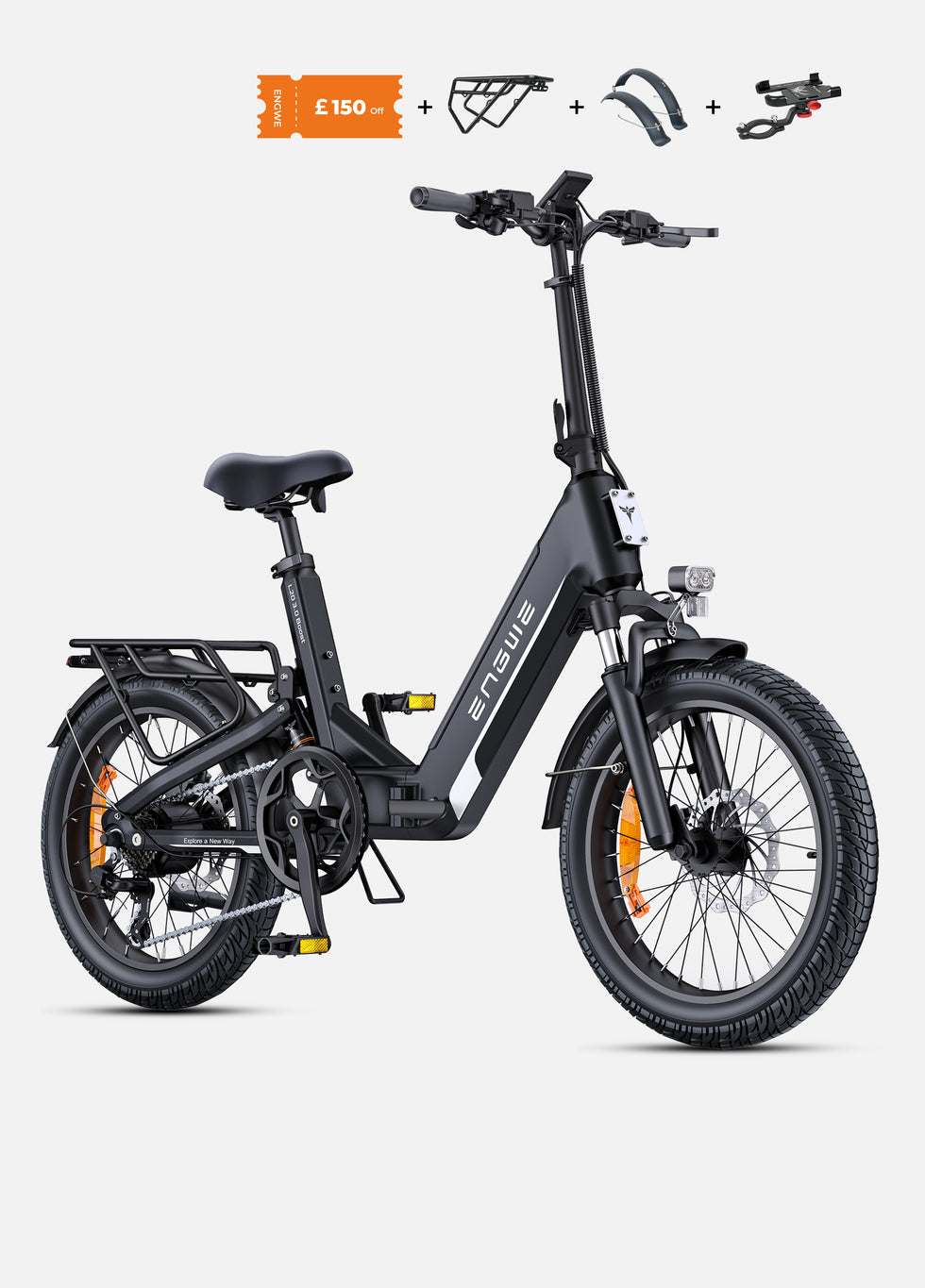
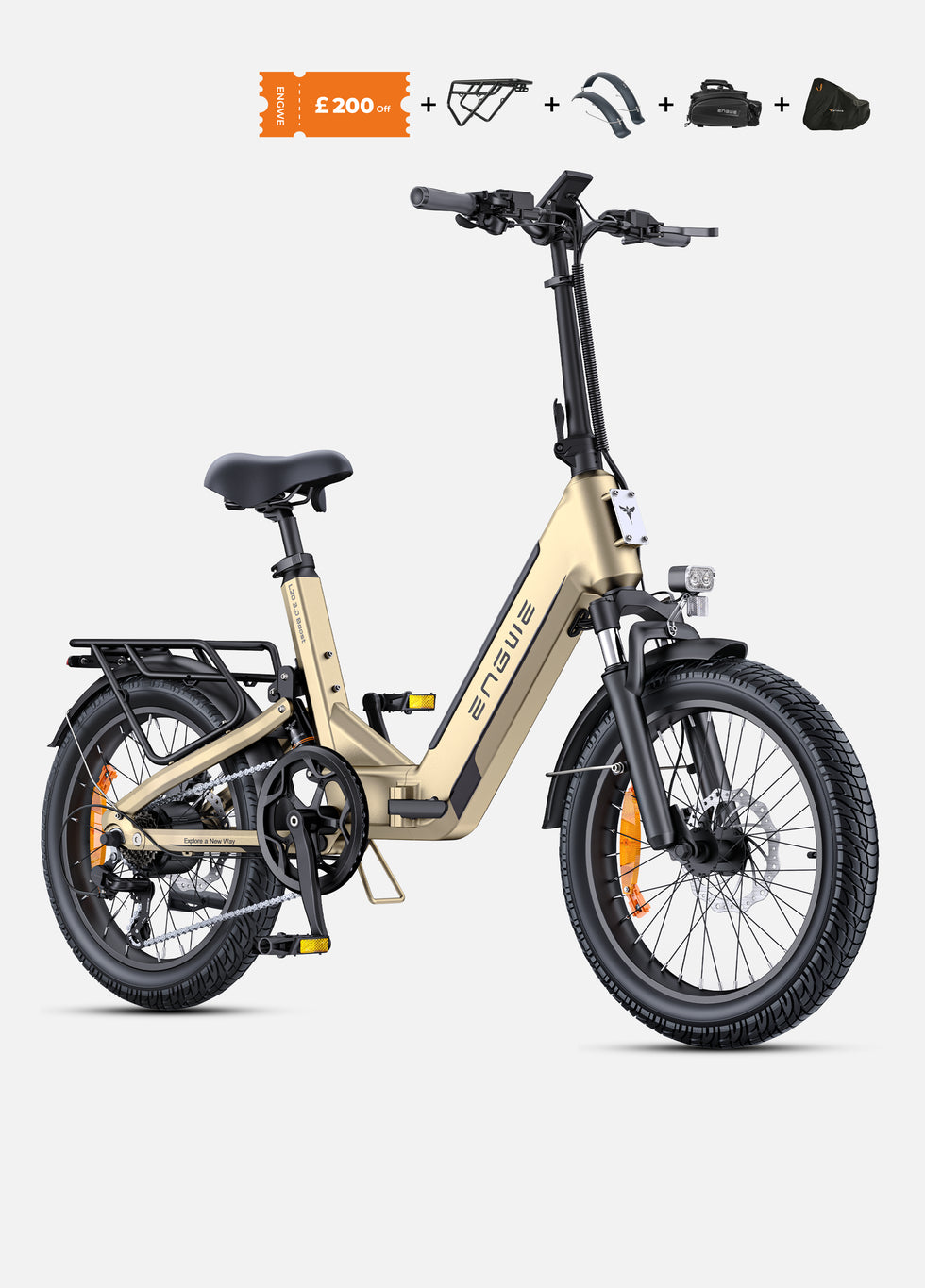
| L20 3.0 Boost | 648Wh battery, low step-through frame | Comfortable urban journeys |
| O20 Boost | 720Wh battery, folding frame | City commuting and storage |
| EP-2 3.0 Boost | 648Wh battery, 20 × 4.0-inch tyres | Fat-tyre riding and folding practicality |
| Engine Pro 3.0 Boost | 720Wh battery, full suspension | Mixed-surface riding and folding comfort |
Battery capacities and other specifications are manufacturer-stated figures. Range depends on assistance level, rider weight, terrain, temperature and riding conditions. Check the current product page for price, colour availability and dispatch information before ordering.
Under £1,000: Affordable City and Folding Electric Bikes
This budget includes ENGWE designs for people who want an electric bike for everyday journeys without spending more than £1,000 at the displayed prices.
ENGWE P275 SE: Everyday City Commuting
The ENGWE P275 SE is designed around everyday urban cycling, with a 250W rear-hub motor, 55Nm maximum torque, a 468Wh removable battery and hydraulic disc brakes.
A torque sensor detects how firmly you press the pedals and adjusts motor assistance in response. That means assistance follows your pedalling effort when accelerating away from junctions or maintaining a steady pace.
The 27.5 × 1.95-inch city tyres and upright riding position complement journeys on roads and established cycle routes.
ENGWE specifies up to 100km of range under its lowest pedal-assistance setting. That is a manufacturer-stated figure rather than a guaranteed distance for every commute.
For riders planning regular trips to work, local shopping or leisure rides around town, the P275 SE brings together useful commuting equipment within the under-£1,000 budget.

ENGWE Zip: Lightweight Folding for Urban Travel
The ENGWE Zip focuses on compact storage and multi-stage urban journeys.
Its triple-folding frame, 16 × 1.95-inch tyres and 19.4kg stated weight including the battery make storage and portability central to its design. Folding reduces the space the bicycle occupies, although riders should still check its folded dimensions and lifting requirements.
The Zip uses a 250W rear-hub motor with 40Nm maximum torque, a torque sensor and a removable 360Wh battery. Hydraulic disc brakes provide braking through fluid-operated callipers, while the suspension seatpost helps absorb some impacts transmitted through the saddle.
The battery also supports USB-C charging and power delivery, adding convenience for compatible devices.
If your everyday journey involves limited storage space, a flat, office or occasional vehicle transport, this electric fold up bike offers a design centred on those practical needs.
£1,000–£1,500: Commuter, Folding and All-Terrain Electric Bikes
This price bracket includes ENGWE electric bikes with distinct approaches to riding comfort, motor assistance, tyre design and folding practicality.

ENGWE E26: All-Terrain Riding and Longer Journeys
The ENGWE E26 is an all-terrain electric bike designed for riders whose journeys include roads, country lanes and suitable uneven surfaces.
Its 26 × 4.0-inch tyres provide a broad contact patch, while front and rear suspension help absorb irregularities in the riding surface. Hydraulic disc brakes use hydraulic pressure to apply braking force at both wheels.
The E26 combines a 250W motor with a removable 48V 16Ah battery, equivalent to 768Wh.
ENGWE states a maximum assisted range of 140km under specified conditions. Actual distance depends on factors such as assistance level, hills, tyre pressure and rider load.
The larger battery capacity is useful when planning longer journeys because it gives riders more stored electrical energy to draw upon between charges.
With high-step and step-through frame configurations available, the E26 accommodates different preferences for mounting and everyday use.

ENGWE L20 3.0 Pro: Mid-Drive Power for Daily Riding
The ENGWE L20 3.0 Pro combines a 250W mid-drive motor, 100Nm stated maximum torque, a 720Wh battery and a compact folding frame.
A mid-drive motor sends assistance through the bicycle's chain and gears. This allows the rider to select mechanical gearing appropriate to the terrain while the motor contributes to driving the rear wheel.
That arrangement is particularly relevant when routes include frequent speed changes or sustained inclines. The torque sensor adjusts assistance in response to pedalling effort.
Full suspension and 20 × 3.0-inch tyres help manage surface irregularities, while hydraulic disc brakes provide controlled braking.
For a commuter who also enjoys longer leisure rides or regularly encounters hills, the L20 3.0 Pro brings several relevant features into one bicycle.
Its folding frame also allows more compact storage when not in use.

ENGWE L20 3.0 Boost: Comfortable Step-Through Commuting
The ENGWE L20 3.0 Boost combines a low step-through frame with a folding design, full suspension and 20 × 3.0-inch urban-hybrid tyres.
The low frame entry reduces the height riders need to step over when mounting or dismounting. This can be particularly convenient during journeys with repeated stops.
Its rear-hub motor provides up to 75Nm of stated torque, while the 648Wh removable battery stores energy for daily travel. The torque sensor varies assistance according to pedal pressure, and hydraulic disc brakes support controlled stopping.
A full-suspension arrangement helps manage impacts from uneven road surfaces, while the folding mechanism provides an additional storage option.
Riders seeking a comfort e bike for shopping trips, local commuting and regular urban journeys can look at this combination of frame accessibility, pedal assistance and suspension.

ENGWE O20 Boost: Folding Convenience for City Travel
The ENGWE O20 Boost combines a folding step-through frame, 250W hub motor and removable 720Wh battery.
Its stated weight is 26.5kg, and the folded dimensions are approximately 88 × 52.5 × 85cm.
The O20 Boost has a 75Nm maximum torque rating, torque sensor, hydraulic disc brakes and a front suspension fork with 50mm of travel.
Front suspension helps absorb impacts through the front wheel, which can be useful where a city route includes uneven tarmac and surface changes.
The 20 × 2.125-inch tyres complement its urban focus, while the Shimano eight-speed drivetrain allows riders to adjust gearing for different gradients.
For someone considering an electric fold up bike, the O20 Boost combines compact storage with commuting-focused equipment and a substantial battery capacity.
Its design is relevant to riders who need to store their bicycle in a limited space but also want to use it regularly across town.

ENGWE EP-2 3.0 Boost: Fat-Tyre Versatility and Folding Practicality
The ENGWE EP-2 3.0 Boost combines 20 × 4.0-inch tyres, a folding frame, front suspension and a 648Wh battery.
Wide tyres allow riders to adjust tyre pressure within the manufacturer's recommended limits to suit different permitted surfaces and loads. Tyre construction, tread pattern and pressure all influence grip, rolling resistance and ride comfort.
The EP-2 3.0 Boost also includes a torque sensor, 75Nm stated maximum torque and hydraulic disc brakes with 180mm rotors.
A magnesium-alloy frame integrates the battery into the bicycle's design, while the folding mechanism makes storage more flexible.
This fat tyre folding e bike is particularly relevant to riders who regularly move between urban roads, gravel-paved paths and country routes where cycling is permitted.
The combination of fat tyres, suspension and a folding frame gives the EP-2 3.0 Boost a distinctive purpose within ENGWE's range.

£1,500–£2,000: Full-Suspension Folding Electric Bikes
This budget bracket includes ENGWE designs that combine substantial battery capacity, advanced controls and suspension systems intended for mixed-surface use.
ENGWE Engine Pro 3.0 Boost: Full-Suspension Comfort and Smart Features
The ENGWE Engine Pro 3.0 Boost combines a folding magnesium-alloy frame with front and rear suspension, 20 × 4.0-inch tyres and a removable 720Wh battery.
Its UK configuration uses a 250W hub motor with up to 90Nm of stated maximum torque. A torque sensor adjusts assistance to the rider's pedalling effort, while the Boost function provides additional torque assistance under its operating conditions.
The suspension system includes 50mm front travel and 62mm rear travel. By allowing the wheels to move relative to the frame, suspension helps absorb impacts from irregular surfaces.
A 54.6V 8A charger supports approximately two-hour charging under ENGWE's stated conditions, making shorter daytime charging sessions practical.
The Engine Pro 3.0 Boost also features an integrated GPS, 4G and Bluetooth-connected system for compatible smart and anti-theft functions.
For riders who want a fat tyre folding e bike with full suspension and connected technology, these features support longer leisure journeys, mixed-surface riding and compact storage between trips.

What Affects Electric Bike Cost?
Battery technology, motor configuration, frame construction and fitted equipment all influence electric bike cost. The relevant question is how each component changes the experience of owning and using the bicycle.
Battery Capacity and Expected Range
Battery capacity is measured in watt-hours (Wh). The figure tells you how much energy a battery can store, rather than how many miles a bike will automatically travel.
For example, a 720Wh battery stores twice the nominal energy of a 360Wh battery. That does not necessarily mean twice the range, because motor efficiency, rider effort, gradient, temperature and rolling resistance also affect energy consumption.
A rider travelling five miles to work can calculate a minimum practical range by considering the return journey, likely assistance level and a reserve for unexpected detours.
For longer routes, battery capacity becomes especially relevant to charging frequency and journey planning.
When comparing the price of electric bikes, check battery capacity alongside the manufacturer's range conditions. Two identical range claims may not have been measured under comparable conditions.
Motor Systems, Brakes and Suspension
An e-bike motor's rated power, torque, sensing system and location each describe different aspects of its operation.
A hub motor drives a wheel directly. A mid-drive motor works through the bicycle's drivetrain and selected gears. Either configuration can serve regular cycling needs when properly matched to the rider and route.
Torque, measured in newton-metres (Nm), describes rotational force. It is not the same measurement as motor power in watts.
A torque sensor measures the rider's pedalling force and uses that input to regulate assistance. This can be useful when changing speed, starting on inclines or riding through stop-start traffic.
Braking and suspension also affect construction costs. Hydraulic disc brakes operate through fluid pressure, while suspension systems absorb some forces generated by rough surfaces.
For example, the ENGWE L20 3.0 Pro uses a mid-drive motor, while the Engine Pro 3.0 Boost combines a hub motor with full suspension. Each system supports its intended riding experience through a different mechanical arrangement.
Frame Design, Weight and After-Sales Support
Frame design affects manufacturing complexity, riding position, portability and everyday convenience.
A step-through frame makes mounting and dismounting straightforward. A folding frame reduces the bicycle's storage dimensions, although folding alone does not mean the bike is particularly light.
For city riders, total weight and folded size should be checked separately, especially if a bicycle must be carried upstairs or lifted into a vehicle.
Manufacturers also invest in integrated wiring, displays, battery management systems and dedicated components.
Before purchasing, check the applicable warranty, availability of compatible replacement parts and options for professional servicing. These factors matter when calculating the cost of electric bike ownership over several years.
Electric Bike Cost Over Three Years: Charging, Servicing and Batteries
The three-year cost of an electric bike includes its purchase price, charging electricity, maintenance, accessories and any repairs or replacements actually required.
Charging is usually a small part of the total. The larger variable is mechanical maintenance, which depends on mileage, riding conditions and how components wear.
How Much Does It Cost to Charge an Electric Bike?
Charging a 500Wh electric bike battery costs approximately 15p from empty to full at the average UK electricity unit rate for October–December 2026, using an illustrative 15% allowance for charging losses.
Ofgem publishes an average electricity unit rate of 26.32p per kWh for direct-debit customers under the price cap for that period in Great Britain. Individual tariffs and regions vary.
You can estimate the cost using:
Charging cost = Battery capacity (Wh) ÷ 1,000 × Electricity rate (£/kWh) × Charging-loss factor
The following examples use a charging-loss factor of 1.15. This is a calculation assumption, not a measured efficiency figure for any ENGWE charger.
| Battery capacity | Energy stored | Estimated full-charge electricity cost |
|---|---|---|
| 360Wh | 0.360kWh | 10.9p |
| 500Wh | 0.500kWh | 15.1p |
| 648Wh | 0.648kWh | 19.6p |
| 720Wh | 0.720kWh | 21.8p |
| 768Wh | 0.768kWh | 23.2p |
For example, two equivalent full charges each week of a 720Wh battery would cost approximately £22.66 annually under these assumptions.
In reality, riders frequently recharge before the battery is empty. The electricity used depends on the energy replaced, not simply the number of times the charger is connected.
Charging safety matters as much as electricity cost. Use the supplied or manufacturer-approved compatible charger, charge where heat can dissipate, and disconnect the charger when charging is complete. Do not leave a battery charging unattended or while asleep, in line with London Fire Brigade guidance.
Servicing, Tyres and Brake Replacement
Professional electric bike servicing varies by location and the work required.
As one documented UK example, London workshop BikeClinique publishes e-bike service prices ranging from £85 for a safety check to £260 for a full service, with more comprehensive work costing extra. Replacement components are generally charged separately.
Routine maintenance includes:
-
Tyres: Maintaining the recommended pressure, checking tread condition and inspecting for damage or punctures.
-
Brakes: Checking pad wear, rotor condition and braking performance, particularly after frequent wet-weather riding.
-
Drivetrain: Cleaning and lubricating the chain, checking wear and adjusting the gears.
-
Electrical system: Checking accessible connections, battery mounting and displays according to manufacturer instructions.
Actual replacement frequency depends on mileage, rider load, weather and terrain. A frequently used commuter bike may require attention at different intervals from a bicycle used for occasional weekend rides.
For a three-year budget, ask a local workshop for a quotation that separates labour from parts. Also confirm that the workshop can service your particular motor and electrical system.
Battery Lifespan, Replacement and Three-Year Cost Example
An electric bike's lithium-ion battery gradually loses usable capacity as it ages and undergoes charge cycles.
Battery life is influenced by storage temperature, depth of discharge, charging conditions, battery design and usage. There is no universal date at which every battery must be replaced.
If a battery eventually requires replacement, use a compatible, manufacturer-approved unit rather than selecting a replacement based solely on matching voltage and physical dimensions.
For an accurate electric bike cost estimate, battery replacement should be treated as a possible future expense, not an automatic charge in year three.
An illustrative three-year ownership budget
The table below uses two ENGWE models and identical hypothetical usage assumptions:
-
Two equivalent full battery charges per week, or 104 per year.
-
An electricity price of 26.32p/kWh, held constant purely for comparison.
-
A 15% allowance for charging losses.
-
£150 per year for scheduled servicing and a maintenance allowance.
-
£80 of initial accessories.
-
No battery replacement or exceptional repairs during the example period.
| Expense | ENGWE E26 | ENGWE L20 3.0 Pro |
|---|---|---|
| Purchase price | £1,299.00 | £1,399.00 |
| Battery capacity | 768Wh | 720Wh |
| Estimated electricity, 3 years | £72.53 | £67.99 |
| Assumed maintenance allowance, 3 years | £450.00 | £450.00 |
| Assumed initial accessories | £80.00 | £80.00 |
| Illustrative three-year total | £1,901.53 | £1,996.99 |
These are budgeting examples, not recorded customer expenses or forecasts. The £150 annual maintenance allowance and £80 accessories allowance are assumptions, not ENGWE service quotations. They exclude optional insurance, unexpected repairs, replacement batteries, potential price changes and resale value.
The calculation also assumes the same number of equivalent full charging cycles, rather than the same distance travelled. Different bikes may travel different distances per unit of energy.
To calculate your own three-year total, substitute your actual purchase price, tariff, expected charging use and local servicing quotation.
What Extra Costs Should You Allow For?
Beyond the advertised bicycle price, consider the equipment needed to use, park and maintain the bike in your particular circumstances.
Some electric bikes include lights, mudguards, luggage racks or other accessories, so check the package contents before adding items to your shopping budget.
Locks, Lights and Everyday Accessories
A good lock is one of the most useful purchases for an electric bike parked away from home.
When selecting a lock, consider its security rating, the value of the bicycle and any requirements imposed by your insurer. Secure the frame to an immovable object wherever permitted.
For everyday commuting, accessories worth considering include:
-
Front and rear lights suitable for your journey.
-
A secure lock and, where appropriate, an additional lock.
-
Mudguards for wet roads.
-
A luggage rack or pannier bag for carrying work items.
-
A properly fitting cycle helmet.
Some ENGWE models already include equipment such as lighting, mudguards or racks. Check the individual product's included accessories before budgeting for replacements or additions.
For someone researching a comfort e bike for daily commuting, practical details such as luggage space, a suitable riding position and convenient parking can be just as relevant as motor specifications.
Insurance and Theft Protection
Dedicated electric bike insurance is optional for electrically assisted pedal cycles that meet the applicable UK legal requirements.
Policies may cover theft, accidental damage and third-party liability, but the cover, exclusions and security conditions vary.
A rider who regularly parks in public areas may want to compare insurance policies and check requirements for approved locks or secure storage.
ENGWE also offers security-related equipment and connected functions on selected bikes. For example, the Engine Pro 3.0 Boost incorporates GPS and connected features that can support compatible tracking functions.
Insurance and physical security serve different purposes. A suitable lock helps protect the bicycle when parked, while an insurance policy may provide financial protection against specific covered events.
UK Road-Legal Rules and Their Cost Implications
In Great Britain, an electrically assisted pedal cycle (EAPC) generally must have usable pedals, a motor with no more than 250W maximum continuous rated power and assistance that cuts off at 15.5mph.
A qualifying EAPC does not require vehicle registration, Vehicle Excise Duty, a driving licence or compulsory motor insurance. Riders must be at least 14 years old. Northern Ireland also has EAPC rules, with official guidance available through nidirect.
Not every vehicle marketed as an electric bike automatically qualifies.
Motor ratings and torque figures describe different characteristics. A stated 75Nm, 90Nm or 100Nm maximum torque figure does not, by itself, establish that a bike exceeds the 250W continuous power limit.
For road use, check the exact UK product configuration and avoid modifications that remove legally required assistance limits.
These distinctions matter financially: a vehicle outside the EAPC classification can be subject to motor-vehicle registration, insurance, licensing and approval requirements.
You can find the full requirements in the UK government's electric bike rules.
Is an Electric Bike Worth the Cost for UK Commuters?
An electric bike can reduce transport spending when it regularly replaces journeys that would otherwise require paid public transport or car use.
The financial benefit depends on how often the bicycle replaces those journeys, the cost of the alternative transport and the expenses of owning the bike.
Comparing E-Bike Costs with Driving and Public Transport
The most useful comparison uses the same journey and time period.
Consider someone currently spending £6 per working day on transport and replacing 200 of those journeys with an electric bike.
Their avoided fare spending would be:
£6 × 200 days = £1,200 per year
That £1,200 is an illustrative assumption, not a quoted UK transport fare. The rider would then subtract electricity, servicing and other relevant cycling expenses, and account for the bicycle's purchase price.
Car comparisons require similar care. Fuel, parking, maintenance, insurance and vehicle depreciation may be relevant, but not every cost disappears when a driver substitutes some journeys with cycling.
The strongest financial case arises when a bicycle is used regularly enough to replace a meaningful amount of existing transport spending.
For urban commuters, a folding bike such as the ENGWE Zip or O20 Boost may fit into a journey involving compact storage. For longer or more varied routes, the ENGWE E26 and L20 3.0 Pro offer different approaches to battery capacity and assisted riding.
Saving Money with the Cycle to Work Scheme
The UK's Cycle to Work scheme can reduce the effective cost of obtaining an eligible electric bike through participating employers.
Under a qualifying arrangement, the employer provides a bicycle and related equipment, often through salary sacrifice. Employees may benefit from income tax and National Insurance savings, depending on their circumstances.
However, the amount saved is not a universal percentage.
Eligibility, participating retailers, salary-sacrifice terms and any end-of-hire arrangements should be checked before committing.
An employee should also confirm whether the particular ENGWE purchase route is accepted by their employer's scheme provider. A bicycle being legally suitable for commuting does not automatically mean every retailer or online checkout can process a scheme transaction.
See the UK government's Cycle to Work guidance for the official framework.
Buying New vs Second-Hand or Using a Conversion Kit
The initial cost of electric bike ownership can also be influenced by whether you purchase a complete new bike, a used bicycle or a conversion kit.
A second-hand electric bike may have a lower purchase price, but buyers should establish the battery's condition, charging history where available, authenticity, compatibility and access to replacement parts.
Converting a conventional bicycle involves installing compatible electrical components, potentially including a motor, battery, controller and associated wiring. Professional fitting may add to the total cost, and the completed bicycle must meet applicable legal requirements for its intended use.
The cost of a conversion therefore includes more than the advertised kit price.
Buying a complete ENGWE electric bike provides an integrated motor, battery, frame and control system designed for that model, together with the applicable manufacturer support and warranty terms.
For buyers who prefer a complete bicycle with its electrical components already specified, exploring ENGWE's UK electric bike range offers a straightforward way to compare designs and budgets.
Conclusion
The cost of an electric bike in the UK is easiest to understand when you separate the purchase price from the expenses of actually riding and maintaining it.
For many buyers, a budget between £1,000 and £2,000 provides access to a wide variety of commuting, folding and all-terrain designs. ENGWE also offers city-focused bicycles below £1,000, making it possible to match a purchase to different spending limits.
Battery capacity, motor configuration, tyre design, frame accessibility and storage needs should guide the decision. Once you have selected a suitable bicycle, use your own electricity tariff, commuting frequency and servicing estimates to assess long-term ownership costs.
Explore the ENGWE UK electric bike collection to compare current prices, specifications and available designs before choosing the bike that fits your everyday journeys.
Frequently Asked Questions
How Much Should You Spend on Your First Electric Bike?
How Much Should You Spend on Your First Electric Bike?
A first electric bike does not have to cost £2,000. The appropriate budget depends on your daily distance, terrain, storage requirements and desired features. For example, the ENGWE P275 SE offers torque-sensing assistance and hydraulic disc brakes for urban commuting at a displayed price below £1,000. The ENGWE E26 combines wide tyres, dual suspension and a 768Wh battery for more varied routes. Start with your intended journeys, then check which features and accessories are included within your spending limit.
Are Electric Bikes More Expensive to Maintain Than Regular Bikes?
Are Electric Bikes More Expensive to Maintain Than Regular Bikes?
Electric bikes share many maintenance tasks with conventional bicycles, including servicing brakes, tyres, chains and gears. They also have electrical components that may require specialist inspection or diagnosis. Actual costs depend on use and the work needed. As a published example, London workshop BikeClinique charges £85 for an e-bike safety check and £160 for an intermediate service, with parts charged separately. Regular cleaning, tyre-pressure checks and timely attention to worn components help keep maintenance predictable.
Do Electric Bikes Hold Their Value?
Do Electric Bikes Hold Their Value?
Electric bikes can retain resale value, but there is no reliable fixed percentage that applies to every model. Age, battery condition, mileage, frame condition, available accessories and market demand all influence a second-hand price. Maintaining service records, retaining the original charger and looking after the battery can make a bicycle easier for a prospective buyer to assess. If resale is part of your ownership calculation, use current comparable second-hand listings rather than assuming a particular future selling price.