Wheel size is one of those numbers on every e-bike listing, with no one explaining it. Most first-time buyers glance at it and move straight on to the motor and battery figures.
It’s an easy mistake to make, because you can feel the difference between a 20-inch bike and a 26-inch electric bicycle as soon as you set off. The bigger one feels roomy and steady, a lot like a normal mountain bike. The smaller one is shorter and quicker to turn, and it’s much easier to find a spot for at home.
Choose ENGWE as your preferred source on Google
Get ENGWE deals & e-bike tipsHow Wheel Size Changes the Way an E-Bike Rides
The size of the wheels changes how a bike deals with bumps and corners. It usually changes how long the frame is and how much room you’ll need to store it, too.
What a 26-Inch Electric Bicycle Offers
The 26-inch wheel was the standard size on mountain bikes for a long time, and it’s still a good fit for a 26-inch electric bicycle that’s built around comfort. Because the wheel is larger, it meets a pothole or a tree root at a gentler angle. In practice, that means it’s more likely to roll straight over small obstacles than catch on them. How well it does this also depends on your tyre pressure and the bike’s suspension.
Full-size frames tend to have a longer wheelbase, which is the gap between the front and back axles. A longer wheelbase helps the bike hold a straight line, and that’s reassuring when you’re still getting your balance. The downside is that it takes up more room, and most of these bikes don’t fold.
Where a 20-inch Folding Electric Bike Fits In
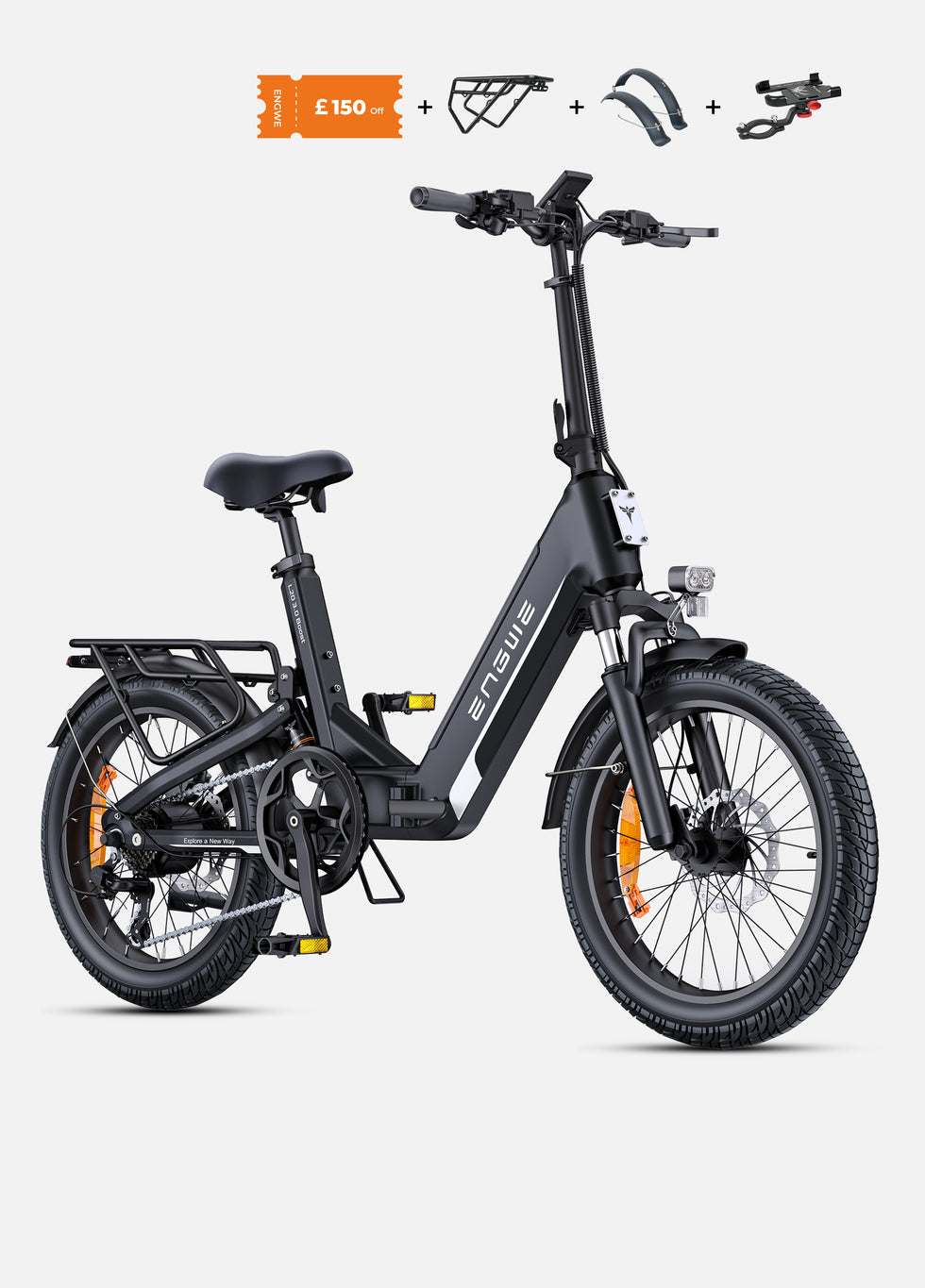
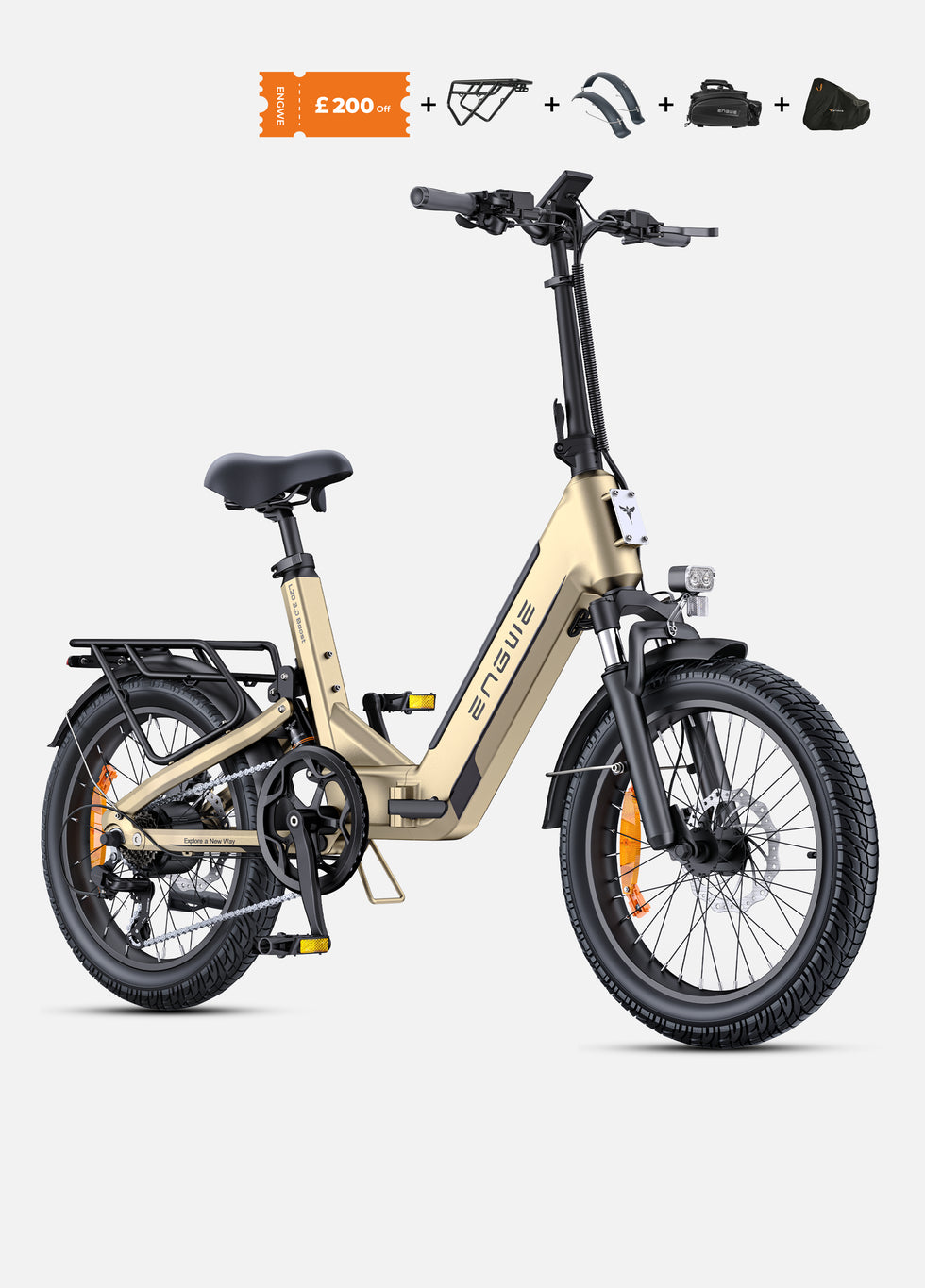
A 20-inch folding electric bike is shorter overall, so it usually feels quicker to steer along narrow paths and round bollards. Once you’re home, you can fold it up and keep it in the hallway.
On rough ground, small wheels with thin tyres can feel a bit bouncy and nervous. That’s where fat tyres really help. A four-inch tyre holds lots of air, so it soaks up small bumps, and a 20-inch fat-tyre bike usually feels much comfier than a folder with skinny tyres. The suspension and frame design still have a say in how it rides, though.
Is a 26-Inch Electric Bicycle Easier for Beginners?
It can be, but wheel size is only one piece of the puzzle, alongside fit, frame measurements, your usual routes and storage.
Stability and Rolling Over Bumps
If your rides take in gravel, broken tarmac or towpaths with roots sticking up, you’ll notice the bigger wheel straight away. A 26-inch bike with its longer wheelbase doesn’t get thrown about as much, and it just feels calmer. That’s really the main stability advantage of the larger size.
A 20-inch bike with fat tyres can close a lot of that gap, as long as you get the pressure right. Pump them up too hard and you lose most of the cushioning. Let too much air out and the steering starts to feel loose and vague.
Fit, Standover Height and Rider Size
For a beginner, fit often matters more than wheel size. Being able to put a foot down comfortably when you stop builds confidence.
Here's how the three ENGWE bikes compare on ENGWE's UK size charts:
● E26: 72cm standover height, with a Step-Thru frame option that's easier to get on and off
● Engine Pro 3.0 Boost: 68cm standover height, for riders from 165cm to 190cm
● EP-2 3.0 Boost: 68cm standover height, for riders from 165cm to 190cm
Your height gives you a rough idea of which size to go for, but it’s not the whole story. Standover height and frame style matter just as much. Taller riders often feel right at home on a 26-inch electric bicycle, and some shorter riders find a 20-inch frame easier to control. The best way to know is to check the size chart for each bike you’re looking at.
Manoeuvring at Low Speed
Many beginner rides happen at walking pace, like edging out of a driveway or getting through a gate, and this is where frame length shows.
The two 20-inch ENGWE models measure 166cm and 168cm long, with wheelbases of about 110cm. The E26 is 194.5cm long with a 120.5cm wheelbase. Those extra 26.5cm to 28.5cm won’t make the E26 any harder to ride, but you’ll feel the difference when you’re wheeling it down a narrow side passage.
Electric Bike Weight, Storage and Everyday Handling
Electric bike weight and storage decide how easy a bike is to live with.
Here's how the three ENGWE models compare on weight:
● EP-2 3.0 Boost: 32.3kg
● E26: 33.5kg (Step-Thru) or 34.5kg (High-Step)
● Engine Pro 3.0 Boost: 34.7kg
There’s only 2.4kg between the lightest and heaviest of the three, and each one comes in above 32kg, which is normal for bikes with fat tyres and big batteries. If you’ll be lifting yours up a front step or into a shed every day, electric bike weight is worth thinking about, whichever model you go for.
Storage is where the two sizes really differ. Both 20-inch models fold down to 97 x 53 x 81cm, which makes them a good fit for flats and hallways. The E26 doesn’t fold, so as a 26-inch electric bicycle it’s happiest in a garage, shed or ground-floor room. All three have batteries you can take out, so you can charge them indoors wherever the bike is parked.
UK Rules for 20-Inch and 26-Inch E-Bikes
Wheel size doesn't change UK law, so the same rules apply to every bike in this guide.
To count as a legal e-bike, a bike needs working pedals and a motor of up to 250 watts that stops helping at 15.5mph.
You need to be at least 14 to ride one. Once you are, you can take it on roads, cycle paths and anywhere else a normal bike is allowed, just not on the pavement. You don’t need a licence, tax or insurance either. If a bike goes past those limits, the law treats it as a motorbike or moped instead, and then it has to be registered, taxed and insured, and you’ll need a licence to ride it.
Off-road access depends on the rules for each path, so check before you head out. For the full details, see the government's electric bike rules. ENGWE lists all three bikes below with 250W motors and assistance up to 15.5mph.
ENGWE E26: A 26-Inch Electric Bicycle for Longer Rides
ENGWE's E26 is the only full-size 26-inch electric bicycle in this group, built for riders who prefer covering distance in comfort over tackling technical trails.
The E26 runs on 26 x 4.0-inch fat tyres, with suspension at the front and back and a 120.5cm wheelbase. Put together, they keep the bike steady on gravel, grass and patchy tarmac. It’s best thought of as a relaxed electric mountain bike with fat tyres rather than something for steep descents. For hills, the 250W motor gives you 70Nm of torque, and the Shimano 7-speed gears help when the slope changes. Stopping is handled by 180mm hydraulic disc brakes on both wheels.
Range is the other thing the E26 does really well. On pedal assist, ENGWE says the removable 48V 16Ah battery will take you up to 140km — plenty for a long day in the saddle, and a big reason the E26 works so well as an electric mountain bike for longer trips. Will you always hit that number? Probably not. Hills, extra weight and higher assist levels all eat into it. Charging takes 5.5 to 6 hours, which sounds like a while, but plug it in while you’re home and awake.
Getting on and off is easy on the E26, as you can choose a High-Step frame or a lower Step-Thru one. It’s handy for errands as well. The rear rack holds up to 25kg, and the whole bike is rated to carry 150kg. Got room at home for a full-length bike? Does the size chart match your height? If the answer to both is yes, the E26 is a natural place to start your search for a 26-inch electric bicycle.

ENGWE Engine Pro 3.0 Boost: A Compact 20-Inch Bike With Full Suspension
The Engine Pro 3.0 Boost takes a different route to comfort, packing full suspension, a torque sensor and up to 90Nm of torque into a 20-inch folding frame.
Small wheels feel bumps more than big ones, which is why ENGWE gave this bike suspension front and back. You get 50mm of travel up front, and you can lock it out when you’re on smooth roads, plus 62mm at the rear. Add 4.0-inch tyres with a 3mm puncture-resistant layer and the ride stays nicely composed on towpaths and gravel. In short, it feels like a compact electric mountain bike with fat tyres, yet it still folds down when you’re done riding.
The torque sensor is a big help when you’re still learning. Push gently and you get a gentle boost; push harder and the motor gives you more. That’s why setting off slowly from a junction feels calm and controlled. On range, ENGWE says the 720Wh battery lasts up to 130km on PAS 1, its lowest assist setting, and 80km on PAS 5, the highest. Their test used a 75kg rider on flat roads at 25°C, so hills and colder days will bring that down a bit. Charging is quick, too. With the 8A charger, it’s full again in around two hours.
Dual-piston hydraulic brakes on 180mm rotors take care of stopping. The bike carries a 150kg payload rating, and a built-in IoT module connects to the ENGWE app for GPS tracking and anti-theft alerts. At 34.7kg, it weighs about the same as the E26, but it’s 26.5cm shorter and folds down to 97 x 53 x 81cm. So you get full suspension without having to find room for a full-length bike.

ENGWE EP-2 3.0 Boost: The Lightest 20-Inch Folding Electric Bike Here
The EP-2 3.0 Boost is the lightest bike here at 32.3kg. As an adult fat-tyre electric bike, it keeps things straightforward, pairing grippy four-inch tyres and a torque sensor with a folding frame.
Like the Engine Pro 3.0 Boost, it rolls on 20-inch wheels with puncture-resistant 4.0-inch tyres, and up front there’s a 50mm hydraulic fork you can lock out. Having suspension at the front only keeps the weight down. It’s also the shortest bike of the three at 166cm, which makes it easier to steer and store in tight spots. Paths, parks and gravel tracks are where it’s most at home. If you know you’ll be riding rough, rooty trails a lot, the Engine Pro’s rear suspension might suit you better.
The EP-2 3.0 Boost pairs its 75Nm motor with a torque sensor, so the harder you pedal, the more help you get — nothing sudden, just a steady build. How far will the 648Wh battery go? ENGWE puts it at anywhere from 80km to 120km, and where you land in that range comes down to the assist level you pick.
The 4A charger that comes with it gets the battery full again in about 3.5 hours. Stopping is handled by dual-piston hydraulic disc brakes with 180mm rotors, and there’s a Shimano 7-speed setup for the gears.
Folded, it matches the Engine Pro's size of 97 x 53 x 81cm. It also pairs with the ENGWE app via Bluetooth. With a 150kg payload rating, it makes a sensible first 20-inch folding electric bike for anyone who wants something easy to store.

Comparing the Three ENGWE Models
|
Model |
Wheels and tyres |
Suspension |
Peak torque |
Battery |
Weight |
Folds |
|
E26 |
26" x 4.0" |
Front and rear |
70Nm |
48V 16Ah |
33.5- 34.5 kg |
No |
|
Engine Pro 3.0 Boost |
20" x 4.0" |
Front 50mm, rear 62mm |
90Nm |
720Wh |
34.7kg |
Yes, 97 x 53 x 81cm |
|
EP-2 3.0 Boost |
20" x 4.0" |
Front 50mm |
75Nm |
648Wh |
32.3kg |
Yes, 97 x 53 x 81cm |
Which Wheel Size Suits Your Riding
The table below matches common situations with a 20-inch model or a 26-inch electric bicycle.
|
Your situation |
Better fit |
|
Taller rider who prefers a full-size feel |
26-inch electric bicycle |
|
Long countryside rides and weekend touring |
26-inch electric bicycle |
|
Flat, hallway or limited storage space |
20-inch folding electric bike |
|
Tight paths with frequent stops and turns |
20-inch model |
|
Rough ground on a compact bike |
20-inch full-suspension model |
|
Carrying shopping or a day's kit |
Any of the three, as all come with a rear rack |
Each ENGWE model here is a fat tyre electric bike for adults on four-inch tyres, so tyre width won't separate them. Fit and storage usually tip the decision.
Key Checks for Beginners Before Buying
Before ordering, run through these checks:
• Fit and standover height: Make sure you can put a foot down comfortably, and compare each size chart with your height.
• Storage space: Measure where you'll keep the bike, then compare it with the bike's full length or folded size.
• Electric bike weight: If the bike has to go over a step or into a shed, think about whether you can lift it comfortably.
• Typical routes: Long, open rides favour a bigger wheel, while busy routes with plenty of turns favour a smaller one.
• Suspension: A front fork handles paths and tracks well, and full suspension helps on rougher ground.
• Charging: Check charging time and whether the battery is removable.
• UK compliance: Confirm the UK product page lists a 250W motor and a 15.5mph assistance limit.
Final Thoughts
So which size should you go for? If you enjoy longer rides and there’s room at home for a full-length bike, a 26-inch electric bicycle is often the easier pick for a beginner. Short on space, or riding routes with lots of tight turns? Then a 20-inch model probably makes more sense. Just be sure to check the measurements first – your height and your storage space both matter.
Within ENGWE's range, the E26 is the comfortable, full-size electric mountain bike for long-distance riding; the Engine Pro 3.0 Boost brings full suspension to a folding frame, while the lightest and simplest of the trio is the EP-2 3.0 Boost.
FAQs
1. Do 20-inch electric bikes make you pedal faster than 26-inch bikes?
1. Do 20-inch electric bikes make you pedal faster than 26-inch bikes?
Not necessarily. With identical gearing, a smaller wheel travels less distance per pedal revolution, but the chainring, rear sprockets and selected gear also determine your pedalling cadence.
The 20-inch ENGWE EP-2 3.0 Boost uses a Shimano 7-speed drivetrain, allowing beginners to select an appropriate gear for setting off, cruising or climbing. The 26-inch ENGWE E26 also features seven gears for adjusting pedalling effort across changing gradients. Choose by your preferred riding position and routes rather than wheel diameter alone.
2. Can a 20-inch electric bike cope with hilly UK routes?
2. Can a 20-inch electric bike cope with hilly UK routes?
Yes. Hill-climbing depends on motor torque, gearing, gradient, traction and total riding weight, not simply wheel diameter. A hub motor drives the wheel directly, while the bicycle's gears help riders adjust their own pedalling effort.
The 20-inch ENGWE Engine Pro 3.0 Boost delivers up to 90Nm of torque through a UK-legal 250W-rated hub motor. Its torque sensor increases assistance in response to pedal pressure, helping riders manage changing gradients. The 26-inch ENGWE E26 offers 70Nm and Shimano 7-speed gearing for countryside routes with repeated climbs.
3. Can someone who is six feet tall ride a 20-inch electric bicycle?
3. Can someone who is six feet tall ride a 20-inch electric bicycle?
Yes. Twenty-inch wheels do not necessarily mean a small adult riding position. Riders around six feet tall should check saddle height, handlebar reach and leg extension rather than relying on wheel diameter.
The ENGWE EP-2 3.0 Boost is designed for riders between 165cm and 190cm tall, covering someone approximately six feet (183cm) tall. Its saddle adjusts between 88cm and 104cm from the ground, while its standover height is 68cm. These measurements help riders assess pedalling position and frame clearance before choosing a folding electric bicycle.
4. Does a 26-inch electric bicycle go further on one charge than a 20-inch model?
4. Does a 26-inch electric bicycle go further on one charge than a 20-inch model?
Not automatically. Battery capacity, assistance level, hills, tyre pressure and rider weight all influence range. Compare battery energy in watt-hours rather than assuming larger wheels mean longer journeys.
The 20-inch ENGWE Engine Pro 3.0 Boost has a 720Wh battery, with published ranges of 108km in PAS 3 and 80km in PAS 5. The 26-inch ENGWE E26 uses a 48V 16Ah (768Wh) battery with up to 140km of advertised pedal-assist range. Since the published figures use different test descriptions, beginners should allow a battery reserve when planning journeys.
5. Can a 20-inch electric bike carry shopping and luggage like a 26-inch bike?
5. Can a 20-inch electric bike carry shopping and luggage like a 26-inch bike?
Yes. Carrying capacity depends on the frame's specified payload and the rack's separate weight limit, rather than wheel diameter alone.
Both the 20-inch ENGWE EP-2 3.0 Boost and 26-inch ENGWE E26 have a maximum load rating of 150kg. The EP-2 3.0 Boost combines this capacity with a folding frame for everyday errands and compact home storage. The E26 features a rear rack rated for up to 25kg, making it useful for panniers and countryside day-trip equipment. Always include rider and luggage weight when checking payload limits.
6. Does wheel size affect braking on wet British roads?
6. Does wheel size affect braking on wet British roads?
Wheel diameter alone cannot determine stopping performance. Beginners should consider tyre grip, brake design, riding speed and road conditions. Hydraulic disc brakes transmit lever pressure through fluid to press brake pads against a rotor, allowing riders to modulate braking force.
The 20-inch ENGWE EP-2 3.0 Boost features dual-piston hydraulic brakes with 180mm front and rear rotors. The 26-inch ENGWE E26 also uses 180mm hydraulic disc brakes at both wheels. These configurations support controlled braking during repeated junction stops, although riders must allow additional stopping distance when road grip is reduced.