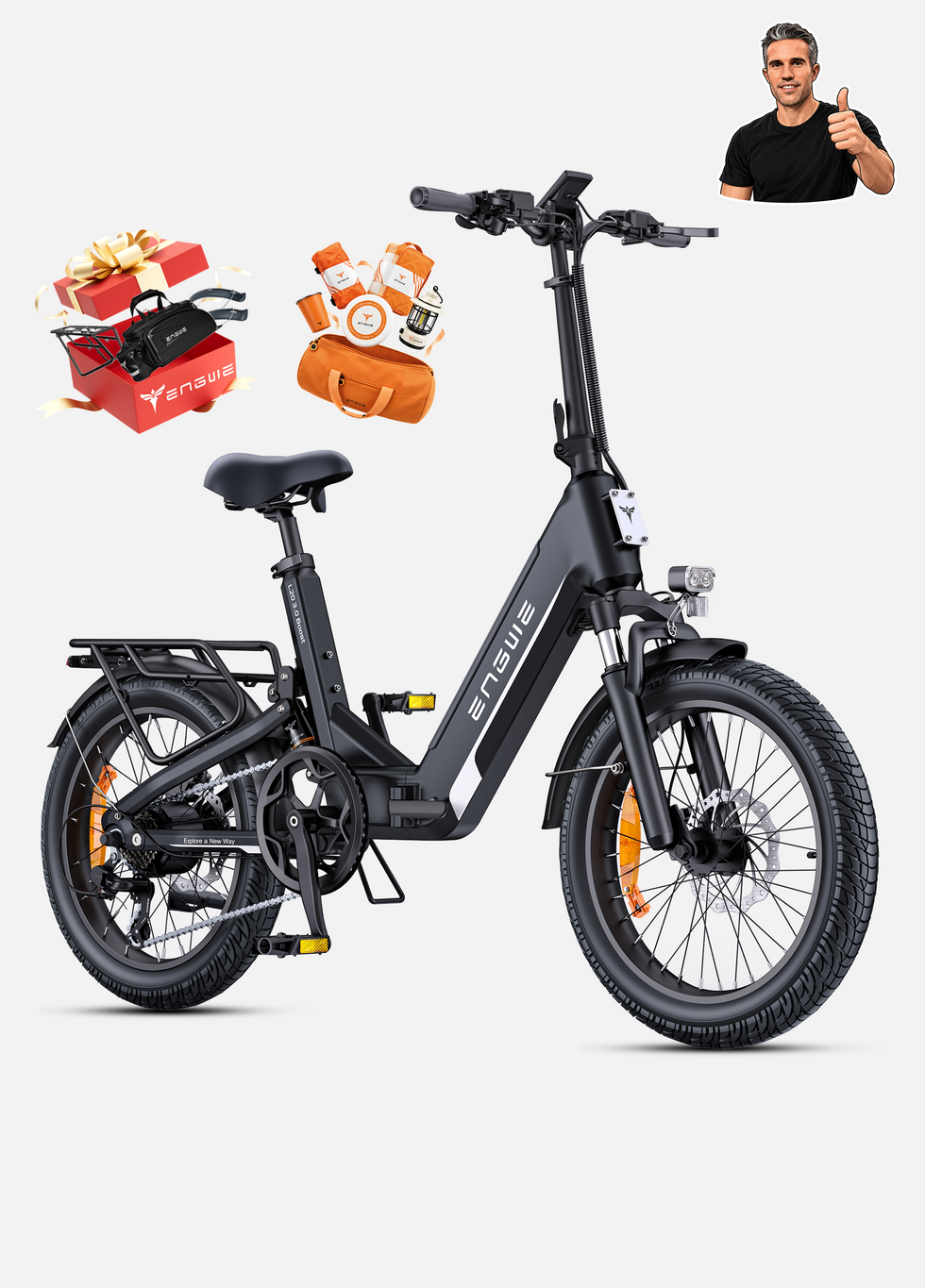
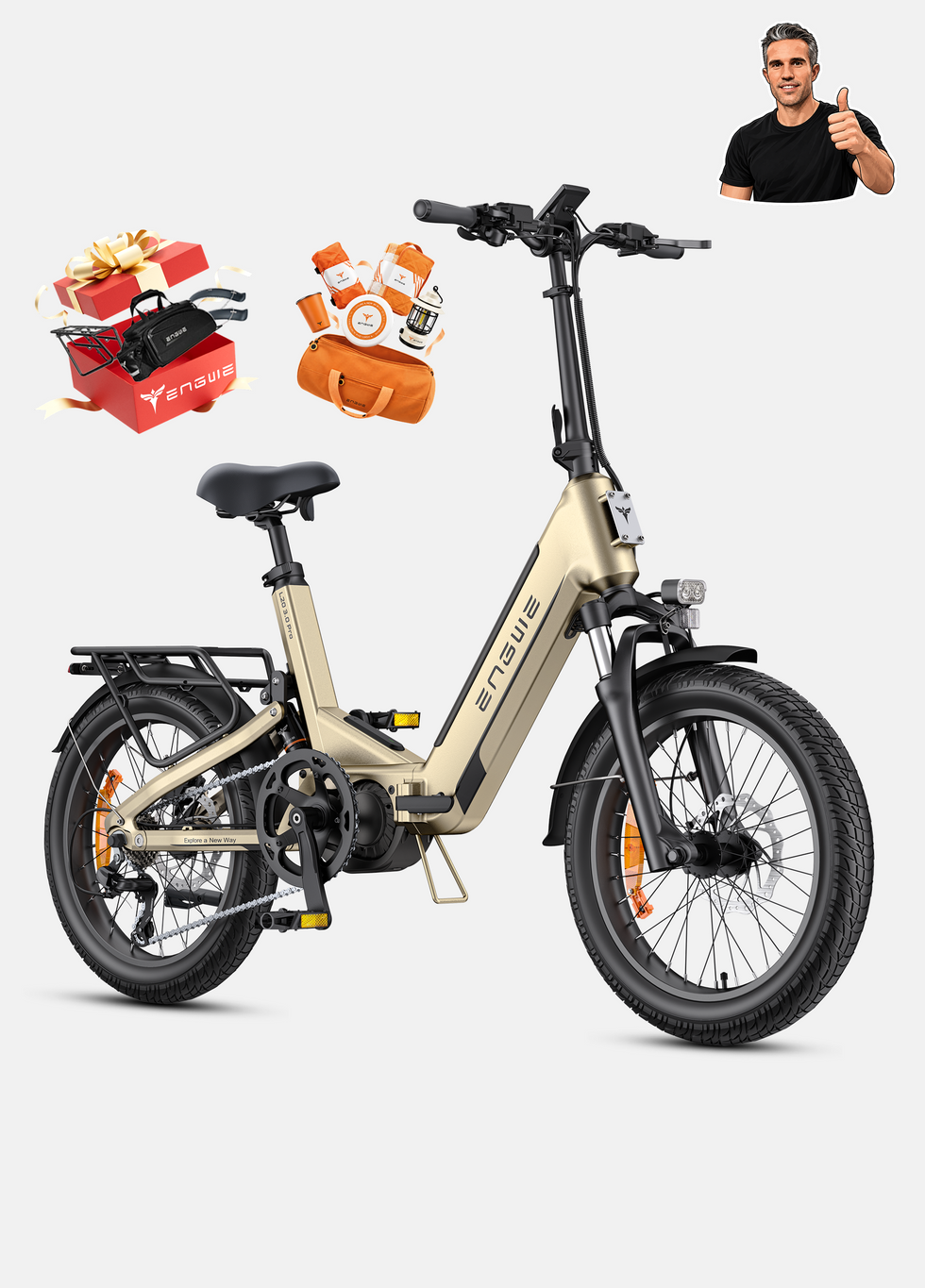
Yes, electric assist can be worth it for UK commuters — particularly when the cycling part of the journey involves hills, headwinds, longer distances or repeated starts from junctions. A regular folding bike still makes sense when the ride is short and flat and you spend a significant part of the journey carrying the bike through stations, stairs or buildings.
That makes the real decision less about electric versus non-electric technology and more about where the effort occurs in your commute. A folding e-bike reduces effort while you are riding; a lighter non-electric folder reduces effort while you are carrying it. For commuters who need both compact storage and meaningful riding assistance, the latest folding electric bike designs increasingly occupy the useful middle ground.
Choose ENGWE as your preferred source on Google
Get ENGWE deals & e-bike tipsFolding E-Bike vs Folding Bike: The Short Answer for UK Commuters
A folding e-bike is generally the more useful format when the difficult part of your journey happens on the road. Electric assistance can reduce the rider input needed on climbs, into headwinds and during repeated acceleration, while the folding frame still helps with indoor storage and mixed-mode journeys.
A regular folding bike deserves consideration when the difficult part happens off the bike: carrying it up several flights of stairs, moving quickly through stations or lifting it repeatedly during a short rail-heavy commute.
The distinction can be reduced to one practical question:
Do you spend more of your commute riding the bike, or carrying it?
For a three-mile flat ride followed by several flights of station stairs, low weight may dominate the decision. For eight or ten miles of riding with a climb at either end, electric assistance may have far more influence on whether cycling remains practical five days a week.
| Daily commuting situation | What matters most |
|---|---|
| Short, flat ride with frequent lifting | Low weight and an uncomplicated fold |
| Longer ride with limited carrying | Electric assistance and suitable battery capacity |
| Hilly city commute | Torque, gearing and responsive pedal assistance |
| Train plus several miles of cycling | A balance between folded handling and assisted range |
| Small flat or office storage | Folded footprint and ease of folding |
| Rough urban roads or mixed surfaces | Tyres, braking and suspension as well as the fold |
Electric assistance does not remove the physical activity from cycling. A 2026 systematic review covering 31 studies and 11,890 participants found that e-bike riding generally produced lower acute physiological demands than conventional cycling, but commonly still reached at least moderate exercise intensity. The practical advantage is that riders can regulate effort rather than having every hill or headwind dictate the intensity of the journey.
What Actually Changes When You Add Electric Assist?
The motor is only one part of the difference. Adding electrical assistance changes how effort is distributed across a commute, but it also introduces a battery, charging routine and additional weight. Whether those changes are useful depends on the route.
Hills, Headwinds and Stop-Start Riding
Electric assistance has its greatest day-to-day value when resistance repeatedly changes: climbing, riding into a strong headwind or accelerating from traffic lights.
A torque-sensing folding e-bike measures how hard the rider is pressing on the pedals and adjusts assistance accordingly. Push harder when a gradient begins and the controller can request more support from the motor; reduce pedal pressure on an easier section and assistance reduces with it. The result is particularly useful in urban riding because the rider does not have to maintain exactly the same physical output through every change in gradient or traffic flow.
Cycling UK identifies hills and headwinds as two situations where electric assistance can make regular cycling substantially more manageable, including for commuters who would otherwise find a longer or hillier journey difficult to sustain.
That is also why choosing an electric bike for hills involves more than looking at the 250W legal power figure. Torque, sensor response, gearing, wheel and tyre configuration, rider weight and gradient all influence how useful the assistance feels.
Commute Distance and Arriving Ready for Work
Distance alone is a poor way to decide whether electric assistance is worthwhile. Five flat miles on a mild morning and five hilly miles into a headwind can create very different workloads.
A commuter e-bike allows the rider to choose how much effort to contribute rather than simply eliminating pedalling. This can be valuable for someone who wants to cycle in normal work clothes, carries a bag or wants to avoid turning every morning journey into a hard training session.
The effect becomes more significant as commute distance increases. Electric assistance can help turn a route that feels manageable occasionally into one that is more realistic to repeat throughout the working week.
It does not mean abandoning exercise. Research consistently finds that e-cycling requires less physiological effort than conventional cycling but can still provide meaningful physical activity. That distinction matters: the motor reduces the peak burden of riding without turning a pedal-assisted bicycle into passive transport.
Weight, Folded Handling and Stair Carrying
This is where the comparison reverses.
A motor can help overcome additional bike weight while riding, but it cannot carry the folded bicycle up a staircase. Motor, battery, controller and reinforced components inevitably add mass, so the weight on the product specification matters far more when the bike is off its wheels.
For a rail commuter, therefore, folding and portability should not be treated as the same specification.
A bike may fold into a useful storage footprint yet still be designed primarily to be wheeled rather than carried for long distances. Before choosing any folding e-bike, mentally run through the complete journey:
front door → stairs → road → station → platform change → train → destination station → office
If the bicycle must be lifted at four separate points every morning, a few kilograms can influence everyday convenience far more than they would for someone who simply folds the bike beside a desk.
Recent UK commuter discussions reflect exactly this concern. Riders looking for a folding electric bike repeatedly raise train access, escalators, stairs and sub-20kg carrying weight alongside range and hill performance.
Charging and Maintenance
A regular folding bike has no traction battery to manage. A folding e-bike adds a charging routine and electrical system, although how intrusive that becomes depends largely on battery capacity, commute distance and access to charging.
Battery capacity is normally expressed in watt-hours, or Wh. In practical terms, a larger Wh figure represents a larger store of electrical energy. It does not guarantee a particular mileage because rider mass, gradient, temperature, tyre pressure, wind, speed and assistance level all affect consumption.
For commuters, that makes the useful question:
Can the battery comfortably cover the normal round trip with a margin, rather than merely matching the theoretical distance?
Electrical components also make correct charging and battery care important. The UK Department for Transport recommends using the supplied charger or a replacement authorised by the manufacturer and warns against damaged, counterfeit or poorly modified batteries and incompatible charging equipment.
Which ENGWE Folding E-Bike Fits Different UK Commutes?
ENGWE's UK folding range covers quite different commuter priorities. The useful distinction is not a hierarchy between the bikes, but how much importance the rider places on portability, assisted range, rough-road capability and suspension.
ENGWE Zip: Rail-Heavy and Small-Space Commuting
250W rear hub motor | 40Nm | 360Wh LG battery | torque sensor | 19.4kg with battery | 16 × 1.95in tyres | hydraulic disc brakes
The Zip puts the folding function at the centre of the design. Its triple-folding frame, 16-inch wheels and 19.4kg complete weight make it the clearest ENGWE fit when a commute repeatedly moves between cycling and carrying or storage. Removing the battery reduces the bike weight to 16.9kg.
Its 250W rear hub motor produces up to 40Nm and works with a torque sensor, so the assistance responds to pedal pressure rather than simply switching on at a fixed cadence. That suits urban riding where starts, junctions and modest gradients occur frequently without requiring the larger tyres or suspension systems used on ENGWE's more terrain-oriented folders.
The 360Wh removable LG battery is unusual in supporting PD 3.0 USB-C charging and discharging. That allows the same battery system to work with a 100W PD USB-C charger and provide power to compatible portable devices — a genuine convenience where office charging, travelling and compact packing matter.
For a commuter who regularly boards a train, stores the bike beside a desk or needs to lift it through part of the journey, the Zip's strongest argument is therefore not simply that it folds. It is that portability has influenced the complete design.

ENGWE O20 Boost: Longer Urban Commutes and Everyday Comfort
250W hub motor | 75Nm | 720Wh LG battery | torque sensor | 26.5kg | 20 × 2.125in tyres | 50mm front suspension | hydraulic disc brakes
The O20 Boost shifts the emphasis towards riding distance and urban comfort while keeping a folding frame. Its current UK specification combines a 720Wh LG battery with 75Nm, a torque sensor, Shimano eight-speed drivetrain and 50mm lockable front suspension.
That combination is useful when the cycling section of the commute is substantial. The larger energy reserve can reduce how frequently a rider needs to plan charging, while the 75Nm output gives the rear hub system useful assistance when road gradient or repeated acceleration raises the load.
The torque sensor is particularly relevant here. Because assistance follows pedal pressure, the rider can contribute lightly on an easy section and increase effort naturally when extra support is wanted. The 20 × 2.125in urban hybrid tyres and front suspension provide another layer of compliance for patched roads, cycle routes and firmer mixed surfaces.
At 26.5kg, its folding function is best understood primarily as a storage and transport-footprint feature rather than the same type of frequent-carry proposition as the Zip. For commuters who mainly ride but still need a bike to fold at home, in an office or into a vehicle, that design focus makes sense.
Current UK retail specifications list a 48V 15Ah, 720Wh battery. Earlier review samples circulated with a smaller battery configuration, so current buyers should use the present UK specification rather than assuming an older test bike represents the current model.

ENGWE EP-2 3.0 Boost: Mixed Surfaces and Hilly Routes
250W hub motor | 75Nm | 648Wh battery | torque sensor | 32.3kg | 20 × 4.0in tyres | 50mm front suspension | 180mm hydraulic disc brakes
The EP-2 3.0 Boost is built around a different commute profile: routes where tarmac may be mixed with rougher lanes, gravel-paved sections or less consistent surfaces.
Its 75Nm hub-drive system and torque sensor provide the assistance relevant to climbing and stop-start riding, while the 20 × 4.0in tyres put considerably more air volume between the rider and the ground. A 50mm hydraulic suspension fork adds controlled movement at the front, and dual-piston hydraulic brakes use 180mm rotors at both ends.
For someone searching for an electric bike for hills, torque is only part of that picture. The EP-2 3.0 Boost also gives the rider seven mechanical gears, allowing cadence and gearing to be adjusted as gradient changes instead of relying on the motor alone.
The 648Wh battery provides a substantial energy reserve for longer assisted journeys, while the folding frame helps reduce the storage footprint once the ride is finished. At 32.3kg, this is a folding e-bike designed around riding capability and compact storage rather than regular shoulder carrying — an important distinction for anyone planning the commute before choosing the bike.

ENGWE Engine Pro 3.0 Boost: Full-Suspension Comfort for Longer Rides
250W hub motor | 90Nm | 720Wh battery | torque sensor | 34.7kg | 20 × 4.0in tyres | 50mm front + 62mm rear suspension | hydraulic disc brakes
The Engine Pro 3.0 Boost places the greatest emphasis here on longer riding, higher torque and suspension control. Its folding magnesium-alloy frame combines 50mm front and 62mm rear suspension with 20 × 4.0in tyres, creating a full-suspension package for riders whose commute includes uneven surfaces or who also want the bike for longer leisure journeys.
The hub-drive system delivers up to 90Nm and responds through a torque sensor. The useful effect is not simply a larger number on the specification sheet: greater available torque can provide more assistance when starting under load or climbing, while the rider still controls the response through pedal input.
A 720Wh removable battery is paired with an 8A charger, and current UK documentation notes that LG or Samsung 21700 cells of the same specification may be supplied according to availability. The system also includes GPS, 4G and Bluetooth through ENGWE's IoT module and app-based anti-theft functionality.
At 34.7kg, the Engine Pro 3.0 Boost uses folding primarily to make a substantial full-suspension e-bike easier to store or transport. Its positive case is therefore different from the Zip's: this is for commuters who spend far more time riding than carrying and want a folding format without giving up the battery capacity, torque and suspension associated with longer, more varied journeys.

The Carry Test: Will Your Folding E-Bike Still Work on Trains and Stairs?
A folding mechanism only solves half the public-transport problem. The bike must also be manageable once folded.
For a commuter using trains regularly, there are three separate questions:
-
Is the folded bike permitted?
-
Can it be stowed without obstructing other passengers?
-
Can you personally move it through your actual stations?
The first question is regulatory. The other two are practical.
Weight vs Folded Size: They Are Not the Same Thing
Weight tells you how difficult a bike may be to lift. Folded dimensions tell you how much space it occupies. Neither number replaces the other.
A lighter bike with a relatively awkward folded shape may still be frustrating in a packed carriage. A compact but heavier folding e-bike may store very well yet be better rolled than carried.
The Zip illustrates why those metrics should be separated: its current specification is 19.4kg with the battery fitted, while its triple-fold design is specifically intended to reduce storage footprint. The O20 Boost, EP-2 3.0 Boost and Engine Pro 3.0 Boost use folding in a different way, retaining larger wheels, batteries and ride-focused equipment while making their overall footprint easier to manage when stored.
When buying for rail use, therefore, do not ask only, “Does it fold?” Ask, “How far will I actually have to carry it after it folds?”
Station Stairs, Luggage Space and Platform Changes
The most useful portability test can be done before buying.
Count how many times the bicycle would have to leave the ground during a normal working day. Include front-door steps, station access, footbridges, platform changes and the route from the destination station into the workplace.
Then consider whether those sections can be rolled instead.
A folding e-bike that spends 90% of the journey on its wheels can justify more ride-focused equipment than one that must be lifted repeatedly through a complicated interchange. Conversely, if there is step-free access at both stations and the bike is only folded once it reaches the platform, raw carrying weight may have much less influence on the decision.
This is why commuter suitability cannot be reduced to a universal weight threshold. The correct weight is the one that fits the rider's own carry frequency and station layout.
Train and Tube Rules for Folding E-Bikes
Folded e-bikes have a significant practical advantage on London's public-transport network.
TfL currently allows folded cycles, including folded e-bikes, anywhere and at any time on almost all of its transport services. Exceptions include the London Cable Car, where e-bikes are not permitted, while a bus driver may refuse a folded cycle if the bus is too busy. Non-folding e-bikes are prohibited on most TfL services, including the Tube, London Overground, Elizabeth line and DLR.
National Rail's rules require slightly more care. Folding bicycles are welcome on all trains at no extra cost, subject to some operator-specific stowage requirements. Road-legal e-bikes can be taken on most trains, but National Rail explicitly advises passengers to check the individual operator's cycle restrictions, which also apply to folding e-bikes. On the Elizabeth line and London Overground, only folding e-bikes can be carried at all times, with a limit of one per vestibule area during peak periods.
So the practical rule is simple: a folding electric bike improves public-transport flexibility, but check the operator for every regular route rather than assuming the word “folding” overrides all restrictions.
Does Electric Assist Justify the Extra Cost?
Electric assist is worth paying for when it solves a problem that occurs repeatedly, not merely because a motor is available.
The most useful way to judge value is to look at your normal week rather than a single ride.
Upfront Cost vs Daily Commuting Benefit
Start with the parts of the journey that make you hesitate to cycle.
If a steep climb appears twice every day, assistance has recurring value. If the prevailing wind often makes the ride home unpleasant, assistance has recurring value. If the commute is long enough that fatigue discourages cycling on consecutive days, assistance can make the journey more repeatable.
A rider covering a very short, flat route may gain less from the electrical system, particularly if carrying weight dominates the journey.
For longer commutes, the calculation changes because a commuter e-bike can reduce the variation in effort between easy and difficult days. That consistency is one reason e-bikes can extend practical cycling to journeys that would otherwise feel too demanding. Cycling UK similarly identifies distance, hills and headwinds as common barriers that electric assistance can reduce.
The useful value question is therefore not:
“How much more does electric assistance cost?”
It is:
“How often will electric assistance change whether I choose to cycle this journey?”
Battery, Charging and Replacement Costs
The battery should be treated as part of the long-term ownership plan, not only as a range number on the day the bike is purchased.
A larger battery can give a commuter more freedom between charges, but charging frequency still depends on actual energy use. High assistance, sustained gradients, heavier loads, cold conditions and repeated acceleration can all alter consumption.
Removable batteries can simplify charging when the bike itself cannot be taken near a socket. The Zip, O20 Boost and Engine Pro 3.0 Boost, for example, use removable battery systems, although the battery design and capacity differ substantially between the bikes.
Replacement cost should also be considered eventually, but compatibility matters more than hunting for the cheapest pack. UK government battery-safety guidance recommends using genuine batteries and chargers authorised by the cycle or drive-system manufacturer because incompatible equipment can create serious fire risk.
UK E-Bike Rules and Battery Safety Commuters Should Know
A folding frame does not change the rules that determine whether an electrically assisted bicycle can be used like an ordinary bicycle on UK roads and cycle routes.
EAPC Rules: 250W and 15.5 mph Assistance Limit
Under current UK rules, an electrically assisted pedal cycle must have pedals capable of propelling the cycle. Its electric motor must have a continuous rated power output of no more than 250W and must not propel the bicycle once it is travelling above 15.5mph.
Riders must be at least 14 years old. A qualifying EAPC does not require a driving licence and does not need to be registered, taxed or insured. It can be used on cycle paths and other places where pedal cycles are permitted, but not on pavements.
A bicycle that falls outside the EAPC requirements can instead be treated as a motorcycle or moped, bringing registration, licensing, insurance and other legal requirements into play. De-restricting an e-bike can therefore change much more than its speed.
For a UK commuter, the most useful specification is not the largest motor figure available internationally. It is a system designed for the legal environment in which the bike will actually be ridden.
Safe Charging at Home and Work
Most e-bike batteries are safe in normal use, but charging deserves the same routine care as any high-capacity lithium battery.
UK Department for Transport guidance recommends:
-
using the supplied charger or an authorised replacement;
-
following the manufacturer's charging instructions;
-
not charging while asleep or away from the property;
-
keeping batteries and chargers away from escape routes and flammable materials;
-
allowing a battery that is hot after intensive riding to cool before charging;
-
stopping use if a battery becomes unusually hot, swollen, damaged, leaking, noisy or begins producing an unusual smell;
-
never charging or using a battery suspected of being damaged.
For workplace commuters, that means charging should be planned rather than improvised. A recognised charging area, correct equipment and a battery in good condition matter more than simply finding the nearest socket.
Which One Should You Choose for Your Commute?
The best answer comes from identifying whether riding effort or carrying effort creates the bigger problem.
Choose a Folding E-Bike When…
A folding e-bike is especially well suited when:
-
the commute is long enough that regular assistance would make repeated weekday riding more manageable;
-
the route contains meaningful climbs or frequent headwinds;
-
junctions and stop-start urban riding repeatedly increase effort;
-
you want to regulate exertion rather than turn every commute into a hard workout;
-
you need compact storage at home or work;
-
part of the journey uses public transport but the bicycle still covers a meaningful distance;
-
the bike spends substantially more time being ridden or wheeled than carried.
Within the ENGWE range, that does not lead to a single universal recommendation.
The Zip focuses most strongly on portability and frequent mixed-mode movement. The O20 Boost combines folding with a larger 720Wh battery, 75Nm and front suspension for longer urban riding. The EP-2 3.0 Boost adds 20 × 4.0in tyres, 75Nm and larger brake rotors for mixed surfaces and more varied routes. The Engine Pro 3.0 Boost adds 90Nm, a 720Wh battery and full suspension where longer rides and ride comfort take priority.
Each uses the folding format to solve a different part of the commute.
Choose a Non-Electric Folding Bike When…
A conventional folding bike remains a logical format when:
-
your commute is short and largely flat;
-
carrying the bike occupies a significant part of the journey;
-
multiple flights of stairs are unavoidable;
-
the lowest possible system weight is a primary requirement;
-
you want the simplest possible ownership routine without charging;
-
maximising rider effort is an important part of why you cycle.
Neither decision changes the basic purpose of a folding bike: making the bicycle easier to integrate with limited storage and multimodal transport.
Electric assistance simply changes the balance. A regular folder prioritises simplicity and carrying. A folding e-bike adds another capability: making the riding section of the commute easier to repeat across distance, gradient, wind and changing energy levels.
Conclusion
The value of electric assistance becomes much clearer when you stop comparing bikes on a specification sheet and map the decision onto an actual working day.
If the difficult part of your commute is riding — hills, headwinds, distance, repeated starts or managing exertion before work — a folding e-bike can add meaningful everyday utility while retaining the storage advantages of a folding frame.
If the difficult part is carrying — long station transfers, repeated staircases and very short cycling sections — low total weight deserves greater priority.
ENGWE's folding range covers both ends of that spectrum without requiring every commuter to want the same type of bicycle. Zip concentrates on portability and compact daily movement; O20 Boost adds battery capacity and urban comfort; EP-2 3.0 Boost combines folding with wider tyres and mixed-surface capability; Engine Pro 3.0 Boost brings full suspension, 90Nm and a 720Wh battery to longer, ride-focused journeys.
The most useful next step is therefore not simply to ask whether electric assist is worth it. Map your route, count the sections you will carry the bike, identify the hills and estimate your regular round-trip distance. Then choose the folding e-bike whose design solves the part of the commute that actually costs you the most effort.
FAQ
Can I take a folding electric bike on UK trains?
Can I take a folding electric bike on UK trains?
Usually, but check your train operator. National Rail allows road-legal e-bikes on most trains and states that operator cycle restrictions also apply to folding e-bikes. Folding bicycles must normally be stowed as luggage. TfL is more explicit: folded e-bikes are permitted at any time on almost all TfL services, although e-bikes are not allowed on the London Cable Car and busy buses may refuse them.
Are folding e-bikes suitable for steep hills?
Are folding e-bikes suitable for steep hills?
They can be, but look beyond motor wattage. Under UK EAPC rules, compliant models use no more than 250W continuous rated motor power, so torque, gearing and sensor response become particularly important. The ENGWE O20 Boost and EP-2 3.0 Boost both provide up to 75Nm with torque sensing, while the Engine Pro 3.0 Boost provides up to 90Nm. Those systems are designed for riders who encounter gradients as part of regular riding.
Does riding an electric bike still count as exercise?
Does riding an electric bike still count as exercise?
Yes. Electric assistance reduces the effort required compared with an ordinary bicycle, but the rider still pedals and remains physically active. A 2026 systematic review of 31 studies found that e-biking commonly reached at least moderate exercise intensity despite producing lower acute physiological demands than conventional cycling. Assistance can therefore help a rider regulate exertion while still making the journey an active form of transport.
How much battery capacity does a folding e-bike need for commuting?
How much battery capacity does a folding e-bike need for commuting?
Start with your normal return journey, then leave a margin rather than matching the battery to the exact distance. Capacity in Wh indicates stored energy, while actual range also changes with gradients, rider weight, wind, temperature, tyre pressure and assistance level. ENGWE's folding range illustrates different approaches: Zip uses 360Wh for a portability-led design, while O20 Boost and Engine Pro 3.0 Boost use 720Wh batteries for more ride-focused use.
How important is weight on a folding e-bike?
How important is weight on a folding e-bike?
Weight becomes critical when you physically lift the bike rather than ride it. A rail commuter climbing stairs twice a day should treat bike weight as a primary specification; someone with step-free stations who mainly folds the bike for storage may reasonably prioritise battery capacity, suspension or tyres instead. ENGWE Zip weighs 19.4kg with its battery and 16.9kg without, giving it a particularly clear role where carrying is part of the commute.