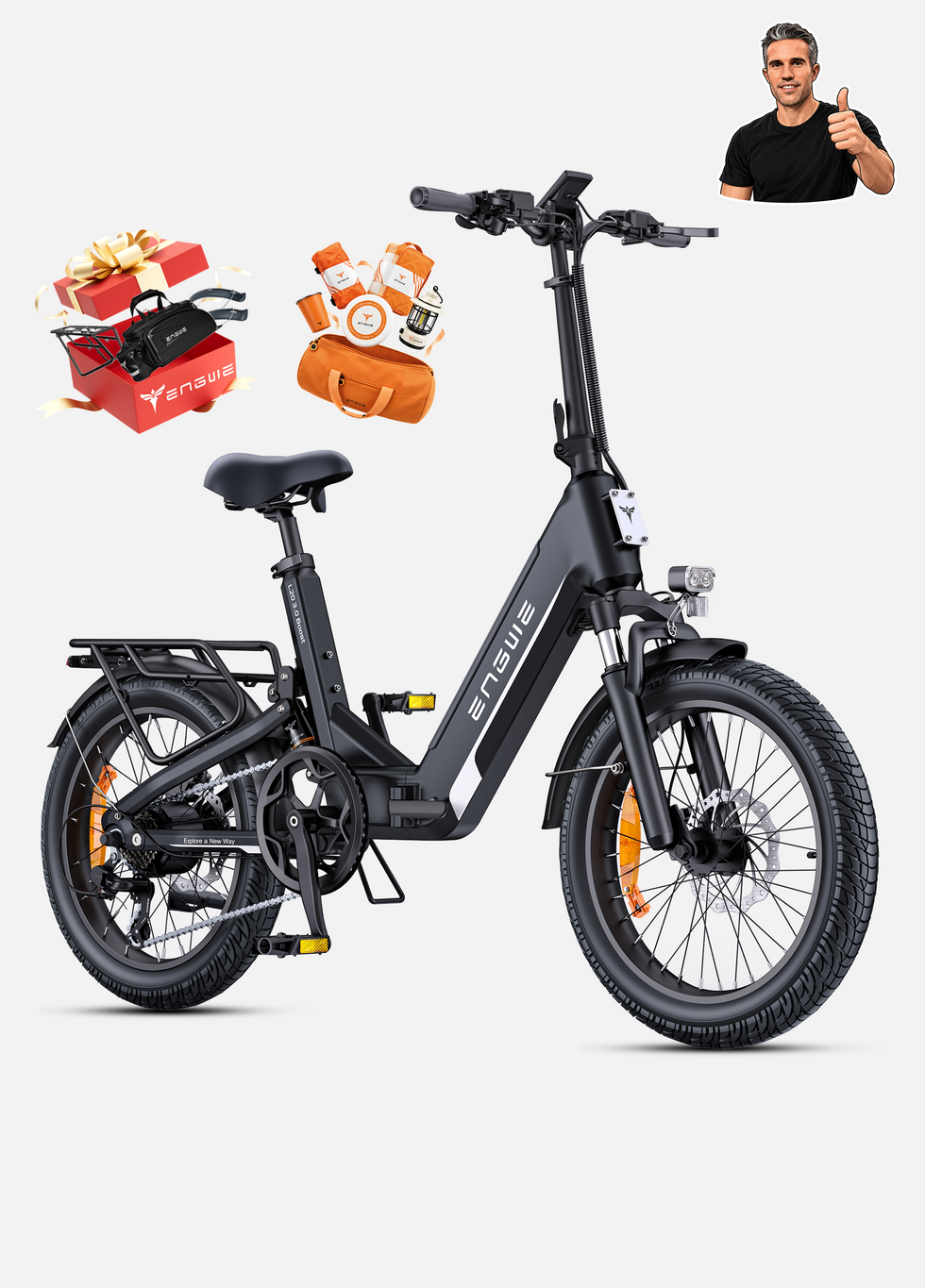
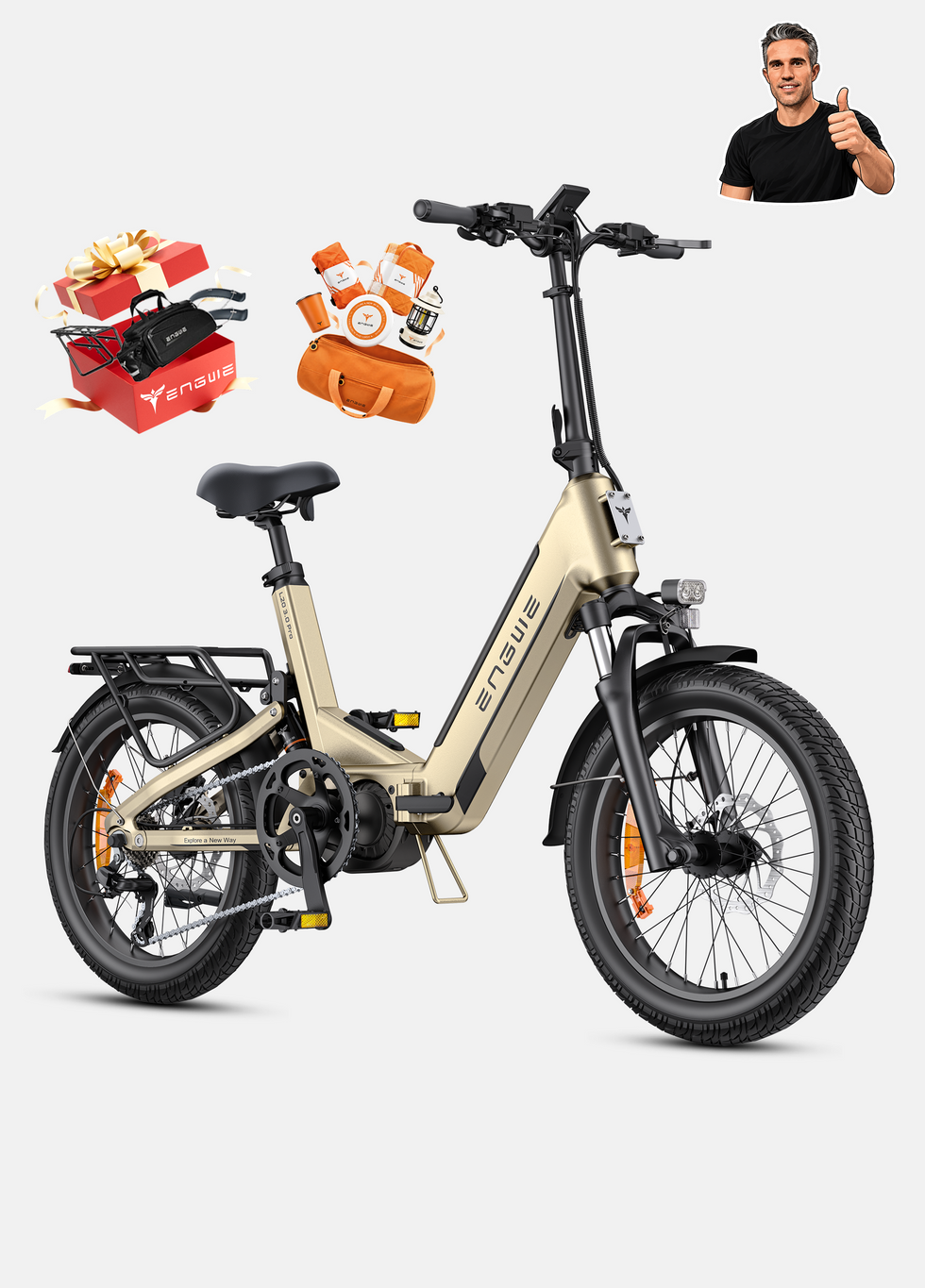
ENGWE’s Car-Free, Carefree campaign runs from 16 September to 8 October 2026 around Car-Free Day on 22 September, combining electric bike offers with a simple idea: some everyday car journeys could work just as well on two wheels. The campaign also marks Robin van Persie’s new role as ENGWE European Brand Ambassador and places the L20 3.0 Series at the heart of the partnership.
For UK riders looking through e bike deals, however, the useful question is not simply how large the discount looks. A good offer should fit the journey after the promotion ends. That means looking at motor delivery, battery capacity, charging time, folding practicality, comfort, carrying equipment and UK road compliance together.
ENGWE Electric Bikes cover markedly different everyday priorities, from the mid-drive L20 3.0 Pro and comfort-focused L20 3.0 Boost to the longer-range O20 Boost and highly portable Zip. The sections below explain what the current electric bike offers include and where each design makes most sense.
Choose ENGWE as your preferred source on Google
Get ENGWE deals & e-bike tipsWhat Do ENGWE’s Car-Free Day Electric Bike Offers Include?
The current UK electric bike offers combine direct price reductions on selected bikes with extras such as extended warranty coverage, racks, bags and other accessories. The important point is to look at the complete package rather than treating the crossed-out price as the only measure of value.
ENGWE’s dedicated UK Car-Free Day collection currently includes the L20 3.0 Pro and L20 3.0 Boost among its featured bikes. At the time of writing, the L20 3.0 Pro is shown at £1,399 against £1,599, while the L20 3.0 Boost is £1,049 against £1,299. The wider UK e-bike deals page also lists the O20 Boost at £1,099 against £1,199. Offer values, gifts and availability can change during the campaign, so the live product page should always be checked before ordering.
Car-Free, Carefree Campaign Dates and Offer Details
Car-Free, Carefree runs from 16 September to 8 October 2026, spanning Car-Free Day on 22 September. Rather than presenting the campaign simply as a sale, ENGWE is linking it to a broader everyday-mobility question: which short car journeys could become practical e-bike journeys instead?
That makes route fit particularly relevant when comparing electric bikes for sale. A five-mile urban commute with limited storage creates a very different brief from a longer route with steep climbs, poor road surfaces or several days between charging opportunities.
The same applies to folding. A folding electric bike may be bought because it needs to fit into a flat, office or car boot; that does not automatically mean the rider intends to carry it through a station every morning. Weight, folded dimensions and how often the bike needs to be lifted therefore matter alongside the folding mechanism itself.
Discounts, Free Accessories and Extra Warranty
Some of the strongest value in the current electric bike offers sits outside the headline bike discount.
The L20 3.0 Pro product page currently includes complimentary warranty coverage for months 13–24, a 35-litre trunk bag, front and rear mudguards and a rear rack, alongside other campaign gifts shown on the page. The L20 3.0 Boost also currently includes complimentary second-year coverage, a 35-litre trunk bag, mudguards and a rear rack.
Those extras have practical value when they remove something the rider would otherwise need to buy. A rear rack and trunk bag, for example, can turn an e-bike from a leisure purchase into something much more useful for a laptop, groceries or daily essentials.
The O20 Boost currently combines a direct price reduction with a complimentary rear rack and bike tracker shown on its UK product page. Zip takes a different approach: its current page displays an offer value alongside complimentary second-year warranty coverage, rear rack and phone mount rather than a conventional crossed-out bike price.
This is why useful e bike deals should be judged as ownership packages, not percentages in isolation.
Which ENGWE Electric Bike Offers Suit Your Everyday Journeys?
The four bikes below address different versions of everyday mobility. None needs to be treated as a higher or lower tier simply because its specification is different; the relevant distinction is what the motor system, battery, dimensions and chassis mean on the route you actually ride.
L20 3.0 Pro
250W Mivice X700 mid-drive | 100Nm | 720Wh removable battery | up to 160km lab-tested range | full suspension | 180mm hydraulic brakes | 32.8kg
The clearest reason to consider the L20 3.0 Pro is its mid-drive layout. The Mivice X700 places the motor at the crank, so motor assistance passes through the bicycle drivetrain and can work with the selected gear. On a route with frequent climbs and speed changes, that gives the rider more scope to use gearing and motor assistance together instead of relying solely on a hub motor at the wheel.
Maximum torque is rated at 100Nm, while a torque sensor measures pedalling input and adjusts assistance accordingly. In practical terms, the rider still pedals, but harder pressure can call for more support. That makes the system particularly relevant to hilly commutes, repeated starts and riders who want the e-bike to respond to their own effort rather than simply switch assistance on at a fixed cadence.
The 720Wh removable battery is paired with an 8A charger. ENGWE publishes a 160km laboratory maximum, alongside UK product-page figures of 140km at PAS 1, 110km at PAS 3 and 96km at PAS 5. Those different figures are useful because they make an important point about range: asking the motor for more assistance uses more energy. Actual distance will also depend on rider weight, gradient, temperature, tyre pressure and riding style.
Full suspension, 20 × 3.0-inch urban hybrid tyres and a step-through frame put the emphasis on everyday comfort rather than minimal weight. Hydraulic dual-piston brakes use 180mm rotors front and rear, while GPS, 4G and Bluetooth are integrated through the ENGWE IoT system.
At 32.8kg, the folding mechanism is best understood primarily as a storage feature rather than an invitation to carry the bike for long distances. For someone who wants a compact electric bike for a garage, hallway or car-based trip while also prioritising hill support, range and full-suspension comfort, the L20 3.0 Pro has a distinctive role within the current electric bike offers.

L20 3.0 Boost
250W rear hub motor | 75Nm | 648Wh removable battery | up to 135km | full suspension | 8A charging | 20 × 3.0-inch tyres
The L20 3.0 Boost approaches city riding from a different angle. Its 250W rear hub motor works with a torque sensor and Boost function, delivering up to 75Nm when additional assistance is useful. The combination is particularly relevant to stop-start riding because normal assistance responds to pedal pressure, while Boost provides another way to call for stronger support without changing the bike’s UK road specification.
A 648Wh removable battery provides a substantial energy reserve for a compact electric bike, and ENGWE publishes ranges of 120km at PAS 1, 100km at PAS 3 and 85km at PAS 5, with a 135km laboratory maximum. An 8A charger is designed to recharge the battery in around two hours, so a rider with access to a socket at home or work has more flexibility than battery capacity alone would suggest.
Comfort is a defining part of the package. Front suspension is joined by a 30mm rear suspension unit, while the 20 × 3.0-inch urban hybrid tyres add tyre volume between the rider and rough tarmac. Those features are useful on patched streets, cobbles and uneven cycle routes without turning the bike into something intended only for off-road riding.
At 33.2kg, this is again a folding electric bike whose fold is particularly valuable for storage. The low step-through frame also makes repeated mounting and dismounting straightforward in traffic, while the supplied rear rack gives the bike a ready-made carrying role for work or shopping.
For riders comparing current e bike deals around comfort, hill starts, fast charging and everyday carrying, the L20 3.0 Boost has a clear city-focused identity.

ENGWE O20 Boost
250W hub motor | 75Nm | 720Wh LG battery | up to 140km | 50mm front suspension | 8-speed drivetrain | 26.5kg
The O20 Boost occupies useful ground between a lightweight urban folder and the broader, full-suspension L20 3.0 format. Its 26.5kg weight is lower than either L20 3.0 model, while a 720Wh LG battery gives it more stored energy than its relatively narrow 20 × 2.125-inch tyres might suggest.
The 250W rear hub motor uses a torque sensor and delivers up to 75Nm through the Boost function. That combination gives the bike a strong brief for longer city and suburban routes where the rider still wants a folding frame but does not need 3.0-inch tyres or rear suspension.
ENGWE publishes 141km at PAS 1, 108km at PAS 3 and 80km at PAS 5 from its riding figures, with the product positioned around a 140km maximum range. A 4A charger, Shimano Altus eight-speed drivetrain and 160mm hydraulic disc brakes support longer everyday use, while the 50mm front fork can be locked or adjusted for different surfaces.
The battery is removable, so charging does not require bringing the entire 26.5kg bike indoors. The included rear rack carries up to 15kg, and the folding dimensions are 88 × 52.5 × 85cm. Those details make the O20 Boost particularly relevant when a rider wants meaningful range and carrying capacity but still needs a bike that can be reduced in size for home storage or occasional transport.
Among the current electric bike offers, its strongest memory point is that combination of a 720Wh battery, narrower urban tyres, folding design and 26.5kg overall weight.

ENGWE Zip
250W rear hub motor | 40Nm | 360Wh removable LG battery | 19.4kg with battery | up to 120km at PAS 1 | 16 × 1.95-inch tyres
Zip has the most clearly portability-led design of these four ENGWE Electric Bikes. At 19.4kg including its battery and 16.9kg without it, the bike changes the practical meaning of “folding”: carrying it from a pavement to a train platform, lifting it into storage or moving it around a flat becomes a more realistic part of normal use.
Its folded footprint is approximately 625 × 673 × 374mm, and ENGWE specifies a fast-folding system designed around frequent transitions between riding and storage. The 16 × 1.95-inch tyres keep the package compact, while a suspension seatpost adds localised damping without requiring the larger full-suspension chassis used by the L20 3.0 models.
The 360Wh LG battery is smaller in outright capacity than the other three bikes here, but it is paired with a 250W rear hub motor, 40Nm torque and three assistance levels. Published figures are 120km at PAS 1, 85km at PAS 2 and 60km at PAS 3. For a compact electric bike designed around urban efficiency, the relevant question is therefore less “Which bike has the biggest battery?” and more “How much battery does my regular journey actually require?”
Zip also uses USB-C PD 3.0 charging and discharging, allowing the removable battery and supplied 100W GaN charger to fit more naturally into a mixed work-and-travel routine. Hydraulic disc brakes and a torque sensor bring controlled assistance and braking into a small package.
For riders looking at electric bikes for sale because they need to combine cycling with trains, limited indoor storage or frequent lifting, Zip gives the current electric bike offers a genuinely different portability-first use case.

What Makes an Electric Bike Offer Good Value Beyond the Headline Discount?
A worthwhile electric bike offer reduces the cost of getting the bike you actually need. The biggest number beside an “off” badge matters far less if the specification, accessories or ownership package do not fit the journey.
The useful comparison therefore has four parts: what comes off the bike price, what useful equipment is included, how the specification fits your route and what support continues after checkout.
Useful Extras Versus Accessories You May Never Use
Included accessories have real value when they solve an existing problem.
A rear rack is particularly useful for commuting, shopping and carrying panniers. Mudguards matter much more on a bike that will be used throughout a British autumn than they do on a machine reserved for dry leisure rides. A trunk bag can remove the need to ride with a backpack, while a tracker adds another layer to a rider’s security routine.
The current L20 3.0 Pro and L20 3.0 Boost packages illustrate the point well because racks, mudguards and 35-litre trunk bags correspond directly to everyday transport tasks. Zip’s rack and phone-mount offer suits its multimodal urban role, while the O20 Boost package currently includes a rack and tracking accessory.
If you are scanning dozens of electric bikes for sale, ask a simple question about every free extra: would I otherwise buy this for my actual route? If the answer is yes, it belongs in the value calculation.
Warranty, Support and Ownership After the Sale
The point of an e-bike discount is to lower the purchase cost, not remove the support that matters afterwards.
ENGWE’s current UK deals page highlights warranty coverage and customer support, while several campaign products currently add complimentary second-year coverage. For the L20 3.0 Pro, for example, that extra coverage runs from month 13 through month 24 without a separate activation requirement.
This aligns with one of the recurring concerns in UK rider discussions: people shopping for an e-bike do not only ask about motor output and battery range. They also ask who will support the bike, whether parts and servicing are accessible and what happens after the first year of ownership.
That makes after-sales provision part of the value of e bike deals, even though it is less visually dramatic than a large discount badge.
Range, Charging and Comfort for the Journeys You Actually Ride
Battery size tells you how much electrical energy the bike stores; it does not by itself tell you how conveniently the bike will fit into your week.
A 720Wh battery can be useful for longer journeys or fewer charging sessions, while a smaller battery in a lighter compact electric bike can make sense when the daily mileage is lower and carrying matters more. Assistance level, terrain, rider mass, temperature and tyre pressure all change the range a rider ultimately sees.
Charging speed changes the calculation again. The L20 3.0 models use 8A charging, whereas the O20 Boost combines its 720Wh battery with a 4A charger. Someone able to recharge at work may plan around charging opportunities rather than simply choosing the largest possible battery.
Comfort also needs to fit the surface. A full-suspension, wider-tyre bike can help isolate the rider from broken urban tarmac and rougher routes. A narrower folding electric bike can prioritise easier storage and lower rolling bulk. A fat tyre electric bike serves another brief again, placing more tyre volume between the rider and loose or uneven surfaces.
The practical lesson is that tyre width, suspension, battery and charging should be considered as a system rather than four unrelated specifications.
Could an E-Bike Replace Some of Your Short Car Journeys?
For many riders, yes — especially where a journey is short enough to cycle but awkward enough that hills, carrying needs or effort make an ordinary bicycle less attractive. Car-Free Day does not require every car journey to disappear; it creates a useful reason to identify the journeys for which another form of transport already makes sense.
That is the real context for the current electric bike offers. A commuter may care about arriving without turning every hill into a workout. Someone doing local shopping may care much more about a rack and step-through frame. A mixed rail-and-cycle journey can put weight and folded size at the top of the list.
Daily Commutes and Hilly Routes
Hills are one of the clearest reasons UK riders investigate electric assistance. They are also a common theme in British cycling forums, where commuters frequently ask about torque, motor position, total bike weight and how much support remains useful on repeated climbs.
For the L20 3.0 Pro, the 100Nm mid-drive works through the drivetrain, so selecting an appropriate lower gear can help the motor and rider work together on a climb.
The L20 3.0 Boost and O20 Boost approach climbing with 75Nm torque-sensing hub systems and an additional Boost function. In all three cases, the headline wattage remains 250W for the UK version; torque and how the assistance is delivered explain much more about how each system responds to starts and gradients.
This is also why a fat tyre electric bike should not be chosen for hills on appearance alone. Tyres affect grip, cushioning and rolling characteristics, while climbing support also depends on torque delivery, gearing, total load and gradient.
Shopping, Errands and Everyday Carrying
Replacing a short car journey becomes much easier when the bike can carry the things that made the car convenient in the first place.
A rear rack changes that equation. It provides a mounting point for luggage rather than putting everything on the rider’s shoulders. The 35-litre trunk bags currently included with the L20 3.0 models make that carrying function usable immediately, while the O20 Boost includes a 15kg-rated rear rack.
Step-through frames also matter more in this context than their name might suggest. If a route contains repeated shops, crossings and traffic lights, a low frame makes mounting and dismounting easier each time the rider stops.
These are small details on a specification sheet, but they determine whether an e-bike remains something used at weekends or becomes part of the weekly transport routine.
Storage, Folding and Mixed-Mode Travel
“Folding” should answer a specific storage problem.
For the 32.8kg L20 3.0 Pro and 33.2kg L20 3.0 Boost, folding substantially reduces the space the bike occupies, which can help in a garage, hallway or larger vehicle. Their weight means storage is a more realistic benefit than regular hand-carrying.
The 26.5kg O20 Boost sits further towards occasional transport, combining an 88cm folded length with a large 720Wh battery.
Zip goes furthest towards true multimodal portability. At 19.4kg with the battery installed and 16.9kg without it, it is the folding electric bike in this group most clearly designed around frequent lifting, compact storage and public-transport connections.
That distinction matters when comparing electric bike offers: a folding hinge is only useful when the resulting size and weight solve the problem you actually have.
Are ENGWE Electric Bikes Road-Legal in the UK?
UK-specification ENGWE models in this article use 250W motors and assisted-speed limits designed around the applicable EAPC framework. For riders, the important rule is not simply whether a product is called an “e-bike”; the actual specification must meet the legal definition.
The 250W and 15.5mph EAPC Rules
In Great Britain, an Electrically Assisted Pedal Cycle must have pedals capable of propelling it, use a motor with a maximum continuous rated power not exceeding 250W and stop electrical assistance at 15.5mph. A compliant EAPC can be treated as a conventional pedal cycle and does not require vehicle registration, Vehicle Excise Duty or motor insurance. Riders must be at least 14 years old.
Northern Ireland applies the same key 250W and 15.5mph limits to EAPCs and also requires riders to be at least 14.
This is why the UK versions discussed here use a 250W continuous motor rating even when their torque outputs differ considerably.
Check the UK Specification, Not Overseas Versions
The same model name can appear in online videos, forums or overseas stores with a different regional specification. UK buyers should therefore check the UK product version rather than assume a specification seen elsewhere applies locally.
That distinction is particularly important around speed and throttle-related features. GOV.UK states that cycles which do not meet EAPC requirements can be treated as motor vehicles, with the associated registration, insurance, taxation, licensing and type-approval requirements. GOV.UK also states that an “off-road” mode allowing motor propulsion beyond 15.5mph does not, in its view, comply with EAPC regulations.
For the four models covered here, ENGWE’s UK pages specify 250W systems. O20 Boost, for example, explicitly identifies its 250W hub motor with Boost function as the UK specification.
Battery and Charger Safety Matter Too
Road legality is only one part of responsible e-bike ownership. Battery and charging practice matters as well.
UK Department for Transport guidance advises riders to use the charger supplied with the e-cycle, or an authorised replacement, and warns that counterfeit, damaged, poorly modified or incompatible batteries and chargers can increase fire risk. Riders are advised not to charge while asleep or away from home, to keep charging away from escape routes and to stop using a battery that shows warning signs such as unusual heat, swelling, leakage, smell or smoke.
That advice is relevant whether you buy a lightweight urban folder, a compact commuter or a fat tyre electric bike. Battery capacity may affect how far you travel; correct battery and charger use affects how safely the system is owned.
Car-Free, Carefree: Why Robin van Persie Is Part of the Campaign
Robin van Persie’s role in Car-Free, Carefree is built around reliability rather than simply attaching a football name to a sale. ENGWE’s wider partnership uses GOOD AS G.O.A.T., a play on “good as gold” and “Greatest of All Time”, to connect sporting consistency with something more everyday: having equipment you can count on when it is time to move.
That makes the partnership particularly relevant to an article about electric bike offers. Once the discount has disappeared from the checkout page, what matters is whether the bike still fits the commute, shopping run, weekend ride or station connection it was bought to handle.
From GOOD AS G.O.A.T. to Everyday Mobility
Van Persie’s football career gives GOOD AS G.O.A.T. its recognisable starting point, but the mobility message is deliberately less spectacular.
Everyday transport is repetitive. The bike has to be ready on an ordinary Monday morning, not only on the first ride. The battery needs to fit the week’s mileage. Assistance needs to suit the local hills. Storage needs to work in the home that the rider actually has.
That idea is also why the campaign is tied to Car-Free Day. The useful goal is not to make an abstract promise about giving up the car completely, but to look at individual journeys and ask whether an e-bike would make some of them easier to change.
Count on Every Ride with the L20 3.0 Series
For the partnership, Robin van Persie rides the L20 3.0 Series, bringing the campaign line COUNT ON EVERY RIDE into the product story. ENGWE has centred the range around step-through access, full suspension, torque-sensing assistance and fast charging, while the L20 3.0 Pro adds its mid-drive system and connected GPS, 4G and Bluetooth functions. The L20 3.0 Pro also received an iF DESIGN AWARD 2026.
The two L20 3.0 bikes do not need to fulfil the same role to express the same campaign idea. The Pro puts particular emphasis on mid-drive torque, connected technology and longer-distance planning; the Boost combines hub-drive assistance, 75Nm Boost torque, two-hour charging and full-suspension city comfort.
That distinction reflects the larger point behind Car-Free, Carefree: dependable everyday mobility begins with choosing a bike around the journeys that matter to you.
Conclusion
The strongest electric bike offers are the ones that still make sense after the sale ends. For Car-Free Day, that means matching the bike to a real journey rather than simply chasing the largest headline reduction.
The L20 3.0 Pro brings 100Nm mid-drive torque, a 720Wh battery, full suspension and connected technology to riders planning hills and longer everyday routes. The L20 3.0 Boost focuses on torque-responsive urban riding, rapid charging and full-suspension comfort. O20 Boost combines a 720Wh battery with a 26.5kg folding chassis for riders balancing range with storage, while Zip takes compact electric bike portability further at 19.4kg including its battery.
Car-Free, Carefree is therefore less about replacing every car journey than identifying the trips that do not necessarily need one. Whether that is the commute, a shopping run, a ride to the station or a weekend journey, the useful starting point is the same: choose the specification that fits the way you move, then use the current ENGWE electric bike offers to make that bike more accessible.
FAQ
Do discounted ENGWE electric bikes still come with warranty coverage?
Do discounted ENGWE electric bikes still come with warranty coverage?
Yes. A discount does not automatically remove warranty coverage, and some current ENGWE electric bike offers add extra protection. The L20 3.0 Pro, L20 3.0 Boost and Zip pages currently show complimentary coverage for months 13–24. Check the live terms for the exact bike before purchase, because campaign extras can change.
How far can an ENGWE e-bike travel on one charge?
How far can an ENGWE e-bike travel on one charge?
There is no single range figure for all ENGWE Electric Bikes. Published figures vary with the bike and assistance level: the L20 3.0 Pro lists 140km at PAS 1, the L20 3.0 Boost 120km, O20 Boost 141km and Zip 120km. Higher assistance, hills, temperature, rider weight and tyre pressure can reduce actual distance, so route planning should use an appropriate margin.
Is a folding electric bike suitable for commuting by train?
Is a folding electric bike suitable for commuting by train?
It can be, but folded size and weight matter as much as the word “folding”. Zip weighs 19.4kg with its battery and is designed around frequent carrying and compact storage. The L20 3.0 models also fold, but at more than 32kg their folding systems are particularly useful for reducing storage space rather than repeated lifting through stations. Always check the individual train operator’s cycle policy before travelling.
What matters most in an electric bike for a hilly commute?
What matters most in an electric bike for a hilly commute?
Look beyond the 250W legal motor rating and consider torque, motor position, gearing and torque-sensor response together. The L20 3.0 Pro delivers up to 100Nm through a mid-drive that works through the drivetrain, while the L20 3.0 Boost and O20 Boost provide up to 75Nm through torque-sensing hub systems with Boost assistance. The right fit depends on the gradients, load and riding pattern of your route.
Should I choose a compact electric bike or a fat tyre electric bike?
Should I choose a compact electric bike or a fat tyre electric bike?
Choose around the surfaces and storage conditions you ride most often. A compact electric bike such as Zip or O20 Boost prioritises reduced dimensions and urban storage, while wider-tyre designs can add tyre volume and cushioning for rougher or looser surfaces. Battery capacity, suspension, total weight and tyre construction should still be considered alongside tyre width rather than treating one feature as the whole buying decision.