Somebody asks this question every autumn without fail. Do I really need chunky tyres just to survive winter on a bike? The honest answer comes down to where you ride. An electric bike for winter in Britain rarely sees snowfields. What it actually gets, all winter long, is soaking wet tarmac.
Rain, grit and potholes are guaranteed, plus a pitch-black ride home at half four and snow you only see in photographs. Fat versus city is really a question about your roads rather than the calendar. Pick the right tyre and an electric bike for winter becomes dependable transport. Get it wrong and the bike glares at you through the window till March.
What UK Winter Actually Throws at Your Tyres
What winter throws at your tyres is grit, standing water, hidden potholes and cold, far more than it ever throws snow. Snow alone barely troubles anyone over here; nearly everything else on the road does the damage. Three months from December: grit ground into paste under the tread, potholes full of rainwater you cannot see into, and wet leaves that shift under a wheel.
On low ground snow settles for a day at most before the thaw, so an electric bike for winter in Britain is a wet weather machine. Slush hangs about longer and rides worse, like grey porridge with a drain cover buried somewhere in it. Black ice defeats every tread pattern going, forming unseen on lanes the gritters never reach in the dark before dawn. Rain fills whatever is left of the season, and by midwinter riding through it has stopped feeling like weather at all.
Half the small faults riders report in January are not faults at all, just cold air shrinking rubber and draining batteries faster than usual. Cold air takes up less room, so a tyre pumped firm in a warm kitchen can feel strangely soft on a frosty road. Batteries lose range in the cold too, giving less distance than the display promised in July, sometimes a lot less. Blame physics for that one, not any fault in the bike. Plan around the cold and an electric bike for winter treats you far better than discovering all this at a dark bus stop.
The Wide Tyre Argument: Grip You Can Actually Feel
The case for width is grip: rubber on the road, a carcass that molds instead of bounced off and floats through slush - paid for when the slush is deep. Drop a few PSI and the carcass gives over broken tarmac, wrapping itself around lumps and edges a harder tyre would bounce straight off. On slush, and the odd snowy start, width keeps the bike floating on top, where a narrow tyre digs through and starts to wander.
There is more air in a wide tyre too, and on cratered side roads it takes the sting out of every hole. None of this comes free, because the bill for all that width arrives the moment the slush gets properly deep. Inches deep, the same tyre stops cutting down to the road and rides on top of the slush instead, and the steering goes vague in your hands.
Ask January commuters what the width bought them and speed is never the answer; confidence is, every time. One real limit applies before we go any further. Proper fat bikes run tyres close to four inches wide. The widest rubber in this guide measures 3.0 inches.
The other half of the wide tyre story is tyre pressure, which riders somehow keep forgetting. With plenty of air inside a big tyre, letting out a few PSI fattens the contact patch and the rim never complains. Riders switching to an electric bike with fat tyres for the first time expect the grip part. What catches them out, every time, is the comfort. Frozen ruts and patched tarmac stop arriving through their wrists. On an electric bike for winter, when surfaces are at their worst, that calm is worth money.
The City Tyre Case: Most Winter Roads Are Just Wet
The city tyre's case rests on one fact: most winter riding happens on treated, gritted streets, the ground a narrower tyre suits best. Once the gritters have been round, they leave wet but clear tarmac, and a city tyre on that surface is the natural fit. A narrow tread does the opposite, slicing through standing water and thin slush to find solid tarmac underneath. It rolls easier too, asking less of the motor, and the battery thanks you on every ride. A slimmer bike is lighter too, and it threads into a narrow hallway without the daily wrestling match.
If your whole route runs on treated roads, door to door, an electric bike for winter on city tyres asks the least of your wallet. The balance tips back on the miles nobody treats: farm tracks, untreated lanes, the towpath the gritter never reaches. Take a real look at the rider you actually are. Buying for one snowy week is like buying a boat to cross a puddle.
Running costs still favour the city tyre setup too. Narrower tyres go further on clean tarmac, a fresh one costs less after a flint writes it off, and dragging the bike into a porch after a dark wet ride takes less effort. By February, an electric bike for winter either becomes your favourite possession or the thing cluttering the hallway.
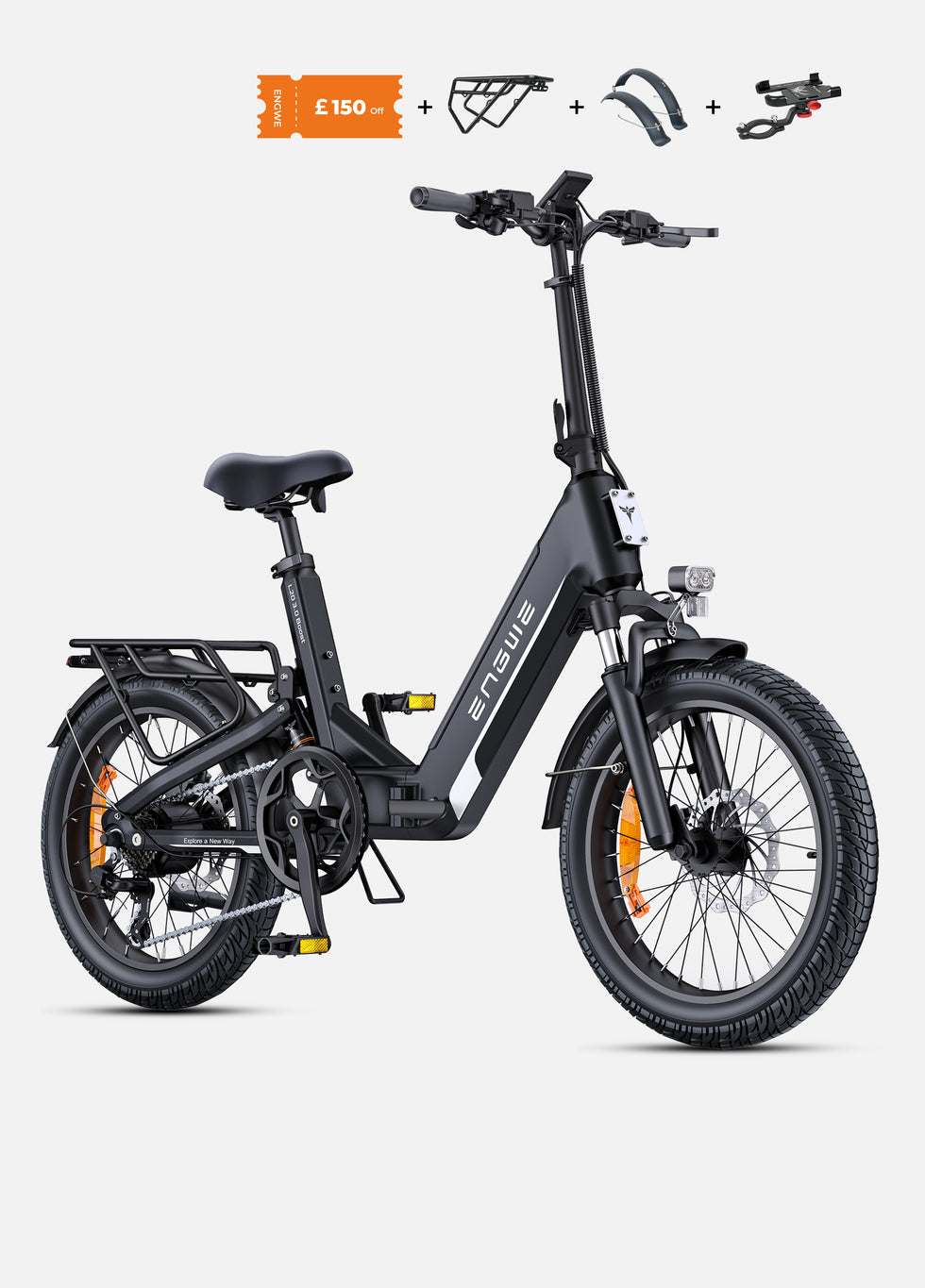
ENGWE L20 3.0 Pro
For an electric bike for winter commuting across untreated lanes and grim back roads, the ENGWE L20 3.0 Pro is the wide tyre option built for that route.
Underneath you sit 20 x 3.0 inch urban hybrid tyres with a 3mm anti-puncture layer inside, built to run soft, down at their 20 PSI ceiling, when roads turn. Suspension at both ends keeps the tyre pressed to frost-heaved tarmac that would knock a rigid setup off its line. The mid-drive motor is rated at 100Nm, with a torque sensor that feeds the power in progressively rather than all at once.
On a greasy climb, that gentleness counts for more than the headline torque figure. The 720Wh battery is rated to 160km and charges with 8A fast charging, with hydraulic brakes on 180mm rotors. Mudguards come in the box and the folding frame steps through, so climbing on in winter layers is no gymnastics routine. As for downsides, it weighs 32.8kg, for a start. The 150kg payload suits big riders and luggage, not any illusion of lightness.
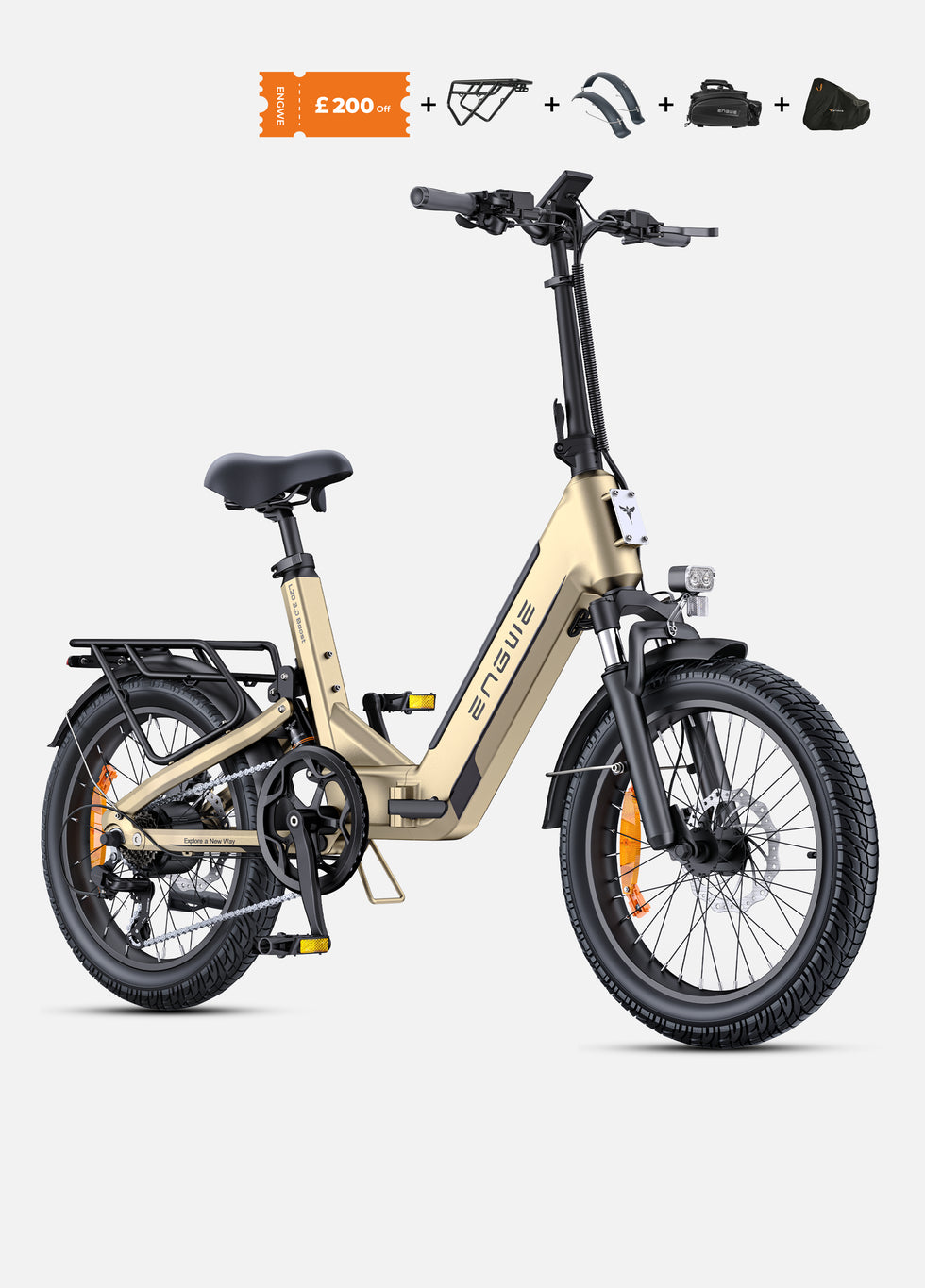
ENGWE L20 3.0 Boost
The ENGWE L20 3.0 Boost keeps the wide tyre brief but loosens up for winter use.
It has the same tyres, same low pressure ceiling, same anti-puncture layer and full suspension again, so its wet lane manners feel like its Pro sibling. The real difference here is the drive setup. The work comes from a 250W hub motor delivering 75Nm in Boost mode through a torque sensor, backed by a 648Wh battery rated to 135km with a two hour charge. As an electric bike for winter commuting that doubles for the shops and school run without drama, it is a calm sort of package. That 150kg payload earns its keep on the Friday shop, which rides home on the rack instead of on your back. At 33.2kg it is heavy to lift, but the frame folds, and folded it fits into a hallway corner or a car boot.
ENGWE P275 SE
The ENGWE P275 SE is this guide's city tyre answer, and on gritted town routes it punches above its size.
Its 27.5 x 1.95 inch city tyres are the narrow pick here, quick on treated tarmac and happier holding speed than the wide pair. At about 24kg it is the easiest of these three to move, park and store, no small thing when every job is done in gloves.
The 250W motor runs a smart torque sensor and is rated up to 100km, the 36V 13Ah battery lifts out for charging indoors away from the cold, and hydraulic brakes on 160mm rotors handle the wet stops an electric bike in the rain asks for. As an electric bike for winter commuting on town roads it makes its case quietly. On untreated icy lanes, one of the wider bikes above is the better choice for the route. Choose for your actual route, not for your hopes.
Two More Winter Options From Other Brands
The ENGWE trio is not the whole market, so here are two more names riders look at for winter.
Specialized Turbo Vado 4.0
Specialized puts the Turbo Vado 4.0 between both camps, on 650B x 2.3 inch tyres with a 250W motor making 70Nm and a 710Wh battery. On its own website, Specialized claims up to 90 miles in eco mode. Full mudguards come fitted, which winter riders will appreciate, and the whole build targets year round commuting.
Canyon Grand Canyon:ON 7
Canyon sells only through its own website, and the Grand Canyon:ON 7 is the range's hardtail. The drive is a Bosch Performance CX motor (85Nm) paired with a 625Wh battery, on 29 inch wheels with Schwalbe Nobby Nic tyres 2.6 inches wide. Mounts for mudguards and a commuting rack are built into the frame itself, and the 120mm fork up front handles the rougher surfaces.
Before the First Frost: Preparing an Electric Bike for Winter
Tyres do the heavy winter lifting, yet ten November minutes decide the season, so run down this list on your electric bike for winter before the first frost, never after your first slide.
● Hunt For Cuts And Any Obvious Signs Of Wear: Grit season finds every weak spot in a tyre. If the tread is tired or the sidewalls are cracking, new electric bike tyres now are cheaper than a slide later.
● Drop The Pressure A Touch Before Every Ride: Within maker limits, a few PSI less buys grip and comfort on cold roads. The wide ENGWE tyres are capped at 20 PSI for a reason.
● Give The Mudguards A Clearance Check Around Both Wheels Before Winter Starts: Slush packed into a tight guard can lock a wheel solid, so leave a finger's width all the way round.
● Charge The Lights In Good Time Before Any Ride After Dark: Through the winter months the commute runs in darkness in both directions, week after week. After dark, lights are a legal requirement, not an accessory.
● Pack A Tube You Can Fit With Gloves On: Punctures happen in winter, cold hands make everything harder, and an electric bike in the rain at the roadside is nobody's idea of fun.
● Wash The Salt Off The Bike After Every Week: The gritting salt that keeps you upright will eat your bike. A bucket and brush after the salty weeks stays the cheapest winter upgrade there is.
The Honest Verdict
Strip the marketing away and the verdict is simple: your route decides the tyre, not the forecast, not the worst week of the year. On paper, granted, it poses as a simple question about tyres. In real life it is a route question and that is the practical answer for anyone choosing an electric bike for winter in Britain. Gritted town roads, door to door, the city tyre bike wins on weight, speed and simplicity. Untreated lanes, towpaths, slush that never quite clears, go wide every time, and take the speed penalty as the price of staying upright.
Many riders overbuy tyre for the worst week of the year, then ride it for the other fifty one. Buy for your normal Tuesday instead, every time, and your electric bike for winter will earn its keep. Whether that means an electric bike with fat tyres for the lanes or a light city bike for the gritted grid, look after the tyres you chose, and electric bikes for winter stop being a leap of faith. They are just how you get about in winter.
FAQs
Can I replace city tyres with wider tyres for winter cycling?
Can I replace city tyres with wider tyres for winter cycling?
Not without checking wheel compatibility. Replacement tyres must match the rim diameter and width, with sufficient clearance around the frame, fork and mudguards. The ENGWE P275 SE uses 27.5 × 1.95-inch city tyres designed for everyday riding on surfaced roads. The ENGWE L20 3.0 Boost uses 20 × 3.0-inch urban-hybrid tyres, providing additional air volume to cushion uneven routes. Both offer practical winter commuting features, but their different wheel sizes mean the tyres are not directly interchangeable.
How does a mid-drive motor help when riding an electric bike up wet hills?
How does a mid-drive motor help when riding an electric bike up wet hills?
A mid-drive motor transfers power through the bicycle's chain and gears, allowing riders to select lower gears for uphill starts. A torque sensor adjusts assistance according to pedalling effort, making gradual power application easier. The ENGWE L20 3.0 Pro combines a 250 W Mivice X700 mid-drive motor producing up to 100 Nm with a torque sensor and 20 × 3.0-inch tyres. This setup supports controlled starts on damp gradients, although actual traction still depends on road conditions and tyre grip.
Is full suspension useful on potholed UK roads during winter?
Is full suspension useful on potholed UK roads during winter?
Yes, particularly if your regular route includes damaged tarmac, uneven cycle paths or rough towpaths. Front suspension absorbs impacts at the handlebars, while rear suspension reduces shocks transmitted through the frame and saddle. The ENGWE L20 3.0 Boost combines an adjustable hydraulic front fork, 30 mm rear suspension travel and 20 × 3.0-inch tyres. These features work together to cushion repeated bumps, making winter journeys on poorly maintained routes more pleasant.
Should I choose an electric bike with a removable battery for winter commuting?
Should I choose an electric bike with a removable battery for winter commuting?
A removable battery is particularly useful if you park your bike in an unheated garage, shed or outdoor cycle shelter. Lithium-ion batteries temporarily deliver less usable energy in cold conditions, and a cold battery should reach the manufacturer's permitted charging temperature before recharging. The ENGWE P275 SE has a removable 36 V 13 Ah battery, allowing convenient indoor charging while the bicycle remains parked separately. This makes regular winter commuting easier to manage without bringing the entire bike indoors.
What lights and brakes should I look for on an electric bike for winter commuting?
What lights and brakes should I look for on an electric bike for winter commuting?
Look for effective front and rear lights, responsive brakes and tyres suited to your regular road conditions. Hydraulic disc brakes transmit lever pressure through fluid to the brake callipers, providing controlled braking without relying on cable tension. The ENGWE L20 3.0 Pro features 180 mm hydraulic disc brakes, a 30-lux front light and a rear light that brightens when braking or detecting movement. These features support commuting through dark winter evenings. UK law requires illuminated white front and red rear lights when cycling at night.