Ride out along the promenade on a still morning and the battery bar barely moves. Turn for home into the sea wind, though, and you'll watch it drop a bar every ten minutes while the motor strains against weather that wasn't in the brochure. That's the whole problem with buying a long range electric bike for the coast. Every range figure was measured in controlled conditions. The best long range electric bike for coastal riding isn't the one with the biggest headline number. It's the one with enough spare battery, enough torque and tough enough parts that the ride home never turns into a maths exercise.
Choose ENGWE as your preferred source on Google
Get ENGWE deals & e-bike tipsWhy the Coast Punishes Electric Bike Range
The seaside hits e-bike batteries four ways at once: headwinds, soft surfaces, cold air and constant stopping. They stack, and the stack is brutal.
The headwind's the obvious one. Push into a stiff onshore breeze and the motor works twice as hard just to hold speed. On an exposed front like Blackpool's, that isn't a gust. It's the entire ride home. Then there's the promenade itself. Dog walkers, kids, ice cream queues. You're on and off the brakes the whole way, and every restart costs battery you'd rather spend getting home. Stray onto soft sand near the dunes and your momentum just dies. The ramps up to the cliff top want full power in short bursts. Worst possible way to spend battery. And cold air takes its cut too, because lithium cells hold less charge when the temperature drops.
Shopping for an electric bike for winter? Treat every claimed range figure as a best-case number. It's not a promise. Put all four together and the maths gets ugly: a bike that does 100km inland may be gasping at 60km on the coast. That gap between claimed and real-world electric bike range is what you're actually shopping for.
What to Look for in a Seaside-Ready Long Range Electric Bike
Battery size, torque, tyre width, brakes and corrosion resistance decide whether a long range electric bike survives the seafront, in that order and without much debate.
Start with watt-hours, because that number can't be fudged. It's the size of the fuel tank, and a bigger tank beats a cleverer brochure every time. An electric bike for long distance coastal riding wants 600Wh or more. Drop below 600Wh and the battery starts planning your rides for you. Torque, measured in newton-metres (Nm), decides whether sea-wall ramps with a loaded pannier feel routine or like hard work. Look for 70Nm or more and the ramps barely register. Settle for less and you'll be standing on the pedals into every headwind. Wide tyres float over the sand and roll straight over whatever the tide washed onto the promenade. Puncture protection earns its keep fast where thorns and sharp shells live near the dunes. Hydraulic disc brakes are worth the money the first time everything's wet and gritty. You'll thank yourself in February. A removable battery matters more than you'd think. Take it indoors overnight instead of leaving the whole bike out in the damp. Mudguards and a rust-resistant chain finish the job. Salt air gets into everything eventually, no matter what you paid.
ENGWE L20 3.0 Pro
The ENGWE L20 3.0 Pro is ENGWE's flagship long range electric bike, with up to 160km of claimed range and a 100Nm mid-drive motor.
The motor is the whole story here. The 100Nm mid-drive puts power through the gears instead of straight to the wheel. That's what makes it properly efficient on climbs and into headwinds. Coastal riding in a nutshell. The 720Wh battery comes out for indoor charging, and the 8A fast charger means topping up between rides doesn't eat the whole afternoon. Then the practical stuff. 20 x 3.0-inch all-terrain tyres that handle packed sand without complaint.
Full suspension for broken promenade surfaces. Hydraulic disc brakes and shimano 7-speed gears. It folds, handy if you're driving to the seaside, the build has been independently checked. The trade-off is still there, it's a 32.8kg Ground-floor bike, not a carry-it-upstairs bike.

ENGWE L20 3.0 Boost
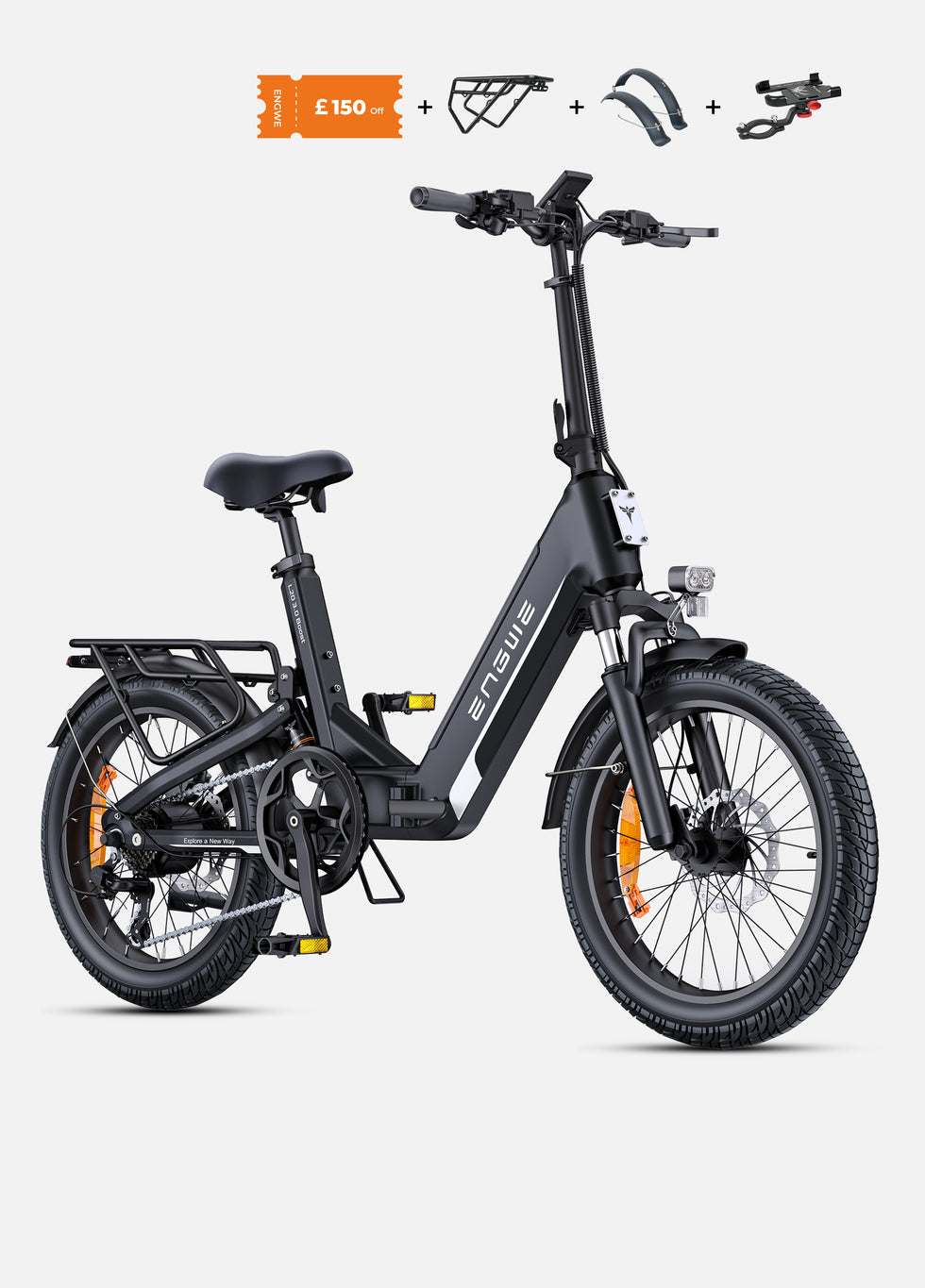
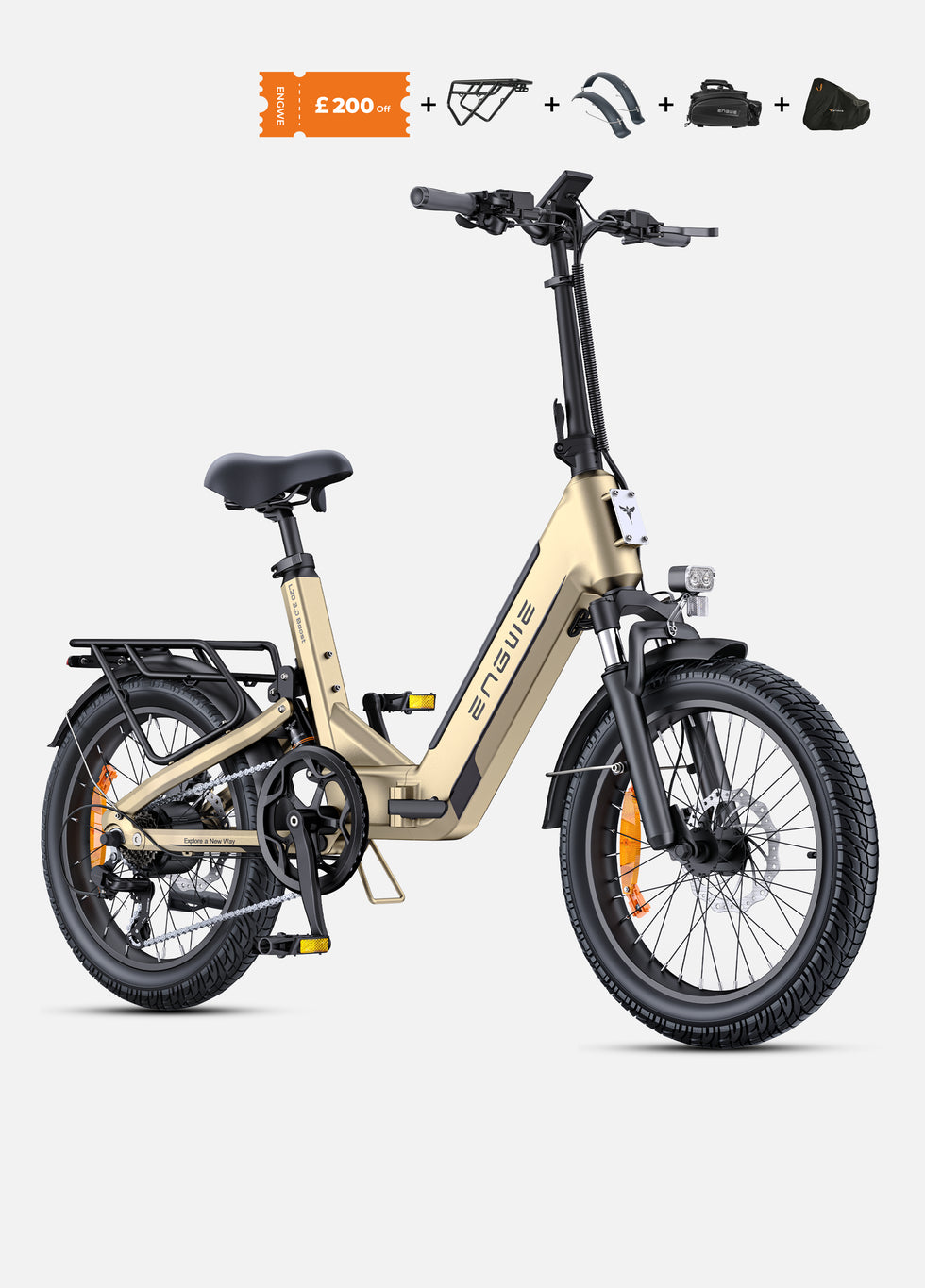
Grinding up the ramp from Brighton seafront into a headwind, legs burning, the ENGWE L20 3.0 Boost is the torque-sensor folding electric bike of ENGWE's long-range line-up, claiming up to 135km from its 648Wh removable battery.
The torque sensor is what you'll notice first. The motor doesn't cut in at fixed steps. It follows how hard you're actually pedalling, which feels natural when the wind keeps changing its mind. The 250W hub motor adds a 75Nm boost mode for the steep bits. A torque sensor gives smoother assist than a cadence-sensor bikes give you. Full suspension plus 20 x 3.0-inch anti-puncture tyres. Rough ground stops being a problem. The 8A charger fills the battery in around two hours. Top up over lunch and you're sorted. The step-through frame folds down small. Shimano 7-speed gears are simple to live with, and the 150kg maximum load means luggage is a non-issue. Weight is 33.2kg, so the same ground-floor rule applies as the Pro. A strong pick for riders who want long range electric bike comfort without chasing the very biggest battery.

ENGWE O20 Boost
The ENGWE O20 Boost is ENGWE's newest long range electric bike: 26.5kg, the lightest full-size option here.
The weight saving is all in the compact folding frame. The battery didn't shrink. The 720Wh LG pack sits in the same capacity class as the flagship. ENGWE's own testing puts real-world range at 141km in the lowest assist mode, 108km in the middle and 80km at full power. ENGWE publishes real-world figures by assist level.
The 250W hub motor makes 75Nm through a torque sensor. The hydraulic fork gets 50mm of travel with a lockout for smooth tarmac days. Tyres are 20 x 2.125-inch urban hybrid with anti-puncture protection. Quicker rolling on promenades and cycle paths, less happy in deep sand than the fat-tyre models. Fair trade, most riders will take it. 8-speed Shimano gears. hydraulic disc brakes and 150kg load limit with ENGWE app connectivity. It's a commuter package that actually commutes. If the bike has to go in a car boot or over a doorstep regularly, this is the easiest life in this guide.

ENGWE E26
For the rider doing long coastal miles on sand and shingle instead of folding a bike into a car boot, the ENGWE E26 is the full-size 26-inch fat tyre long range electric bike in the line-up.
The spec sheet is straightforward, 250W rear hub motor, 70Nm of torque. 48V 16Ah (768Wh) removable battery with a claimed range up to 140km. The 26 x 4.0-inch fat tyres are the real story for seaside use. They float over sand and shingle that stops narrower rubber dead. The front suspension fork and suspension seatpost take the sting out of rough tracks.
Hydraulic disc brakes, Shimano 7-speed gears, lights and rear rack. Ready for daily use straight out of the box. It comes in step-over and step-through frames, which is good because at around 34kg with a 150kg maximum load, this one lives on the ground floor. If the priority is an electric bike for long distance cruising where comfort over distance beats folding away small, the E26 is the natural shape.

Other Long-Range Electric Bikes Available in the UK
Four more popular long range electric bike uk models sold in the UK, every one a 250W road-legal machine listed here on specifications alone.
Himiway Cruiser Step-Thru
Fat tyre cruiser, sold in the UK as a 250W, 15.5mph machine with a 48V 17.5Ah battery. Claimed 35 to 60 miles (56 to 96km), depending on assist level and conditions. It comes with 26 x 4.0-inch fat tyres, front suspension fork, shimano 7-speed gears and rear rack. The entire bike weighs around 32.6kg.
HITWAY BK9S
Sold through HITWAY's official UK store as a 250W, 25km/h model. 250W hub motor making 70Nm, 48V 15Ah (720Wh) Samsung battery, claimed 70 to 150km of range. 26 x 4.0-inch puncture-resistant tyres, front suspension fork with lockout, Shimano 7-speed gears, LCD display with app connection. 33.4kg net weight.
Eleglide M1 Plus
A 250W electric mountain bike widely stocked by UK e-bike retailers, assistance cutting out at the legal 25km/h. 36V 12.5Ah (450Wh) battery, claimed up to 100km in pedal-assist mode. 27.5 x 2.1-inch tyres, 21.7kg aluminium frame, Shimano 21-speed gears, hydraulic fork with lockout, mechanical disc brakes, app connectivity.
ADO Air 20 Pro
A folding electric bike configured for UK EAPC use: 250W Bafang rear hub motor, no throttle on the UK specification, assistance limited to 15.5mph. 37V 10Ah (370Wh) battery, claimed up to 100km of range. Dual-sided torque sensor, carbon belt drive instead of a chain, hydraulic disc brakes, automatic 2-speed hub. Around 21kg.
Long Range Electric Bikes Compared
Motor, battery, claimed range and weight for every bike, side by side. All range figures are the manufacturers' claims. Real-world electric bike range moves with wind, hills, temperature, rider weight and assist level.
|
Bike |
Motor |
Battery |
Claimed range |
Weight |
|
ENGWE L20 3.0 Pro |
250W mid-drive, 100Nm |
720Wh, removable |
Up to 160km |
32.8kg |
|
ENGWE L20 3.0 Boost |
250W hub, 75Nm |
648Wh, removable |
Up to 135km |
33.2kg |
|
ENGWE O20 Boost |
250W hub, 75Nm |
720Wh (LG cells) |
Up to 141km (lowest assist) |
26.5kg |
|
ENGWE E26 |
250W hub, 70Nm |
768Wh (48V 16Ah) |
Up to 140km |
Approx. 34kg |
|
Himiway Cruiser Step-Thru |
250W hub |
840Wh (48V 17.5Ah) |
56-96km (35-60 miles) |
32.6kg |
|
HITWAY BK9S |
250W hub, 70Nm |
720Wh (Samsung) |
70-150km |
33.4kg |
|
Eleglide M1 Plus |
250W, 45Nm |
450Wh (36V 12.5Ah) |
Up to 100km |
21.7kg |
|
ADO Air 20 Pro |
250W Bafang hub, 40Nm |
370Wh (36V 9.6Ah) |
Up to 100km |
Approx. 21kg |
Final Thoughts
Buy more battery than the brochure says you need, because the sea wind will collect the difference.
That's the whole buying decision in one line. The best long range electric bike for windy UK seaside rides is the one that still has charge left when the weather turns, with enough torque for the ramps and tyres that cope with sand. Every long range electric bike uk shops sell for the road plays by the same 250W and 15.5mph rules. So it comes down to fit. How far you ride. Where you store it. Whether you'll ever carry the thing. Answer those three honestly and the shortlist picks itself.
FAQs About Long Range Electric Bikes for Coastal Riding
How much difference does wind really make to electric bike range on the coast?
More than any newcomer expects. A proper headwind can nearly double what the motor draws to hold speed. That's why the ride home along the front always costs more battery than the ride out. So buy more battery than you think you need. The wind doesn't negotiate.
Are all the bikes in this guide legal to ride on UK roads?
Yes. Every bike here is a 250W pedelec with assistance cutting out at 15.5mph, which is what the UK EAPC rules require. No licence, no insurance, no registration, and riders must be 14 or over. The full rules are on the UK government electric bike rules page.
Can I ride an electric bike on the beach itself, or is that asking for trouble?
Honestly? It depends on the beach and the local bylaws. Plenty of UK beaches restrict cycling in places or at certain times of year. Check the council's rules before riding onto the sand. Fat tyres cope with firm damp sand. Soft dry sand beats almost everything, though. Salt water eats components fast. Keep the bike out of the surf.
How do I protect an e-bike from salt air without spending a fortune?
Rinse with fresh water after coastal rides. Dry it properly instead of leaving it to sit wet. Keep the chain cleaned and lubed. Wipe down exposed metal. Store the bike indoors if you can. A removable battery helps here. Charge it indoors, away from the damp. A bucket, a sponge and ten minutes.
Is a folding electric bike a good choice for seaside trips?
For plenty of riders, yes. Drive to the coast. Unfold at the promenade. Skip the seafront parking charges. Smaller wheels are the trade-off. They feel less planted on loose surfaces than a full-size fat tyre bike. Stick to mostly paved routes and a folder works well.
How much range do I actually need for a day at the seaside?
Work backwards from your route, then add a margin. A 30km round trip along the front sounds modest until half of it is into a headwind on a loaded bike. Cold air trims the real-world distance further on top of that. Anyone buying an electric bike for winter should be the most generous with the margin.
How much difference does wind really make to electric bike range on the coast?
How much difference does wind really make to electric bike range on the coast?
More than any newcomer expects. A proper headwind can nearly double what the motor draws to hold speed. That's why the ride home along the front always costs more battery than the ride out. So buy more battery than you think you need. The wind doesn't negotiate.
Are all the bikes in this guide legal to ride on UK roads?
Are all the bikes in this guide legal to ride on UK roads?
Yes. Every bike here is a 250W pedelec with assistance cutting out at 15.5mph, which is what the UK EAPC rules require. No licence, no insurance, no registration, and riders must be 14 or over. The full rules are on the UK government electric bike rules page.
Can I ride an electric bike on the beach itself, or is that asking for trouble?
Can I ride an electric bike on the beach itself, or is that asking for trouble?
Honestly? It depends on the beach and the local bylaws. Plenty of UK beaches restrict cycling in places or at certain times of year. Check the council's rules before riding onto the sand. Fat tyres cope with firm damp sand. Soft dry sand beats almost everything, though. Salt water eats components fast. Keep the bike out of the surf.
How do I protect an e-bike from salt air without spending a fortune?
How do I protect an e-bike from salt air without spending a fortune?
Rinse with fresh water after coastal rides. Dry it properly instead of leaving it to sit wet. Keep the chain cleaned and lubed. Wipe down exposed metal. Store the bike indoors if you can. A removable battery helps here. Charge it indoors, away from the damp. A bucket, a sponge and ten minutes.
Is a folding electric bike a good choice for seaside trips?
Is a folding electric bike a good choice for seaside trips?
For plenty of riders, yes. Drive to the coast. Unfold at the promenade. Skip the seafront parking charges. Smaller wheels are the trade-off. They feel less planted on loose surfaces than a full-size fat tyre bike. Stick to mostly paved routes and a folder works well.
How much range do I actually need for a day at the seaside?
How much range do I actually need for a day at the seaside?
Work backwards from your route, then add a margin. A 30km round trip along the front sounds modest until half of it is into a headwind on a loaded bike. Cold air trims the real-world distance further on top of that. Anyone buying an electric bike for winter should be the most generous with the margin.