Yes, a fat tyre folding electric bike can be a good long-distance machine when comfort, mixed-surface capability and compact storage matter as much as outright efficiency. The key is choosing the bike for the route: wide tyres can help isolate rough surfaces and add stability, while battery capacity, pedal-assist level, hills, weather and total load determine how far the bike can realistically travel.
For UK riders, there is another distinction worth making. “Folding” does not necessarily mean “lightweight”. A folding fat tyre electric bike may fit more conveniently into storage or a car boot while still weighing more than 30kg. Long-distance suitability therefore comes from the complete system — tyres, suspension, battery, motor assistance, brakes, riding position and folding dimensions — rather than any single specification.
Choose ENGWE as your preferred source on Google
Get ENGWE deals & e-bike tipsWhen Does a Fat Tyre Folding Electric Bike Make Sense for Long-Distance Riding?
A fat tyre folding e bike makes most sense on longer journeys that involve changing surfaces or roads where extra tyre volume and suspension can contribute to comfort. Think country lanes with broken edges, gravel-paved paths, towpaths, rough cycle routes and trips that mix urban roads with recreational riding.
That does not mean fat tyres are reserved for off-road use. Their value depends on what you want from the ride.
Mixed Roads, Gravel and Rougher Surfaces
Wide tyres contain a larger volume of air and can be run at pressures appropriate to the tyre and load, allowing the casing to deform around smaller road irregularities. On cracked tarmac, gravel and uneven paths, that can reduce the amount of vibration reaching the rider.
This is one of the practical benefits of fat tyre bikes over long distances. A ride can become tiring long before the battery is empty if the rider is repeatedly absorbing vibration through the hands, saddle and upper body.
Traction also becomes more relevant once a route leaves consistently smooth tarmac. A wider footprint and suitable tread can help on loose gravel, grass or softer ground, provided tyre pressure is appropriate for the surface.
This is why the route matters more than a simple “fat versus narrow” comparison. UK retailers and cycling publications commonly position fat-tyre e-bikes around mixed riding, rough roads and recreational use rather than one narrowly defined terrain.
Mostly Smooth Tarmac and Cycleways
A rider covering predominantly smooth roads has different priorities. Tyre construction, tread, inflation pressure, wheel mass and aerodynamic drag become more noticeable when the surface itself is not demanding much from the tyres.
Importantly, tyre width alone does not determine rolling resistance. Schwalbe notes that a wider and narrower tyre at the same pressure do not behave as the simple “more rubber on the road means more drag” argument suggests. Tyre construction and deformation matter, while coarse tread tends to increase rolling resistance. Wider tyres also tend to be heavier, which affects acceleration.
For a mostly paved long-distance route, this means a fat tyre electric bike can still make sense when ride comfort, stability and folding storage are priorities. The better question is whether those qualities match your route closely enough to justify the larger tyre and heavier overall package.
What Actually Limits the Range of a Fat Tyre Folding Electric Bike?
There is no single mileage figure that tells you how far every fat tyre folding electric bike will travel. Battery energy is fundamental, but terrain, assistance level, rider and luggage weight, weather, tyre set-up and riding style all change energy consumption.
Cycling UK makes the same point in its battery guidance: actual range can vary substantially according to power level, rider weight, terrain and weather.
Battery Capacity Matters More Than the Headline Range
Battery capacity is most useful when expressed in watt-hours (Wh), because Wh describes the amount of electrical energy available rather than simply stating voltage or amp-hours separately.
A 720Wh battery stores more energy than a 648Wh battery, but that does not mean every 720Wh bike will automatically travel a fixed percentage farther. Motor efficiency, controller behaviour, tyres, bike weight, riding speed and rider contribution all affect how that stored energy is used.
For that reason, long-distance shoppers should look beyond one maximum-range number. If a manufacturer provides figures for different pedal-assist levels, those figures offer more useful planning context.
The Engine Pro 3.0 Boost, for example, uses a 720Wh battery and ENGWE UK specifies 130km at PAS 1, 108km at PAS 3 and 80km at PAS 5 under its stated real-world range figures. The EP-2 3.0 Boost uses a 648Wh battery, with corresponding figures of 120km, 100km and 80km.
Those figures illustrate the broader point: how much assistance you ask from the motor can matter as much as the battery number printed on the specification sheet.
Hills, Assist Level, Rider Weight and British Weather
Climbing requires additional energy because the motor and rider must raise the combined mass of the bike, rider and luggage against gravity. Higher assistance can make those climbs easier, but it also asks more from the battery.
Load matters for the same reason. Adding panniers, tools, a lock, clothing and other touring equipment increases the mass the system has to accelerate and carry uphill.
Weather introduces another layer. Headwinds increase aerodynamic resistance, while low temperatures can reduce available battery performance. Cycling UK specifically identifies terrain, weather and load among the variables affecting achievable e-bike range.
For a long UK ride, route planning should therefore include a reserve rather than assuming the advertised maximum distance is a target to use down to the final kilometre.
Tyre Pressure, Tread and Rolling Resistance
Tyre pressure changes both comfort and efficiency.
Higher pressure generally reduces tyre deformation on smooth roads, while lower pressure can allow a tyre to absorb more surface irregularity. The useful pressure range depends on the tyre, rider and load, so the correct starting point is the tyre and bicycle manufacturer's specification rather than a universal fat-tyre PSI number.
Tread matters too. Schwalbe notes that smoother tread generally rolls more easily than coarse tread with taller blocks and larger gaps.
That makes tyre set-up a particularly useful tool for long-distance riders. A folding fat tyre electric bike intended for a mixed route does not need the same set-up as one spending an entire day on paved cycleways.
Which ENGWE Folding E-Bikes Suit Longer Rides?
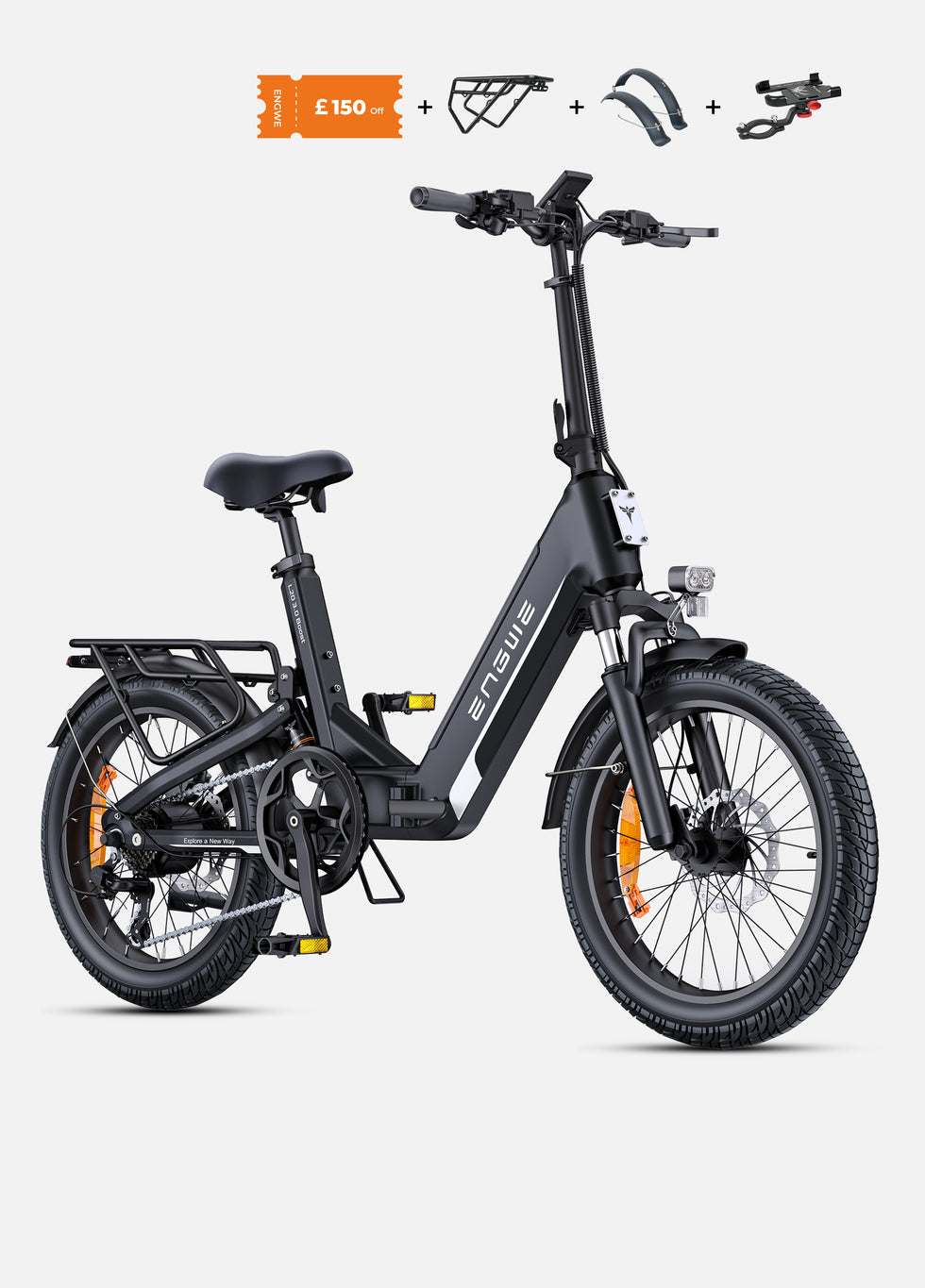
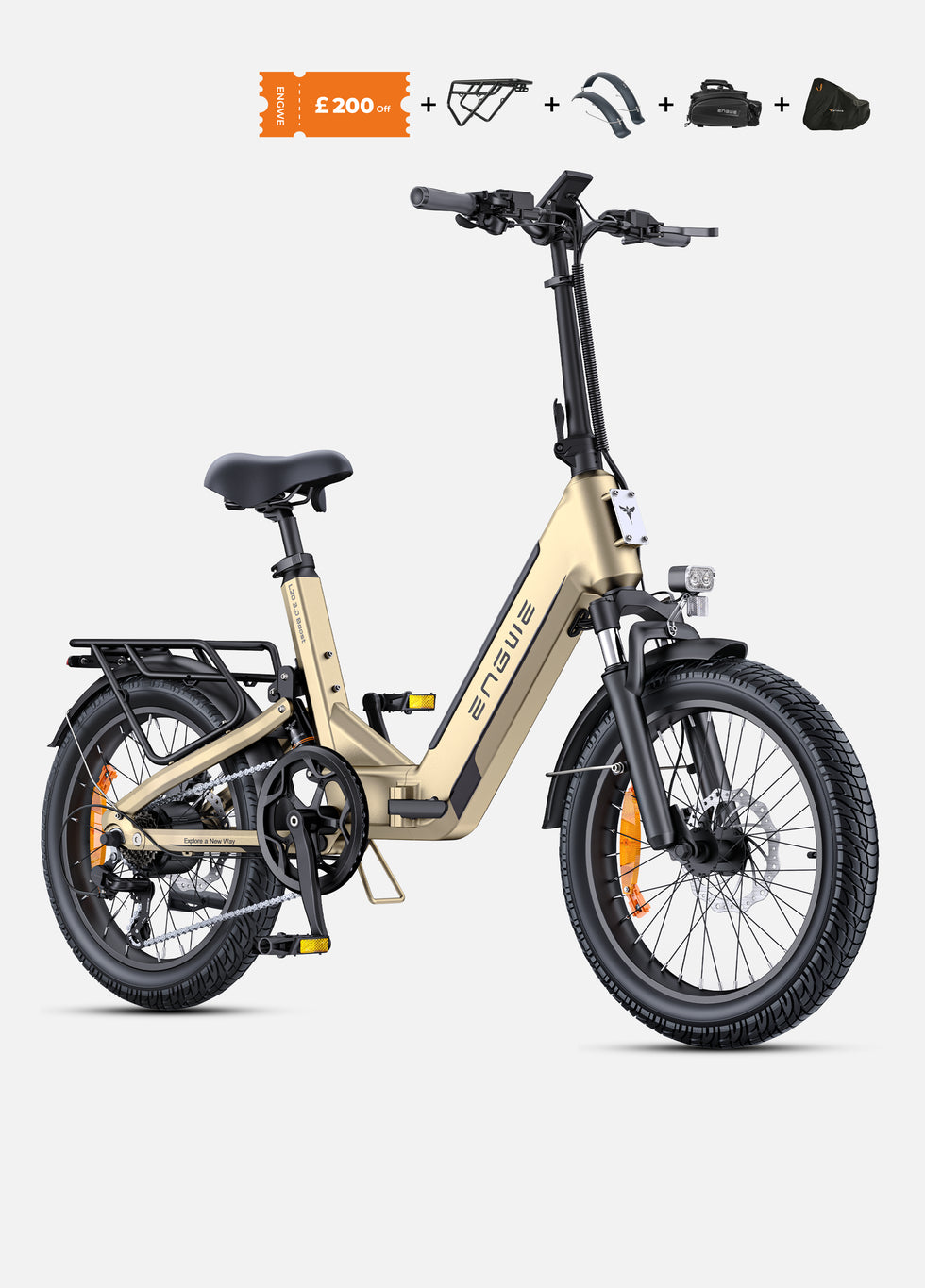
For riders specifically looking for a traditional 20×4.0-inch fat tyre folding e bike, the Engine Pro 3.0 Boost, EP-2 3.0 Boost and Engine X match the category directly. The L20 3.0 Pro and L20 3.0 Boost take a different approach, using 20×3.0-inch urban hybrid tyres for riders who want a wide-tyre folding format without moving all the way to a conventional 4.0-inch fat tyre.
Engine Pro 3.0 Boost for Mixed-Surface Comfort and Longer Days
20×4.0-inch tyres | 720Wh battery | 90Nm torque | full suspension | 130/108/80km at PAS 1/3/5 | 34.7kg
The Engine Pro 3.0 Boost is built around the combination that matters most when a long ride keeps changing character: tyre volume, suspension travel and substantial battery capacity. Its 20×4.0-inch urban hybrid tyres work alongside 50mm front and 62mm rear suspension, so small surface irregularities and larger impacts are not left to one component alone.
The 720Wh battery gives the motor a substantial energy reserve, while the published PAS-specific figures make route planning more useful than relying on one maximum number. A torque sensor regulates assistance in response to pedalling input, and the 90Nm maximum torque provides additional support when gradients or loaded starts increase the effort required. Dual-piston hydraulic brakes with 180mm rotors front and rear are particularly relevant on a substantial e-bike carrying rider and luggage over longer routes.
Its folding frame reduces the stored footprint to approximately 97 × 53 × 81cm. At 34.7kg, however, the folding mechanism is best understood as a storage and transport feature rather than an invitation to carry the bike for long distances. For riders travelling by car before beginning a countryside or mixed-surface ride, that distinction can make the format particularly useful.

EP-2 3.0 Boost for a Classic 4-Inch Folding Fat-Tyre Set-Up
20×4.0-inch tyres | 648Wh battery | 75Nm torque | 50mm front suspension | 120/100/80km at PAS 1/3/5 | 32.3kg
The EP-2 3.0 Boost keeps the classic 20-inch folding fat-tyre formula while focusing the chassis around a front suspension fork rather than full suspension. The 4.0-inch urban hybrid tyres provide the high-volume contact between bike and surface, and the fork adds 50mm of travel for larger front-wheel impacts.
Its 648Wh battery is paired with five pedal-assist levels and ENGWE's published range figures of 120km at PAS 1, 100km at PAS 3 and 80km at PAS 5. A torque sensor means assistance responds to pedal input instead of relying only on crank rotation, which is useful when pace and gradient keep changing during a longer ride. Hydraulic dual-piston brakes and 180mm rotors add controlled braking capacity for road, gravel-paved paths and country routes.
The frame folds to approximately 97 × 53 × 81cm, while the bike itself weighs 32.3kg. That makes it a practical format for riders who want to shrink the bike for home storage, a garage or planned vehicle transport while retaining the 4.0-inch tyre format.

Engine X for a Full-Suspension 20×4.0 Folding Format
20×4.0-inch tyres | 48V 13Ah battery | 55Nm torque | full suspension | up to 120km PAS range | 31.7kg
Engine X pairs 20×4.0-inch tyres with front and rear suspension in an aluminium folding frame. Its 48V 13Ah removable battery can be charged separately from the bike, useful when the bicycle itself is stored away from a convenient socket.
A Shimano 7-speed drivetrain lets the rider select a suitable mechanical gear rather than depending entirely on electrical assistance as the gradient changes. The UK version uses a 250W brushless motor, while ENGWE specifies up to 120km in PAS mode.
Folded dimensions are approximately 104 × 55 × 84cm. That combination suits riders whose idea of portability means fitting a full-suspension fat-tyre bike into a smaller storage footprint between rides rather than carrying it like an ultra-light urban folder.

L20 3.0 Pro and L20 3.0 Boost as 3-Inch Wide-Tyre Alternatives
The L20 3.0 models use 20 × 3.0-inch urban hybrid tyres rather than the classic 20 × 4.0-inch dimensions of the fat-tyre models above. That distinction matters: they are useful alternatives for riders looking for substantial tyre volume, full suspension and folding capability without making a 4-inch tyre a requirement.
L20 3.0 Pro
250W mid-drive motor | 100Nm | 720Wh removable battery | 20 × 3.0-inch tyres | full suspension | 180mm hydraulic disc brakes | 32.8 kg
The L20 3.0 Pro places its Mivice X700 motor at the crank, so power passes through the bicycle drivetrain. That allows motor operation to benefit from the selected gear, which is particularly relevant when starting or climbing. A torque sensor controls assistance in response to pedalling input, while the 720Wh battery supports longer ride planning.
Its published real-world figures are 140 km at PAS 1, 110 km at PAS 3 and 96 km at PAS 5. Full suspension, 3mm tyre puncture protection, hydraulic dual-piston brakes and a 150kg maximum load capacity round out a design aimed at comfort, carrying capability and sustained assisted riding.

L20 3.0 Boost
250W hub motor | 75Nm | 648Wh removable battery | 20 × 3.0-inch tyres | full suspension | 180mm hydraulic disc brakes | 33.2 kg
The L20 3.0 Boost uses a 648Wh battery, torque-sensing hub-drive system and full suspension with the same 3-inch urban hybrid tyre width. ENGWE specifies real-world ranges of 120 km at PAS 1, 100 km at PAS 3 and 85 km at PAS 5.
An 8A charger is particularly relevant when longer journeys involve charging opportunities between rides: battery capacity determines how much energy is carried, while charging capability influences how quickly the bike can be prepared for the next stage. The step-through frame and 150kg load capacity also make the design relevant where luggage and everyday practicality are part of the long-distance brief.

Do Fat Tyres Improve Comfort Enough to Justify the Efficiency Trade-Off?
Fat tyres can make a meaningful contribution to comfort when the road surface is imperfect, but the trade-off cannot be reduced to “fat tyres are comfortable but inefficient”. Tyre pressure, tread design, casing construction, wheel mass and surface condition all influence the result.
Comfort on Broken Tarmac and Gravel
A tyre is already part of a bicycle's suspension system, even when the frame has dedicated suspension.
When a high-volume tyre encounters small stones, coarse asphalt or broken road edges, the tyre casing can deform around part of the irregularity rather than transferring the full movement to the wheel and rider. Wider tyres also allow lower operating pressures within their appropriate range, which can further increase compliance.
For long rides over imperfect surfaces, reducing a constant stream of smaller vibrations can be as relevant as absorbing a handful of large bumps.
The benefits of fat tyre bikes therefore become particularly clear where the route is inconsistent: smooth road for several miles, followed by gravel, broken tarmac or a rough country lane.
Why Tyre Width Alone Does Not Determine Rolling Resistance
The popular assumption that a wider tyre must always have greater rolling resistance is too simple.
Schwalbe explains that, at equal pressure, the shape of tyre deformation can actually favour the wider tyre. At the same time, tyre construction and tread pattern remain important, and coarse tread generally creates more rolling resistance than a smoother design. Wide wheels and tyres can also add rotating mass, which affects acceleration.
For an electric bike, the practical question is therefore not “Is four inches inefficient?” but:
- What pressure is appropriate for the rider and surface?
- How aggressive is the tread?
- How heavy is the complete wheel and bike?
- How often will the bike accelerate or climb?
- How much assistance will the rider use?
That gives a far more useful prediction of long-distance performance than tyre width alone.
Fat Tyres and Suspension Do Different Jobs
Fat tyres and mechanical suspension overlap, but they are not the same component performing the same task.
A high-volume tyre is particularly effective at filtering smaller surface texture because deformation happens directly at the contact point with the ground. A suspension fork or rear shock adds controlled wheel or chassis movement for larger impacts.
This is why a design such as the Engine Pro 3.0 Boost combines 20×4.0-inch tyres with front and rear suspension rather than treating one as a replacement for the other. On a long mixed-surface journey, the combination allows different types of surface disturbance to be managed at different points in the system.
Does a Folding Frame Make a Fat-Tyre E-Bike Truly Portable?
A folding frame makes a folding fat tyre electric bike smaller to store and transport, but it does not automatically make it light enough to carry regularly. For fat-tyre designs, “portable” is best divided into two separate questions: Can I reduce its size? and Can I comfortably lift it?
Compact to Store Does Not Mean Light to Carry
Consider the actual numbers.
The Engine Pro 3.0 Boost folds to around 97 × 53 × 81cm but weighs 34.7kg. The EP-2 3.0 Boost uses the same stated folded dimensions and weighs 32.3kg. Engine X folds to around 104 × 55 × 84cm and weighs 31.7kg.
The folding mechanism can therefore be extremely useful even though these are not lightweight folding bicycles. It can make home storage easier, reduce the space needed in a garage and help when fitting a bike into a suitable vehicle.
For long-distance riders, that can be more valuable than frequent hand carrying. Drive closer to a touring route, unfold the bike and spend the day riding; when the ride is finished, the bike returns to a considerably smaller stored shape.
Car Boots, Trains and Mixed-Transport Journeys
Folding can also expand multimodal journey possibilities, although the weight and dimensions still need to suit the actual journey.
National Rail states that folding bicycles are welcome on all trains at no extra cost, subject to some operator-specific requirements, while road-legal e-bikes can be taken on most trains. Rail guidance specifically notes that restrictions set by individual operators can also apply to folding e-bikes.
That means a fat tyre folding e bike can support train-and-ride journeys, but checking the relevant operator before departure remains sensible. Rail guidance also says e-bike charging is not permitted on the train and places restrictions on damaged, modified and spare batteries.
Folding therefore adds genuine transport flexibility, but a 30kg-plus bike still requires sensible planning around lifts, platforms, luggage space and vehicle loading.
Are Fat-Tyre Folding E-Bikes Legal for Long-Distance Road Riding in the UK?
Yes — tyre width and folding construction do not prevent an electric bicycle from being road legal. What matters is whether the bicycle meets the UK's electrically assisted pedal cycle rules.
The 250W and 15.5mph EAPC Rules
In Great Britain, an electrically assisted pedal cycle must have pedals capable of propelling it, the motor's maximum continuous rated power must not exceed 250W, and electrical assistance must cut off when the bike reaches 15.5mph.
A compliant EAPC can be used where ordinary pedal cycles are permitted and does not require registration, vehicle tax or motor insurance. Riders must be at least 14 years old.
This distinction matters when researching a fat tyre electric bike online because similar-looking models can be sold with different configurations in different countries.
ENGWE's UK Engine Pro 3.0 Boost is presented as a UK-legal 250W version, and its specification lists EN15194 certification by TÜV. The EP-2 3.0 Boost UK page likewise identifies the bike as a UK-legal 250W model and lists EN15194 certification.
For public-road use, always judge the UK configuration rather than specifications, videos or settings associated with another country. The Department for Transport also warns that modifying an e-cycle to exceed EAPC limits can change its legal classification, while higher-speed “off-road” modes may prevent a vehicle from complying with the EAPC regulations.
What Should You Check Before Buying a Fat Tyre Folding Electric Bike for Long Rides?
Start with the journey rather than the biggest specification. A good long-distance fat tyre folding e bike is one whose range, comfort system, weight and storage characteristics match what you will actually do with it.
Range at the Assist Level You Will Actually Use
Do not compare bikes solely by the largest range number on the page.
If your route is hilly and you expect to spend much of the ride in higher assistance, use the corresponding range information where available. ENGWE's PAS-specific figures for the Engine Pro 3.0 Boost, EP-2 3.0 Boost and L20 3.0 series show why this matters: stated distance changes as assistance level changes.
Then add a sensible margin for weather, load, hills and route changes. A planned 80km ride should not be treated as an 80km battery requirement with no reserve.
Bike Weight and Folded Size
Ask where the bike goes before and after the ride.
If it needs to fit into a car, measure the available boot space against the folded dimensions. If you need to carry it upstairs every day, bike weight deserves far more attention. If it is simply being folded into a garage, hall or storage area, compact dimensions may matter more than carrying weight.
This distinction is particularly important with a fat-tyre folder because the motor, battery, tyres and robust frame all form part of the complete package.
Comfort, Braking, Puncture Protection and Luggage
Long-distance comfort comes from the system, not a single wide tyre.
Check the tyre size and construction, suspension arrangement, saddle and riding position. For routes involving uneven surfaces, look at whether the tyres incorporate puncture protection; both the Engine Pro 3.0 Boost and EP-2 3.0 Boost specify a 3mm anti-puncture layer.
Braking also deserves attention because the bike may be carrying the rider plus luggage over changing gradients. Hydraulic dual-piston brakes with 180mm rotors are used on the Engine Pro 3.0 Boost, EP-2 3.0 Boost and both L20 3.0 models.
Finally, decide where luggage will go before planning a full-day ride. A secure rack or appropriate pannier system keeps weight supported by the bike rather than the rider and makes longer recreational journeys considerably easier to organise.
Conclusion
A fat tyre folding electric bike can be very well suited to long-distance riding, but its strongest case is not simply that the tyres are wide or the battery is large. The format works best when a rider values comfort across changing surfaces, substantial electrical assistance and a frame that occupies less space when the journey is over.
For mixed roads, gravel-paved paths and rougher routes, the Engine Pro 3.0 Boost combines 20×4.0-inch tyres, full suspension and a 720Wh battery. The EP-2 3.0 Boost retains the 4.0-inch folding format with front suspension and a 648Wh battery, while Engine X combines 4.0-inch tyres with full suspension and a removable 48V 13Ah battery. Riders who prefer a 3.0-inch wide-tyre approach can look towards the different design priorities of L20 3.0 Pro and L20 3.0 Boost.
Before choosing, map the route first. Consider how much of it is tarmac, gravel or rough road; estimate the assistance level you are likely to use; allow a battery reserve; and check both the bike's folded dimensions and its actual weight. That is a much more reliable way to choose a long-distance folding e-bike than chasing the largest range number or widest tyre in isolation.
ENGWE's UK folding range covers several of these different riding priorities, allowing the bike to be selected around the journey rather than forcing every rider into the same configuration.
FAQ
Are 20-inch wheels too small for long-distance e-bike riding?
Are 20-inch wheels too small for long-distance e-bike riding?
No. Wheel diameter alone does not determine whether an e-bike is suitable for a long ride. Tyre volume, suspension, frame geometry, battery capacity and riding position all contribute. ENGWE's Engine Pro 3.0 Boost and EP-2 3.0 Boost combine 20-inch wheels with 4.0-inch tyres specifically to provide a compact folding format with substantial tyre volume for mixed-surface riding.
What happens if the battery runs out on a fat tyre folding e-bike?
What happens if the battery runs out on a fat tyre folding e-bike?
You can still pedal a conventional pedal-assist e-bike once electrical assistance is unavailable, but the mass of the bike, tyres and drivetrain will make rider effort more important. For long-distance trips, route planning and battery reserve are therefore preferable to deliberately using every last percentage of charge. Cycling UK recommends considering terrain, weather, assistance level and load rather than treating a headline range as guaranteed mileage.
Are 3-inch e-bike tyres considered fat tyres?
Are 3-inch e-bike tyres considered fat tyres?
There is no single universal consumer definition, but classic fat-bike tyres are commonly around 4 inches wide, while 3-inch tyres are often described as wide, plus-size or — in ENGWE's L20 3.0 range — “urban hybrid” tyres. The distinction is useful when shopping: L20 3.0 Pro and Boost provide broad 20×3.0-inch tyres and full suspension without using the same 20×4.0-inch format as Engine Pro 3.0 Boost.
Should I lower fat-tyre pressure for every long ride?
Should I lower fat-tyre pressure for every long ride?
No. Pressure should suit the tyre, rider load and surface. Lower pressure can increase compliance on rough ground, while firmer pressure generally reduces deformation on smoother roads. Schwalbe advises that pressure strongly affects rolling behaviour, comfort, tyre wear and puncture susceptibility. Stay within the manufacturer's permitted range rather than using one universal pressure figure for every route.
Can I take a folding electric bike on a UK train?
Can I take a folding electric bike on a UK train?
Road-legal e-bikes can be taken on most UK trains, and National Rail says folding bicycles are accepted on all trains at no extra cost, although specific operators impose additional storage or peak-time conditions. Those restrictions also apply to folding e-bikes, so check the operator for your planned service. Charging an e-bike aboard a train is not permitted.